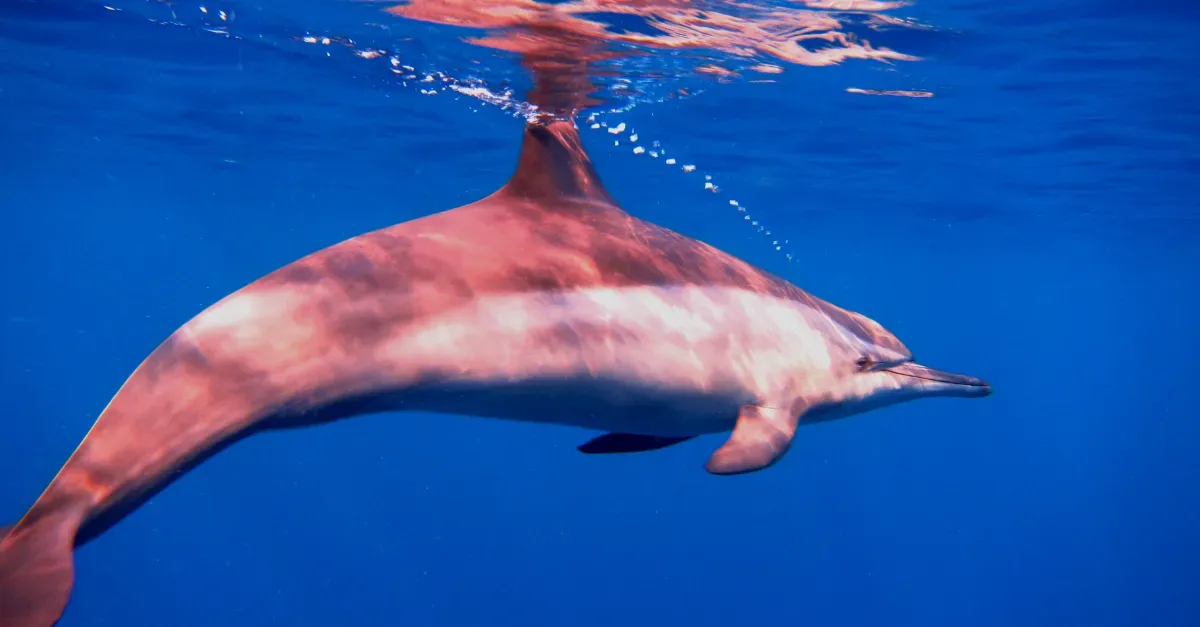
The pink dolphin (or ‘boto’) takes its name from the unique and extraordinary colour of its skin. It is a freshwater species (one of the few left on the entire planet) found only in the rivers of South America.
Much loved by tourists who come from all over the world to visit the Amazon, it is a creature considered almost mythical in local culture, revered or reviled depending on belief.
Inia geoffrensis, to use its scientific name, is clearly distinct from the grey river dolphins or tucuxi (Sotalia fluviatilis), which are more similar to marine dolphins in both build and habits.
In fact, pink dolphins are not born with that distinctive and extraordinary colour. They are born grey, slowly turning pink with age. Since male dolphins are markedly pinker than females, naturalists think the colouring is the product of scar tissue, caused by rough play or fights over mates. But behaviour, the position of the capillaries, diet and exposure to sunlight also affect their colouring. In fact, the individuals that can show off the brightest pink are also those that attract the most attention from females.
And that is not all. When dolphins are excited, they can blush a brighter pink: just like humans.
Because their neck vertebrae are not fused together, unlike those of other dolphins, pink dolphins are extremely agile. They can turn their heads up to 90 degrees, which allows them to get around tree trunks, rocks and other obstacles.
They can swim forward with one flipper while paddling backwards with the other, and so perform extraordinary spins. They often swim upside down, it is thought to see the riverbed better.
Their eyesight above and below water is excellent: this allows them to find their way through the murky waters of the Amazon to catch their prey, also thanks to an excellent sense of echolocation.
To prevent the loss, and even the extinction, of this wonder of the animal world, the Mamirauá Institute for Sustainable Development (IDSM) has stepped in. It is a social organisation funded and supervised by Brazil’s Ministry of Science, Technology and Innovation (MCTI), which carries out its activities in the Mamirauá and Amanã sustainable development reserves, in the Brazilian state of Amazonas.
The Institute’s researchers are currently engaged in strenuous research work to ensure that the October 2023 die-off is not repeated. They are taking biological samples to test the dolphins’ response to heat. They are studying specimens of the endangered species, carrying out blood tests and other examinations before returning them to their habitat in the lake.
The aim is never again to be caught unprepared should drought once more threaten the Amazon region and its rare dolphins.
Sadly, such an event is foreseeable: scientists have concluded that last year’s record drought was made 30 times more likely by global warming.