The Path of the Gods: a window onto infinity
But if you want to enjoy this breathtaking panorama to the full, put on your backpack and set off along the Path of the Gods, from which you can even admire the Faraglioni of Capri and the Cilento Coast. A natural picture well worth a little effort!
To tackle the path, you do need to be reasonably fit: although many stretches are flat and easy to walk, others are less comfortable. Nothing too difficult, though! If you are a keen walker and have the right equipment, the route is perfectly doable. Hiking boots, practical clothing and walking poles can make the undertaking much easier. Along the way, there are rest areas and small fountains where you can fill your water bottles.
You therefore set off from the little square of Bomerano, from which the start of the path is easily reached. Here you can read a quotation by Erri De Luca that captures the meaning of the walk:
‘The gods have been reduced to mythologies.
Here their name remains bound to a path,
a regal trail of beauty.
Virgil tells Dante he lived
“in the time of the false and lying gods”.
Perched on this path, they are not.
As I walk it I am once again
a polytheistic pagan.’
You continue along walkways almost sheer above the sea, through woods and along mule tracks, sometimes meeting shepherds and farmers who still travel along the paths used for centuries for passage and transhumance. As you approach Nocelle, one of the route’s arrival points, you begin to see the majolica dome of Positano’s cathedral and, little by little, the whole village unfolds before your eyes. From above, it looks almost like a nativity scene perched on the mountains, descending to a clear, glittering sea.
Nocelle: the last stop before Positano
Nocelle is a tiny village of only 150 inhabitants, in whose lovely square the first stretch of the Path of the Gods ends. Here you can, first of all, admire a splendid view, and then rest and refresh yourself before continuing towards Positano. There are two options: go down by bus or, for the more daring, on foot, tackling a flight of 1,500 steps.
At this point, you can spend the afternoon visiting Positano (a few hours are enough), with its colourful lanes full of little shops. In the village, the cathedral dedicated to the Assumption and the Roman villa, discovered in 2004 right beneath the church, with its splendid mosaics, are well worth a visit.
Returning to Bomerano via Amalfi
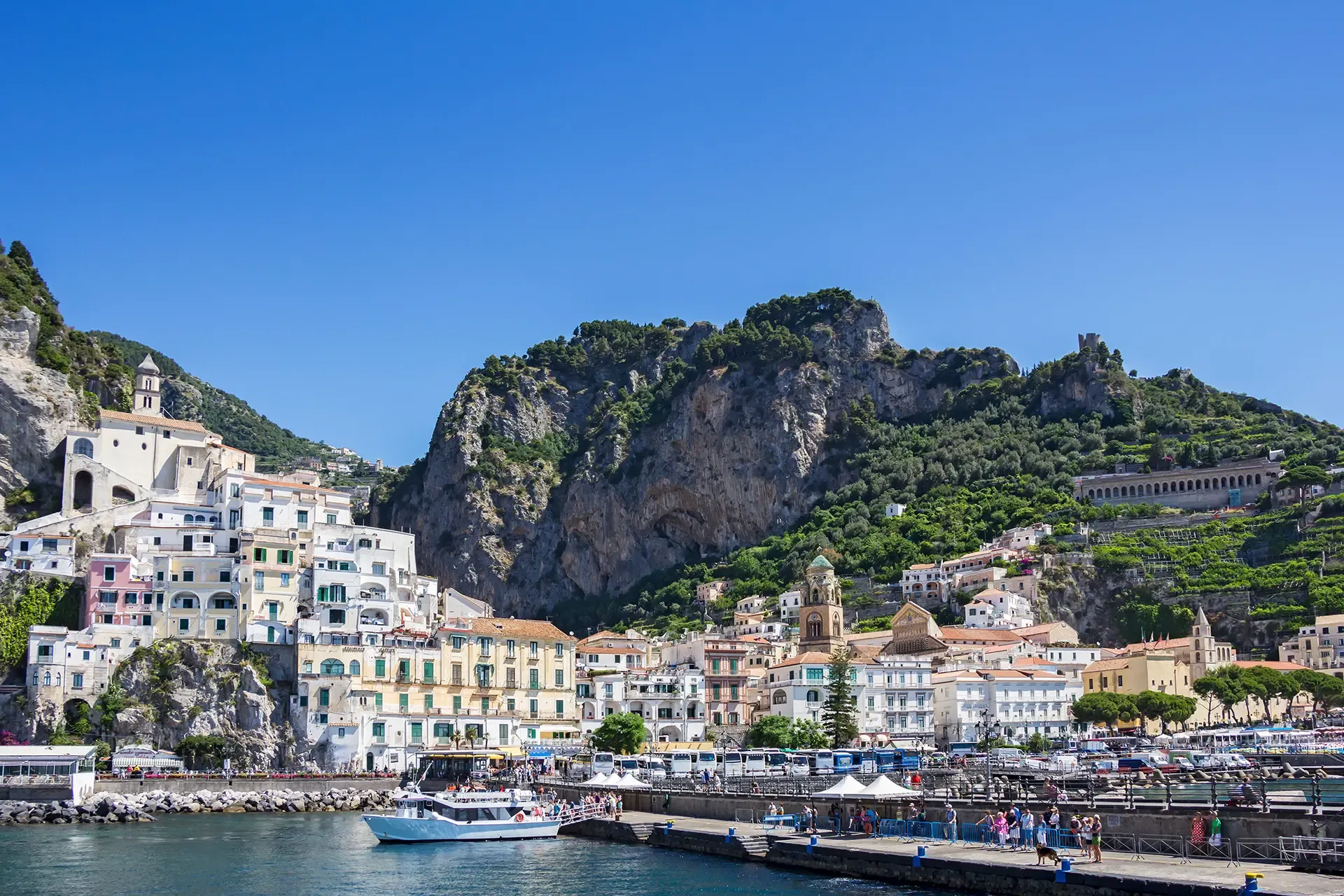
To get back from Positano to Bomerano you have to go through Amalfi, the main hub of the coast. From here, in fact, the buses to the Monti Lattari depart. The Positano–Amalfi stretch is served by both regular buses and ferries, a slightly more expensive choice but highly recommended because, from the boat, you can admire the villages along the coast and the famous Fjord of Furore.
Once in Amalfi, if you still have some energy, it is worth taking a stroll before catching the bus to Bomerano (services run until nine in the evening). The little square with the iconic cathedral certainly deserves at least a glance!
In short, this way you can have a decidedly more authentic and less stressful experience of the Amalfi Coast, avoiding staying directly in the most famous and crowded towns, saving money and enjoying the silence and nature.
Claudia Russo
For more information on the Path of the Gods: https://ilsentierodeglidei.net/
For bus timetables: https://sitasudtrasporti.it/
For ferry timetables: https://www.travelmar.it/