Recanati and Leopardi: a pairing always to be discovered and rediscovered
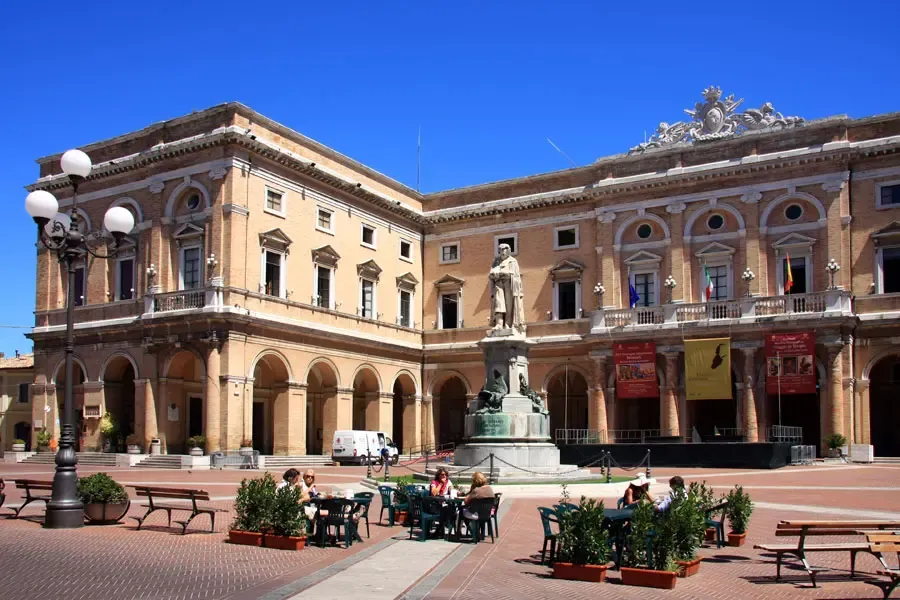
Certainly the young, brooding and tremendously studious scion of the Leopardi household, Count Giacomo, would never have imagined in his lifetime becoming – as we would say today – the tourist and cultural brand (and more) of his beloved and hated town.
The Leopardi tour of Recanati is well known, and anyone wishing to undertake it, or to do it again a second or third time, perhaps with the children, needs no great preparation: the information is available to everyone, both on the web and on the spot.
The little square of the ‘Sabato del villaggio’; the eighteenth-century Palazzo Leopardi with the famous library of his father Monaldo; the House of Silvia, and so on.
What not everyone knows, however, is that for some years now Recanati has offered the chance – not to be missed – of taking a genuine immersive tour of the Leopardi atmosphere.
You need to reach the height on which stands the ancient monastery of Santo Stefano, with its garden known as the Orto delle Monache.
That is the hill of the Infinite. Giacomo Leopardi’s birthplace is, after all, only a few steps away.
You find yourself immersed in a true literary park. Naturally it is dedicated to the poet of ‘A Silvia’, of the ‘Rimembranze’ and, of course, of ‘L’infinito’.
The area, with free admission, was redeveloped in 2018. At sunset you can enjoy new lighting inspired by the poetics of the moon, the result of a collaboration between the Oscar-winning set designer Dante Ferretti and iGuzzini.
Past the historic cellars of Casa Leopardi, the first ‘stop’ on the path will be the Leopardi shrine: a symbolic composition of architectural and literary elements, with stones from Giacomo Leopardi’s original tomb at Fuorigrotta in Naples (and transferred to Recanati in 1937; while the poet’s remains were moved to Mergellina, in the Parco Vergiliano).
A little further on, you will read a plaque on the wall: ‘Sempre caro mi fu quest’ermo colle’. There is no need to explain why. A smaller plaque explains that in 1937, the centenary of Giacomo’s death, ‘with a solemn ritual of the people, there was taken from up here the earth which numerous pilgrims from Recanati lovingly laid on the distant tomb at Fuorigrotta, a symbolic fulfilment of his ardent desire to rest for ever in this beloved soil’. In short, a symbolic gesture to make the soul of little Giacomo – who, as we know, never loved Recanati too much, nor was ever too much loved by his fellow citizens, at least in life – feel a little less far from home.
But the heart of the park is certainly the Orto sul Colle dell’Infinito, the garden of the Monastery of Santo Stefano, the place where, ‘sedendo e mirando’ (‘sitting and gazing’), the twenty-one-year-old Leopardi found inspiration for one of the most extraordinary (and innovative) lyrics in all literature, not only Italian, and not only of the nineteenth century.
A community of Poor Clares had lived here since the fifteenth century. It is from the seventeenth century, however, that we have more detailed information on the life of the monastery and its inmates.
Daily life in the convent was strongly influenced by the events of the town, suspended in the sleepy climate of the provinces of the Papal States that Leopardi described so well for us.
In the second half of the eighteenth century the monastery was modernised and enlarged: the capacity of the dormitory was increased, further storerooms were built and the floor of the church was relaid.
But the renovation was to be of little use. On 14 July 1810 an ordinance of Napoleon, Emperor of the French and King of Italy, drove the nuns out of the monastery, stripped of their religious habit.
The building became a barracks for cavalry and infantry soldiers, with the consequent ruin of its rooms and the loss of several valuable works of art.
It was only from 1850 that the convent, passed into the hands of the noblewoman and Blessed Teresa Eustochio Verzeri and restored by her, regained a minimum of dignity and was able to house a school as well.
Fortunately the cultural and educational vocation of the place has not been lost in our own day. Today the monastery is the seat of the World Centre of Poetry and Culture ‘Giacomo Leopardi’, which hosts young people and scholars from all over the world, as well as of the CNLS, the National Centre for Leopardi Studies. The garden, with the possibility of the immersive visit mentioned above, is run and cared for, to its great credit, by the FAI.
The Museo di Villa Colloredo Mels: the enchantment of Lorenzo Lotto
You need to take a few (very pleasant) steps further north among the lanes of the village to reach the other ‘pearl’ of Recanati. There, again in a dominant position over the historic centre, stands the Villa Colloredo Mels with its precious museum.
The name Colloredo, for anyone fond of nineteenth-century literature, evokes places quite different from these in central Italy. The Colloredo are historically one of the most powerful families of the Friulian plain.
‘From Colloredo to Collalto, a stretch of four miles, I remember that up to twenty years ago two nimble and sturdy horses sweated for three hours to drag a coach so firmly and solidly built as to withstand the jolts of the potholes and boulders they met.’
So wrote Ippolito Nievo in his Confessions of an Italian. And it was in the Castle of Colloredo di Monte Albano, in Friuli, that Nievo spent long periods of his youth, especially in summer: so much so that the castle of Fratta in Nievo’s novel is certainly inspired by that of Colloredo.
But let us return to the Colloredo of Recanati. It is a noble villa, with a part that is even medieval in origin; while the grand staircase is sixteenth-century, and the interior frescoes typically eighteenth-century. Like all the great landowners of those centuries, the Colloredo Mels owned lands all along the peninsula: and they came into possession of this villa in the mid-1700s.
Since 1998 the Colloredo palace has been home to the Museo Civico.
A Leopardi section is of course not to be missed: rich in books, documents, relics and works of art belonging to the collection of the Municipality of Recanati. The collection of preparatory documents, donated by the publisher Le Monnier, for the edition of Leopardi’s Complete Works begun in 1845 by Antonio Ranieri is remarkable; and Leopardi’s death mask, displayed there, gives something of a shiver. The portraits of the members of the Leopardi family are also interesting. We find Monaldo, Giacomo, Pierfrancesco, Carlo, Paolina and the poet’s mother Adelaide Antici. Seeing Leopardi’s handwritten letters is moving, among them the beautiful and heartfelt letter to his father.
But we have said that Recanati is not only Leopardi. And in the villa’s picture gallery we have the proof.
It was worth coming all this way to admire, indeed, one of the masterpieces of Italian art.
There are in fact four works by the great Lorenzo Lotto (another who was neither from Recanati nor from the Marche: a Venetian who, following his restless spirit, wandered the peninsula carrying his artistic genius from Bergamo to the Marche).
There are the Polyptych of San Domenico (1506–1508); the fascinating Transfiguration (c. 1511); the Saint James the Greater (1512–1513). And the great masterpiece itself: the Annunciation (1533–1535).
Lorenzo Lotto was for a long time one of the great misunderstood figures of Italian and world art. His rediscovery began at the start of the twentieth century, thanks to two giants of art history such as Bernard Berenson and Roberto Longhi. It was the latter in particular who showed how Lotto, with his originality outside the canons of ‘official’ sixteenth-century painting, anticipated many of the existential and psychological anxieties of modern art, giving us back an almost ‘twentieth-century’ Lotto.
All this can be seen openly before the Annunciation in Recanati.
Catholic in faith but surrounded by friendships linked to Lutheranism, the wandering Venetian painter turns the most traditional religious subjects (such as the Annunciation) into a supreme moment of reflection on and confrontation between the sphere of the sacred and that of the human.
Anyone who has seen Lotto’s masterpiece, in school textbooks or elsewhere, will surely not forget the expression of Mary, who turns towards the viewer with her back to the announcement and raises her hands in surprise, with a troubled and submissive look; nor the little figure of the cat that slips away, frightened too by the divine power of the announcement, in a humble and dignified domestic interior that could belong to any age.
One can well say, as Longhi did, that we are facing a masterpiece of modernity and humanity, able to transform a traditional religious theme into a profoundly innovative visual and spiritual experience, and restoring the full psychological complexity and historical dimension of the mystery of the Incarnation.
‘It was well worth the visit’, you will exclaim at the end!
The villages of the Recanati area: Cingoli and Treia
Cingoli
Another unmissable ‘balcony’ over the Marche is the village of Cingoli, which can boast a place on the coveted list of the ‘most beautiful villages in Italy’.
Situated on a height of Monte Circe, about 630 metres above sea level, it offers a mix of rare charm combining natural, artistic and historic beauty.
The Balcony of the Marche, they call it. And indeed from the famous viewpoint, the view stretches as far as the Adriatic Sea and, on particularly clear days, even to the mountains of Dalmatia.
The historic centre of Cingoli, of course medieval in layout, preserves, besides the town walls, its historic gates: Porta Montana and Porta Piana.
The humblest houses alternate, as is usual in Italian town planning, with stately buildings: the Palazzo Municipale and above all the Palazzo Castiglioni, which was the birthplace of Pope Pius VIII.
In Cingoli, then, there is another masterpiece by Lotto. The Madonna of the Rosary, a canvas signed and dated on the base beneath the Virgin’s foot: L.LOTUS.MDXXXIX.
Commissioned by the Confraternity of the Rosary of Cingoli for an altar of the church of San Domenico, the canvas remained in situ in the sacred building until the mid-1970s, when it was moved for conservation reasons, first to San Niccolò, then to the Pinacoteca comunale, and finally back to the church of San Domenico.
A word of warning, though. At present, because the church is unsafe, the work is kept in a room of the Palazzo comunale: that is where you can admire it in all its overflowing splendour, with its fifteen medallions containing the themes of the fifteen mysteries of the Marian devotion of the Rosary.
And at the table? Cingoli certainly does not disappoint.
From the crescia of Cingoli, a sort of focaccia or unleavened bread, similar to the Romagna piadina but thicker and more fragrant, to ciauscolo IGP, the soft, spreadable salami of the Marche, to rabbit in porchetta style, flavoured with wild fennel, garlic and rosemary, to vincisgrassi, the Marche version of lasagne, very rich and made with a mixed-meat ragù.
All to be savoured, perhaps, on the occasion of special events, such as the Sagra della Crescia, the Festa dell’Olio Nuovo or the summer events in the central square.
Treia
Among the ‘most beautiful villages’ of the Recanati area (and of Italy), Treia is certainly worth a visit.
The ancient Trea, once a settlement of the Piceni and then of the Romans, stands on a hill about 342 metres above sea level. The view, breathtaking as ever, sweeps here over hills, cultivated fields and olive groves, as far as the Sibillini Mountains.
As testimony to its ancient past, Treia preserves in its Archaeological Museum, opened in June 2004 in the old convent of San Francesco, a fine collection of remains of structures, finds, mosaics, inscriptions and fragments of public or private buildings.
Not without surprise, you will even find yourself in front of finds from ancient Egypt!
They were found in the area where the ancient Trea stood, identified 1.5 km from the built-up area, at the Sanctuary of the Santissimo Crocifisso.
The zone was in fact a sanctuary area dedicated to the Egyptian-Eastern deities Isis and Serapis, whose complex is dated to the mid-2nd century AD.
In 1902, during the demolition of the upper part of the old bell tower of the church of the SS. Crocefisso, two statuettes came to light, fine products of Egyptian art of the 3rd century BC: that is, of the Ptolemaic era.
Treia is therefore among the few sites that can boast, from the first half of the 2nd century AD, evidence of the cult of Isis and Serapis. It testifies to what an interweaving of cultures and civilisations passed through these municipalities and areas of central Italy in antiquity.
But the jewels of the area are not only these. Besides the typical and evocative historic centre and the Teatro Comunale, elegant in its eighteenth-century forms even though it was opened in 1821, the countryside around Treia is dotted with splendid villas built for leisure.
Villa Spada is one of these. Of splendid neoclassical form, it is the work of none other than Giuseppe Valadier, as attested by an autograph sketch of his from 1815 for the design of the main façade. It also boasts a marvellous park of about 2.9 hectares, completely enclosed by walls and containing Italian gardens, vegetable gardens, large wooded areas and magnificent centuries-old trees.
Unfortunately the villa is currently closed to visitors for renovation work: but everyone hopes that it will reopen soon.
And then, in Treia, there is the Gioco del Pallone col Bracciale, the historic sport celebrated by Giacomo Leopardi in his ode to Carlo Didimi, the champion of the day.
The game was played in special arenas, called ‘sferisteri’, built above all in the 18th and 19th centuries in many large and small towns of central and northern Italy.
These veritable stadiums had a flat, well-beaten playing surface, from 90 to 100 m long and from 16 to 18 m wide, with a little space around it for spectators and a side supporting wall about twenty metres high.
The teams are made up of three players called, according to their role, battitore, spalla and terzino. Then there is the mandarino, whose task is to throw (‘send’) the ball to the battitore, who comes down energetically from an inclined springboard, trying to hit it with the bracciale. As in tennis (but also in baseball and cricket, which the players’ white uniforms recall), the serve sets the ball in motion at the start of every game. And as in tennis, in bracciale too the points are counted in 15s.
The sferisterio of Treia, built under the master builders De Mattia and Graziosi, was inaugurated in 1818 with a spectacular match in which the young Carlo Didimi himself took part.
Later, owing to traffic needs, it was turned into a road with an adjoining car park.
Except in the days at the end of July and the beginning of August. When the annual Disfida del Bracciale starts, held without interruption since 1979 and preceded by ten days of festivities.
And it is an event that we warmly advise you not to miss.