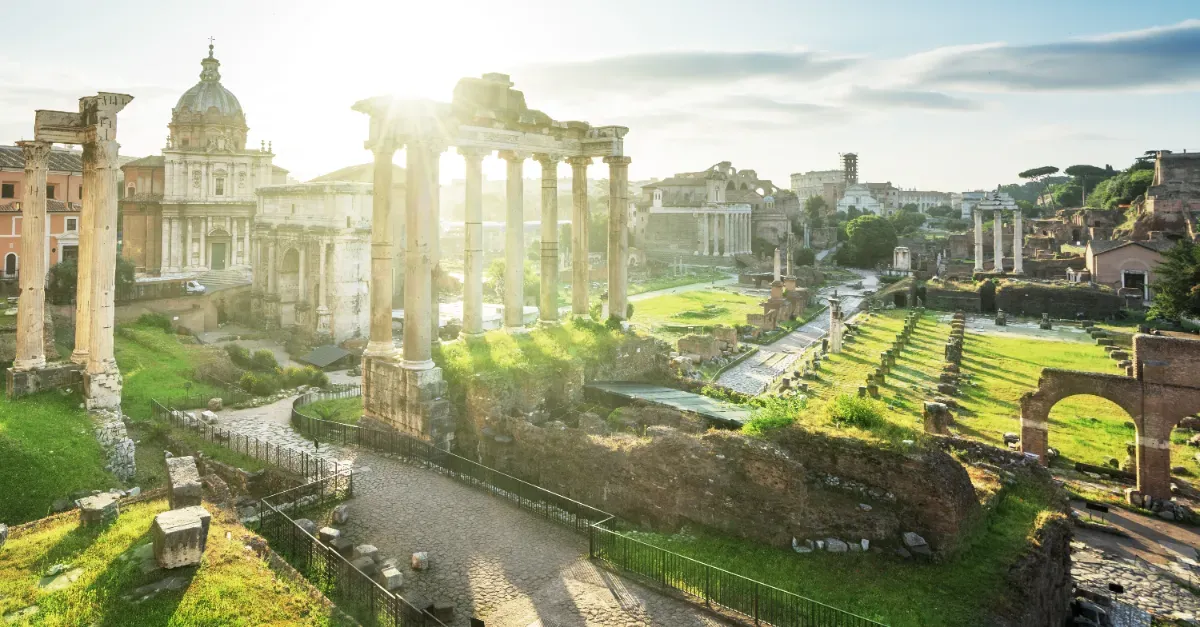
The ‘Roman warm period’ or ‘Roman climatic optimum’ is in fact a period running from about 200 BC to 400 AD (roughly six centuries, then) in which the climate of Europe, the Mediterranean area and the North Atlantic was significantly warmer (by 1.5–2 °C) and wetter than in the preceding and following centuries.
The discovery, as one can easily guess, is the work of palaeoclimatologists, who found, thanks to a series of scientific measurements, that between the 3rd century BC and the 5th century AD the temperature in the areas where Rome’s dominion was (progressively) extending was about 1.5–2 degrees Celsius warmer than the average values of the preceding times and of those that followed. In addition, during that period there was an intensification of rainfall, especially in summer.
It is obvious to suppose that there was a causal link, though not an exclusive one (that is, it was not the only cause), between these ‘favourable’ climatic conditions (but were they really so favourable, given that it was hotter than today, and there was no air conditioning?) and the expansion of Roman dominion over a good part of the then known world. How, is easy to guess.
The warmer climate would have eased some Roman military expeditions, in particular the conquests north of the Alps, in Gaul, Britain and Germany.
The heavier summer rains would have guaranteed water and prosperity to Roman cities: we know that in the 1st and 2nd centuries AD, for example, the floods of the Tiber fell in March and August.
The higher temperature and the increased availability of water would have favoured the development of agriculture: we learned at school that North Africa, today largely desert, was at that time fertile and productive land.
Conversely, the slow but steady cooling of the climate from 150 AD onwards would have contributed to the decline of Roman civilisation, making life harder in many ways (for example, the cold would have encouraged the spread of certain viruses).
Was the Mediterranean warmer?
This field of research also includes the study whose conclusions were published about three years ago and which has been taken up by the media in recent weeks: a study concerning the temperature of the Mediterranean Sea in ancient times.
The research, carried out by the Research Institute for Geo-Hydrological Protection (Cnr-Irpi) in collaboration with the Institute of Marine Sciences (Cnr-Ismar) and the University of Barcelona and published in Scientific Reports, of the Nature group, found that in the time of the Roman Empire the Mediterranean experienced exceptional warming: surface temperatures exceeded by two degrees the average values recorded at the end of the 20th century, the highest of the last two thousand years.
The researchers concentrated in particular on the western sector of the Strait of Sicily. Here, by means of a gravity coring system, it was possible to quantify the extent of the warming in the Mediterranean region during the Roman period (1–500 AD). By integrating these figures with those from other areas of the Mediterranean (the Alboran Sea, the Minorca basin and the Aegean Sea), a phase of exceptional warming emerged, running from the 1st to the 5th century AD.
So what?
This was enough for some (newspapers, commentators of various kinds and backgrounds, and so on) to start up again the refrain we now know well: global warming is the ‘hoax’ of recent decades… Even the Mediterranean, you see, was warmer two thousand years ago…
In short, it is hot in summer, as eminent figures of ours have said, in order to open our eyes to the supposed great ‘fake news’ of a changing climate and an Earth warming at unsustainable rates.
But it is the climatologists who are the first to refute this interpretation of the data.
The rise in land temperatures (in Europe) that occurred in antiquity has nothing to do with today’s global warming.
These are two phenomena that are climatically quite incomparable. For at least two reasons.
The difference from today’s global warming
The first concerns time. The ancient warming took place over at least six centuries: it was therefore long and gradual, unlike the sudden and abrupt warming that is happening now.
It is above all because of this speed that, in recent decades, we have been witnessing an increase in extreme events (rainfall, storms, landslides): events for which there is no evidence in the ancient period, either in the scientific data or in other sources, such as those of the ancient historians.
In other words, this speed of change does not allow the environment to find a new equilibrium: hence the multiplication of more intense phenomena that are harmful to human activities. And this is no small difference.
The second difference concerns place. We know that the ancient warming occurred in a well-defined area: that, as mentioned, of Europe from the North Atlantic to the Mediterranean.
‘Our’ warming, by contrast, is a global phenomenon, affecting the planet as a whole.
But then, is it really true that the ancient warming had only natural causes? And that human action, even though it did not yet know the technology of combustion engines, did not contribute in some way? We shall discuss this in the next article.