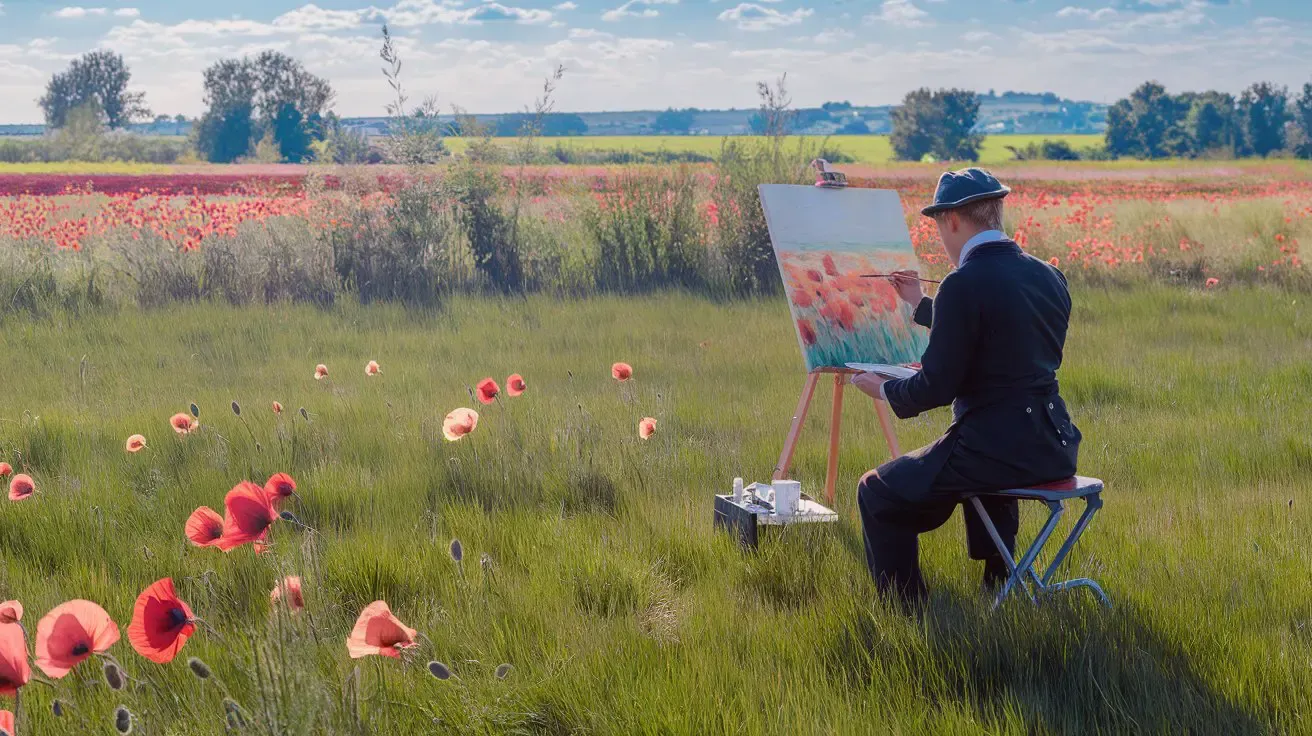
After all, this is what the conventions of the time dictated. However, as someone might say, rules are made to be broken, and indeed a group of young artists imagined and put into practice a new kind of painting: more authentic, able to reproduce things as they really are, struck by natural light rather than imagined in the studio. These painters wanted to bring to their canvases the impression that their eye received at a precise moment, as if photographing an instant, and so they came to be called “Impressionists”.
The irruption of the real: Impressionist landscapes
Bearing Manet’s Luncheon on the Grass in mind, let’s compare it with another painting: The Poppies by Claude Monet (1873, Paris, Musée d’Orsay). The first detail that catches the eye is the colours: while Manet’s are more muted, Monet’s are more realistic and vivid; we could still see the clouds in the sky today on an overcast day.
The field of poppies is swept by the wind, which is why Monet does not paint the outlines of the flowers precisely, but in a blurred manner, giving us the idea of movement. The same goes for the figures of the painter’s wife and his son Claude, in the foreground: they are walking, so their faces cannot be sharp to the eyes of someone quickly capturing the scene on canvas.
In short, Monet is painting what his eye sees at a given moment, without constructing the scene in the studio, but capturing reality en plein air, in the open air.
Monet’s example was followed by a group of painters who were indeed called Impressionists. Among the most famous: Pierre-Auguste Renoir, Camille Pissarro, Edgar Degas and Alfred Sisley. Their insight was a great novelty for the time and, as often happens, was not initially understood by their contemporaries, to the point that artists tied to the academic tradition refused to exhibit alongside them, excluding their works from the annual salons (art exhibitions).
The Impressionists, however, were not discouraged, organising exhibitions “on their own” (the first was held in 1874, as it happens, in the studio of a photographer, Nadar) and continuing to pursue their idea of painting, reflecting on how light interacts with colours.
Take, for example, Monet’s series of paintings devoted to landscapes with haystacks: the subject is always the same, yet never seems the same. Why? Because the light changes: Monet paints the haystacks at different times of the day, showing how colours change according to the light. If we look at the painting Haystacks, White Frost Effect (1889, Farmington, United States, Hill-Stead Museum), we feel we could touch the frost on the fields; conversely, in Haystacks, End of Summer (1891, Paris, Musée d’Orsay) we can sense the summer haze. Until shortly before, such an undertaking would have been unthinkable for artists!
The rediscovery of nature
Naturally, Impressionist output is not limited to the rural landscape: as modern artists, the Impressionists also celebrate the novelties of nineteenth-century Paris, painting grand boulevards and society occasions (Renoir is a master of this, with famous works such as Dance at Le Moulin de la Galette, 1876, Paris, Musée d’Orsay). Nevertheless, it is undeniable that a large part of Impressionist paintings have, for the first time, as their subjects fields of poppies, haystacks, hills, ponds with water lilies (what better than water for plays of light?): the human figure is often secondary, of little importance, if not entirely absent.
In short, the great revolution of the Impressionists was to regain a direct relationship with nature, leaving the studios and painting in the open air. Is it partly thanks to them that, when we find ourselves before a beautiful landscape, we feel the urge to capture the instant, the fleeting impression, by photographing it?