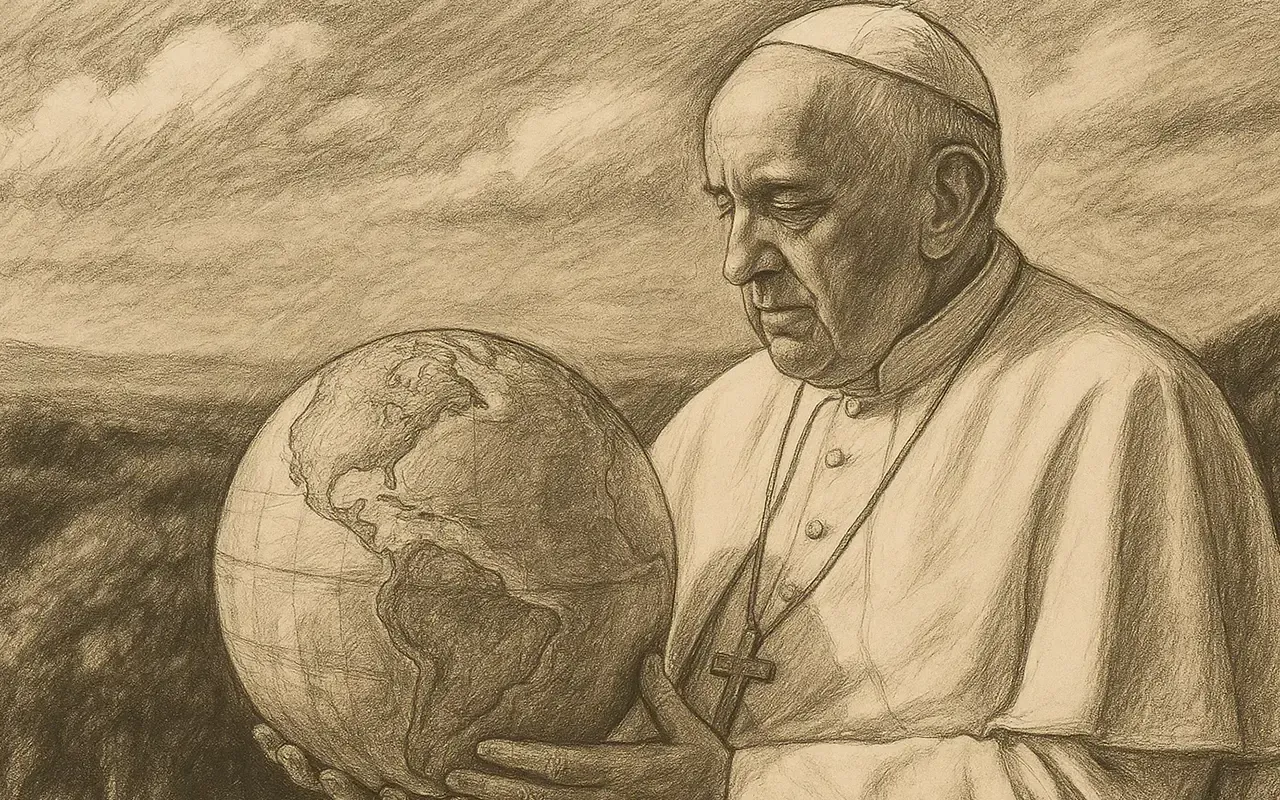
The 2015 Laudato si’ has rightly been described as ‘a groundbreaking text’: and the reason is precisely what has been said above.
It is not only the first papal document devoted entirely to the environmental question: it is the first in which the supreme Catholic authority explicitly speaks of the need for an “integral ecology”.
It has been said that Laudato si’ was in embryo in Pope Bergoglio’s pontificate from the very first day: indeed, from the first evening, on 13 March 2013, when, presenting himself to the world from the central loggia of St Peter’s, the new Pope chose the name Francis for himself.
The citation of the Canticle of the Creatures in the title of the document therefore clearly signified that, in Bergoglio’s vision, St Francis was in some sense an “absolute” model – even among the saints – not only of love for poverty and for the least, but also of harmony between man, nature and God, as emerges from the limpid and sublime verses of the Franciscan lauda.
A spiritual and theological environmentalism
The theological and spiritual foundations of Pope Francis’s environmentalist vision are clearly set out in his encyclical. The first “commandment” in favour of respect for nature is that “man is not God”. He is not the absolute master of creation, nor is creation a slave subjected to him.
The verses of Genesis that might suggest a similar perspective must be interpreted correctly. While it is true that God commanded man to subdue the earth (Gen 1:28) and to till it, he also required him to keep it (Gen 2:15). And it is a fact that, again according to Genesis, “the original harmonious relationship between human beings and nature turned into conflict” (Gen 3:17-19).
This is therefore an original fracture, which must be healed and mended through the exercise of care and love.
The pages of Laudato si’ explain this very well:
Today we must firmly reject the notion that, from the fact of being created in God’s image and from the mandate to subdue the earth, one can deduce absolute dominion over other creatures. It is important to read biblical texts in their context, with a sound hermeneutic, and to remember that they invite us to “till and keep” the garden of the world (Gen 2:15). While “tilling” means ploughing or working the soil, “keeping” means protecting, caring for, preserving, guarding, watching over. This implies
a relationship of responsible reciprocity between human beings and nature.
Integral ecology
The heart of the encyclical, and of all Bergoglio’s thinking on caring for the environment, is however certainly to be found in the inseparable link between environmental justice and social justice: which means commitment to peace, the fight against poverty and inequality, and the protection of the weak and vulnerable.
The most intense and vibrant pages of the encyclical are certainly those against the throwaway culture and the indiscriminate exploitation of natural resources – water above all. As are the passages devoted to the fundamental link between the climate crisis and poverty.
The problem of “climate migrants”, for example, is one of the encyclical’s principal concerns:
Tragically, there is a rise in the number of migrants fleeing poverty worsened by environmental degradation, who are not recognised as refugees in international conventions and bear the burden of their abandoned lives without any legal protection. Sadly, there is widespread indifference to such suffering, which is even now taking place throughout our world. Our lack of response to these tragedies involving our brothers and sisters points to the loss of that sense of responsibility for our fellow men and women upon which all civil society is founded.
On the primary and ultimate responsibility for these dramatic realities, Laudato si’ is very clear: it is the socio-economic system based on exploitation that generates all this, or at the very least allows it to happen without intervening.
Economic powers continue to justify the current global system, where priority tends to be given to speculation and the pursuit of financial gain, which fail to take the context into account, let alone the effects on human dignity and the natural environment. Here we see how environmental deterioration and human and ethical degradation are closely linked.
The finger is thus explicitly pointed at world finance and its logic:
Finance overwhelms the real economy. The lessons of the global financial crisis have not been assimilated, and we are learning very slowly the lessons of environmental deterioration.
It is therefore no surprise that, in the wake of the Pope’s death, a rather acerbic editorial in a newspaper such as the Wall Street Journal essentially accused him of “having defended the poor by promoting the ideas that keep them poor”.
Francis had evidently hit the mark, touching the weak point of the neo-capitalist ideologies so beloved of Wall Street (before, during and after Trump) and its heralds.
Pope Francis’s concrete actions
When it is said that Francis was the first truly “environmentalist” Pope, the intention is also to draw attention to the concrete actions in defence of the environment that he, the first to do so from the throne of Peter, chose to undertake. Starting with the territory of the Vatican itself.
Francis very resolutely wanted the “Scientific Committee for the environmental and energy sustainability project of St Peter’s Basilica” to be established. To coordinate it he appointed the researcher and environmental expert Walter Ganapini, a former co-founder of Legambiente, a professional with decades of ecological study and commitment behind him.
The entire 2025 Jubilee is an event based on rigorous sustainability criteria, as well as being rich in initiatives that promote the protection of the environment and the care of Creation.
To give just one example, the asphalt being used to resurface Rome’s roads for the Jubilee is “green”, that is, made from recycled plastics and graphene.
As for Francis’s role as an authoritative and listened-to voice raised at every international climate conference, newspapers and news outlets have given it ample coverage.
In May 2024 he wanted one held in the Vatican itself: the International Conference of the Catholic Church on climate resilience.
Beyond “ideologies”: Francis’s legacy
The role played by Pope Bergoglio in the difficult battle for the care and conservation of the environment-Creation was therefore an absolute novelty, and as such it irritated more than a few.
Above all those who continue to “brand” environmentalist culture as a product of blind ideology, steeped in “para-Marxism” and in an illiberal anti-capitalism harmful to the development of humanity.
Strong in his vision, at once spiritual, ethical and theological, Francis showed the world that care for the environment – understood as an integral choice and not as a half-measure, to be put away whenever it bothers some particular interest – is not ideology.
It is only and simply, to use an expression from the liturgy, right and just.
sources and further reading:
Laudato si’