And so feet instead of the railway, the emblem of technological mobility already felt at the time to be dehumanising. Walking first of all: which is then the premise for wandering, moving freely over the land in order to ‘enjoy’ it fully, to become almost one with it. And naturally – following the thread of the metaphor – to create one’s own individual paths, with a freedom that borders on anarchy and that is certainly a challenge to every semblance of authority.
WALKING
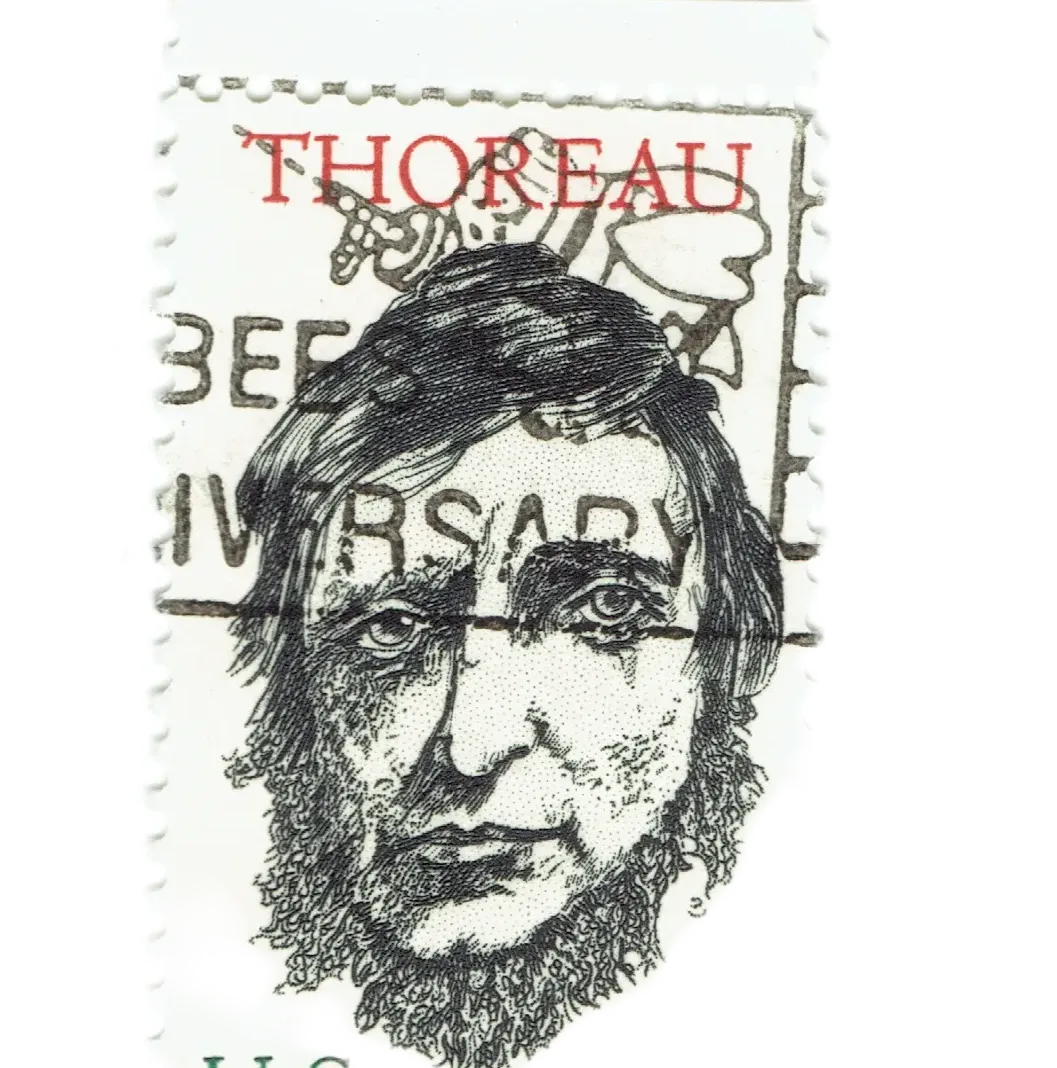
By H. D. Thoreau
I wish to speak a word for Nature, for absolute freedom and wildness, as contrasted with a freedom and culture merely civil: to regard man as an inhabitant, or a part and parcel of Nature, rather than a member of society. I wish to make an extreme statement, if so I may make an emphatic one, for there are enough champions of civilisation: the minister and the school committee, and every one of you will take care of that.
I have met with but one or two persons in the course of my life who understood the art of walking, that is, of taking walks, who had a genius, so to speak, for SAUNTERING, a word which is beautifully derived from ‘idle people who roved about the country, in the Middle Ages, and asked charity, under pretence of going à la Sainte Terre’, to the Holy Land, till the children exclaimed, ‘There goes a Sainte-Terrer’, a Saunterer, a Holy-Lander. Those who never go to the Holy Land in their walks, as they pretend, are indeed mere idlers and vagabonds; but those who do go there are saunterers in the good sense, such as I mean.
Some, however, would derive the word from sans terre, without land or a home, which, therefore, in the good sense, will mean having no particular home, but being equally at home everywhere. For this is the secret of successful sauntering. He who sits still in a house all the time may be the greatest vagrant of all; but the saunterer, in the good sense, is no more vagrant than the meandering river, which is all the while sedulously seeking the shortest course to the sea.
But I prefer the first, which, indeed, is the more probable derivation. For every walk is a sort of crusade, preached by some Peter the Hermit in us, to go forth and reconquer this Holy Land from the hands of the Infidels.
It is true, we are but faint-hearted crusaders, even the walkers, nowadays, who undertake no persevering, never-ending enterprises. Our expeditions are but tours, and come round again at evening to the old hearthside from which we set out. Half the walk is but retracing our steps. We should go forth on the shortest walk, perhaps, in the spirit of undying adventure, never to return, prepared to send back our embalmed hearts only as relics to our desolate kingdoms. If you are ready to leave father and mother, and brother and sister, and wife and child and friends, and never see them again – if you have paid your debts, and made your will, and settled all your affairs, and are a free man – then you are ready for a walk.
To return to my own experience, my companion and I, for I sometimes have a companion, take pleasure in fancying ourselves knights of a new, or rather an old, order, not Equestrians or Chevaliers, not Ritters or Riders, but Walkers, a still more ancient and honourable class, I trust. The chivalric and heroic spirit which once belonged to the Rider seems now to reside in, or perchance to have subsided into, the Walker: not the Knight, but the Walker Errant. He is a sort of fourth estate, outside of Church and State and People.
We have felt that we almost alone hereabouts practised this noble art; though, to tell the truth, at least if their own assertions are to be received, most of my townsmen would fain walk sometimes, as I do, but they cannot. No wealth can buy the requisite leisure, freedom and independence which are the capital in this profession. It comes only by the grace of God. It requires a direct dispensation from Heaven to become a walker. You must be born into the family of the Walkers. Ambulator nascitur, non fit.
Some of my townsmen, it is true, can remember, and have described to me, some walks which they took ten years ago, in which they were so blessed as to lose themselves for half an hour in the woods; but I know very well that they have confined themselves to the highway ever since, whatever pretensions they may make to belong to this select class. No doubt they were elevated for a moment as by the reminiscence of a previous state of existence, when even they were foresters and outlaws.
When he came to the Green Wood,
In a bright morning,
There he heard the small notes
Of the persuasive song of the birds.
The last time I was here, said Robyn,
was a long time ago;
I would like to shoot for a while
I think that I cannot preserve my health and spirits unless I spend at least four hours a day – and it is commonly more than that – sauntering through the woods and over the hills and fields, absolutely free from all worldly engagements. You may safely say: A penny for your thoughts, or a thousand pounds. When sometimes I am reminded that the mechanics and shopkeepers stay in their shops not only all the forenoon, but all the afternoon too, sitting with crossed legs – as if the legs were made to sit upon, and not to stand or walk upon – I think that they deserve some credit for not having all committed suicide long ago.
I, who cannot stay in my chamber for a single day without acquiring some rust, and who, when sometimes I have stolen forth for a walk at the eleventh hour, or even at four in the afternoon, when the day was already lost, when the shades of night were already beginning to be mingled with the day, have felt as if I had committed some sin to be atoned for – well, I confess that I am astonished at the power of endurance, to say nothing of the moral insensibility, of my neighbours who confine themselves to shops and offices the whole day for weeks and months, yes, and years.
I know not what manner of stuff they are made of – sitting there at three o’clock in the afternoon, as if it were three o’clock in the morning. Bonaparte may talk of the three-o’clock-in-the-morning courage, but it is nothing to the courage of one who can sit cheerfully down at three o’clock in the afternoon facing himself, when all the morning he has already starved in a garrison to which he is bound by such strong ties of sympathy. And I wonder that about this time, say between four and five in the afternoon, too late for the morning papers and too early for the evening ones, there is not a general explosion heard up and down the street, scattering to the four winds – to offer a healthy breath of air – the mass of antiquated ideas and all the domestic notions and whims, so that the evil may cure itself.
How women, who are confined to the house still more than men, bear it, I do not know; but I have reason to suspect that most of them do not BEAR it at all. When, early on a summer afternoon, we have shaken the dust of the village from the skirts of our garments, passing quickly by those houses with their pure Doric or Gothic fronts, which convey such an air of repose, my companion whispers that probably about these times their occupants are all gone to bed. It is then that I appreciate the beauty and the glory of architecture, which itself never turns in upon itself, but forever stands erect, keeping watch over the sleepers.
No doubt temperament, and, above all, age, have a good deal to do with it. As a man grows older, his ability to sit still and follow indoor occupations increases. He grows vespertinal in his habits as the evening of life approaches, till at last he comes out only just before sundown, and gets all the walking that he requires in half an hour.
But the walking of which I speak has nothing in it akin to taking exercise, as it is called, as the sick take medicine at stated hours – as the swinging of dumb-bells or chairs; but is itself the enterprise and adventure of the day. If you would get exercise, go in search of the springs of life. Think of a man’s swinging dumb-bells for his health, when those springs are bubbling up in far-off pastures unexplored by him!
Moreover, you must walk like a camel, which is said to be the only beast which ruminates when walking. When a traveller asked Wordsworth’s servant to show him her master’s study, she answered, ‘Here is his library, but his study is out of doors.’
Living much out of doors, in the sun and wind, will no doubt produce a certain roughness of character – will cause a thicker cuticle to grow over some of the finer qualities of our nature, as on the face and hands, or as severe manual labour robs the hands of some of their delicacy of touch. Staying in the house, on the other hand, may produce a softness and smoothness, not to say thinness of skin, accompanied by an increased sensibility to certain impressions.
Perhaps we should be more susceptible to some important influences upon our intellectual and moral growth, if the sun had shone and the wind blown on us a little less; and no doubt it is an interesting question what is the right proportion between thick skin and thin. But it seems to me that it is a little like dandruff, which is easily shaken off – and that the natural remedy is to be found in the proportion which the night bears to the day, the winter to the summer, thought to action. There will be so much the more air and sunshine in our thoughts. The callous palms of the labourer’s hands are familiar with finer tissues of self-respect and heroism, whose touch thrills the heart more than the languid fingers of idleness. This is mere sentimentalism, to regard as pure and unstained that which rests during the day, far from the tan of the sun and the callus of experience.
When we walk, we naturally go to the fields and woods: what would become of us if we walked only in a garden or a city centre? Even some sects of philosophers felt the need to import the woods into themselves, since they did not go to the woods. “They planted groves and avenues of plane trees”, where they took their subdiales ambulationes in open-air porticoes. Of course it is of no use to direct our steps towards the woods if they do not really take us there. It alarms me when I happen to have walked a mile in the woods with my body, without having arrived there in spirit. On my afternoon walk I would like to forget all my morning occupations and my obligations to Society.
But sometimes it happens that I cannot easily shake off the village. The thought of work will whirl in my head and I am not where my body is, I am beside myself. On my walks I would like to come back to myself. What sense is there in going to the woods, if I am thinking of something outside the woods? I suspect myself, and I cannot help shuddering when I find myself so involved even in what are called necessary works – for this too can sometimes happen.
The surrounding area offers many fine walks; and although for so many years I have walked almost every day, and sometimes for several days in a row, I have not yet exhausted them. An absolutely new prospect is a great happiness, and I can still get one every afternoon. Two or three hours of walking will bring me to a country as strange as I would ever expect to see. A solitary farmhouse that I had never seen before is sometimes as good as the dominions of the king of Dahomey. There is in fact a sort of harmony to be detected between the possibilities of the landscape within a radius of ten miles, or even at the end of an afternoon walk, and the threescore years and ten of human life. But it will never become very familiar to you.
Nowadays almost all the so-called progress of man, such as the building of houses and the cutting down of the forest and of all the great trees, does nothing but deform the landscape, and render it ever tamer and cheaper. What a people it would be that began instead to burn the fences and leave the forest standing!
I have seen the fences half consumed, their pickets lost in the middle of the prairie, and a bit of miserly ground with a surveyor toiling to define its limits, while the heavens spread all around him, and he did not see the angels going to and fro, but was looking for an old post-hole in the middle of paradise. I looked again, and saw him standing in the midst of a Stygian marsh, surrounded by devils, and he had no doubt found his boundaries, three little stones in the middle of which a post had been planted, and looking more closely, I saw that the surveyor was the Prince of Darkness.
I can easily walk ten, fifteen, twenty, any number of miles, starting from my own door, without passing any house, without crossing a road except where the fox and the mink do: first along the river, then the brook, and then the meadow and the woods. There are square miles in my neighbourhood that have no inhabitants. From many hills I can see civilisation and the
dwellings of man in the distance. The farmers and their works are little more evident than woodchucks and their burrows. Man and his affairs, Church and State and school and trade and manufactures and agriculture, even politics – the most alarming of them all… I am pleased to see how little space they occupy in the landscape. Politics is but a narrow field, and that still narrower highway yonder leads to it. I sometimes direct the traveller thither.
If you would go to the political world, follow the great road – follow that market-man, keep his dust in your eyes, and it will lead you straight to it; for it too has its place merely, and does not occupy all space. I pass through it as through a bean-field in the woods, and forget it. In half an hour I can walk to some part of the earth’s surface where a single man has not set foot from one year’s end to another, and there, consequently, politics does not exist, for it exists only as the cigar smoke of a man.
The village is the place towards which roads tend, a sort of expansion of the highway, as a lake of a river. It is the body of which roads are the arms and legs – a trivial or quadrivial place, the thoroughfare and ordinary highway of travellers. The word comes from the Latin villa, which together with via, a way, or more anciently ved and vella, Varro derives from veho, to carry, because the villa is the place to and from which things are carried. Those who got their living by carting were said vellaturam facere. Hence, too, the Latin word vilis and our vile, also villain. This suggests what kind of degeneracy the dwellers in villages are liable to. They are worn out by the travel that goes through them, without travelling themselves.
Some do not walk at all; others walk in the highways; a few walk across lots. Roads are made for horses and men of business. I do not travel on them much, compared with others, because I am not in a hurry to get to a tavern, a grocery, a livery-stable or a depot to which they lead. I am a good horse to travel, but only of the kind you choose for sightseeing. The landscape painter uses the figures of men to mark a road. He would not have made that use of my figure. I walk in Nature as the old prophets and poets did, Menu, Moses, Homer, Chaucer. You may call this America, but it is not America; neither Americus Vespucius, nor Columbus, nor others were its discoverers. There is more of truth in the mythology of America than in any so-called history of America that I have read.
Nevertheless, there are some old roads that may be walked with profit, as if they led somewhere now that they are nearly abandoned. There is the old Marlborough Road, which does not lead to Marlborough now, I think, unless Marlborough is the place to which it leads me. I am rather bold to speak of it here, for I presume that there are one or two such roads in every town.
THE OLD MARLBOROUGH ROAD
Where they once dug for money,
but never found any;
where sometimes Martial Miles walks alone,
And so does Elijah Wood,
There I fear and expect no good.
No other man,
Save Elisha Dugan –
O man of wild habits,
Who have no other cares
Than to set snares
For partridges and rabbits,
who live all alone,
with all your needs pared to the bone
There life is sweeter
And you may eat continually.
When spring stirs my blood
with the instinct to travel,
I may have gravel enough
On the old Marlborough Road.
Nobody repairs it,
For nobody wears it out;
It is a living road,
As the Christians say.
Not many are those
who venture along it,
Only the guests of Quin the Irishman.
What is it, what is it,
That yonder, if not a direction
And the bare possibility
Of going anywhere?
Great slabs of stone point the way,
but travellers none;
Cenotaphs of towns
Are named on their crowns.
It is worth going to see
Where you MIGHT go.
What King
Had them built,
I am still wondering;
erected how or when,
By what counsellors,
Gourgas or Lee,
Clark or Darby?
They are the fruit of great effort
Something made to last for ever;
White tablets of stone,
Where a traveller
might groan,
And in a single sentence
engrave all that is known
and that another might read,
In his utmost need.
I know one or two
Of well-fitting verses,
Literature that might keep up
the whole country
That a man might remember
until next December,
And read again in spring,
after the thaw.
If with the wings of fancy spread
you leave your home,
You may go round the world
by the old Marlborough Road.
At present, in these parts, the best part of the land is not private property; the landscape belongs to no one, and the walker enjoys a relative freedom. But perhaps the day will come when it will be divided into so-called pleasure grounds, in which a few will take only a narrow and exclusive pleasure – when fences will be multiplied, and man-traps and other engines invented to confine men to the PUBLIC road, and walking over the surface of God’s earth will be construed as trespassing on some gentleman’s grounds. To enjoy a thing exclusively is commonly to exclude yourself from the true enjoyment of it. Let us improve our opportunities, then, before the evil days come.
What is it that makes it so hard sometimes to determine where we shall walk? I believe that there is a subtle magnetism in Nature, which, if we unconsciously yield to it, will direct us aright. It is not indifferent to us which way we walk. There is a right way; but we are very liable, through carelessness and stupidity, to take the wrong one. We would fain take that walk, never yet taken by us in this actual world, which is perfectly symbolical of the path which we love to travel in the interior and ideal world; and sometimes, no doubt, we find it difficult to choose our direction, because it does not yet exist distinctly in our idea.
When I go out of the house for a walk, uncertain as yet whither I will bend my steps, and submit myself to my instinct to decide for me, I find, strange and whimsical as it may seem, that I finally and inevitably settle south-west, towards some particular wood or meadow or pasture or deserted hill in that direction. My needle is slow to settle, varies a few degrees, and does not always point due south-west, it is true (and it has good authority for these variations), but it always settles between west and south-south-west. The future lies that way to me, and the earth seems more unexhausted and richer on that side. The outline which would bound my walks would be not a circle, but a parabola, or rather one of those cometary orbits which have been thought to be non-returning curves, in this case opening westward, in which my house occupies the place of the sun. I turn round and round irresolute sometimes for a quarter of an hour, until I decide, for the thousandth time, that I will walk into the south-west or west. Eastward I go only by force; but westward I go free.
No business leads me there. It is hard for me to believe that I shall find fair landscapes or sufficient wildness and freedom behind the eastern horizon. I am not excited by the prospect of a walk there; but I believe that the forest which I see in the western horizon stretches uninterruptedly towards the setting sun, and there are no towns or cities in it of enough consequence to disturb me. Let me live where I will, on this side is the city, on that the wilderness, and I am ever more and more inclined to leave the city and retreat into the wilderness.
I should not lay so much stress on this fact, if I did not believe that something like this is the prevailing tendency of my countrymen. I must walk towards Oregon, and not towards Europe. And that way the nation is moving, and I may say that mankind progress from east to west. Within a few years we have witnessed the phenomenon of a south-eastward migration, in the settlement of Australia. But this affects us as a retrograde movement, and, judging from the moral and physical character of the first generation of Australians, has not yet proved a successful experiment.
The eastern Tartars think that there is nothing west beyond Tibet. “The world ends there”, say they; “beyond there is nothing but a shoreless sea”. It is the absolute East in which they live.
We go eastward to realise history and study the works of art and literature, retracing the steps of our human race; we go westward as into the future, with a spirit of enterprise and adventure. The Atlantic is a Lethean stream, in crossing which we have had an opportunity to forget the Old World and its institutions.
If we do not succeed this time, there is perhaps one more chance for the human race before it reaches the banks of the Styx; and that chance is in the Lethe of the Pacific, which is three times as wide.
I do not know how significant it is, or how far it is a proof of singularity, that an individual should thus consent in his pettiest walk with the general movement of the race; but I know that something akin to the migratory instinct in birds and quadrupeds – which, in some instances, is known to have affected the squirrel tribe, impelling them to a general and mysterious movement, in which they were seen, say some, crossing the broadest rivers, each on its particular chip, with its tail raised for a sail, and bridging the narrower streams with their dead – that something like the furor which affects the domestic cattle in the spring, and which is referred to a worm in their tails – affects both nations and individuals, either perennially or from time to time. Not a flock of wild geese cackles over our town, but it to some extent unsettles the value of real estate here, and, if I were a broker, I should probably take that disturbance into account.
(…)
The West of which I speak is but another name for the Wild; and what I have been preparing to say is, that in Wildness is the preservation of the World. Every tree sends its fibres forth in search of the Wild. The cities import it at any price. Men plough and sail for it. From the forest and wilderness come the tonics and barks which brace mankind.
Our ancestors were savages. The story of Romulus and Remus being suckled by a wolf is not a meaningless fable. The founders of every state which has risen to eminence have drawn their nourishment and vigour from a similar wild source. It was because the children of the Empire were not suckled by the wolf that they were conquered and displaced by the children of the northern forests.
I believe in the forest, and in the meadow, and in the night in which the corn grows.(…)
Life consists with wildness. The most alive is the wildest. Not yet subdued to man, its presence refreshes him. One who pressed forward incessantly and never rested from his labours, who grew fast and made infinite demands on life, would always find himself in a new country or wilderness, and surrounded by the raw material of life. He would be climbing over the prostrate stems of primitive forest trees.
Hope and the future for me are not in lawns and cultivated fields, not in towns and cities, but in the impervious and quaking swamps.(…)
The weapons with which we have gained our most important victories, which should be handed down as heirlooms from father to son, are not the sword and the lance, but the bush-whack, the turf-cutter, the spade, and the bog hoe, rusted with the blood of many a meadow, and begrimed with the dust of many a hard-fought field. The very winds blew the Indian’s cornfield into the meadow, and pointed out the way which he had not the skill to follow. He had no better implement with which to intrench himself in the land than a clam-shell. But the farmer is armed with plough and spade. (…)
Nature is a personality so vast and universal that we have never seen one of her features. The walker in the familiar fields which stretch around my native town sometimes finds himself in another land than is described in their owners’ deeds, as it were in some far-away field on the confines of the actual Concord, where her jurisdiction ceases, and the idea which the word Concord suggests ceases to be suggested. These farms which I have myself surveyed, these bounds which I have set up, appear dimly still as through a mist; but they have no chemistry to fix them; they fade from the surface of the glass, and the picture which the painter painted stands out dimly from beneath. The world with which we are commonly acquainted leaves no trace, and it will have no anniversary.
The other afternoon I took a walk to Spaulding’s farm. I saw the setting sun lighting up the opposite side of a stately pine wood.
Its golden rays penetrated the aisles of the wood as into some noble hall. I was impressed as if some ancient and altogether admirable and shining family had settled there in that part of the land called Concord, unknown to me – and the sun was their servant, of that family which had never entered society in the village, which had never been invited. I saw their park, their pleasure-ground, beyond through the wood, in Spaulding’s cranberry meadow. The pines furnished them with gables as they grew. Their house was not obvious to the vision; the trees grew through it. I do not know whether I heard the sounds of a suppressed hilarity or not. They seemed to recline on the sunbeams. They have sons and daughters. They are quite well. The farmer’s cart-path, which leads directly through their hall, does not in the least put them out, as the muddy bottom of a pool is sometimes seen reflecting the sky. They never heard of Spaulding, and do not know that he is their neighbour, notwithstanding I heard him whistle as he drove his team through the house.
Nothing can equal the serenity of their lives. Their coat of arms is simply a lichen. I saw it painted on the pines and oaks. Their attics were in the tops of the trees. They are of no politics. There was no noise of labour.
I did not perceive that they were weaving or spinning. Yet I did detect, when the wind lulled and hearing was done away, the finest imaginable sweet musical hum, as of a distant hive in May, which perhaps was the sound of their thinking. They had no idle thoughts, and no one without could see their work, for their industry was not as in knots and stubble.
But I find it difficult to remember them now. They fade irrevocably out of my mind even now while I speak, and endeavour to recall them and recollect myself. It is only after a long and serious effort to recollect my best thoughts that I become again aware of their cohabitancy. If it were not for such families as this, I think I should move out of Concord.
We are accustomed to say in New England that few and fewer pigeons visit us every year. Our forests furnish no mast for them. So, it would seem, few and fewer thoughts visit each growing man from year to year, for the grove in our minds is laid waste – sold to feed unnecessary fires of ambition, or sent to mill – and there is scarcely a twig left for them to perch on.
They no longer build nor breed with us. In some more genial season, perchance, a faint shadow flits across the landscape of the mind, cast by the wings of some thought in its vernal or autumnal migration, but, looking up, we are unable to detect the substance of the thought itself. Our winged thoughts are turned to poultry. They no longer soar, and they attain only to a Shanghai and Cochin-China grandeur. Those THO-U-OUGHTS! Those gra-a-ate thoughts, you hear of!
We hug the earth – how rarely we mount! I think that we might ascend a little higher. We might at least climb a tree. I once had occasion to climb one myself. It was a tall white pine, on the top of a hill; and though I got well pitched, and nearly smothered, I was well paid for it, for I discovered new mountains on the horizon which I had never seen before – so much more of the earth and the heavens.
I might have walked about the foot of the tree for threescore years and ten, and yet I certainly should never have seen them. But, above all, I discovered around me – it was near the end of June – on the ends of the topmost branches only, a few minute and delicate red cone-like blossoms, the fertile flower of the white pine looking heavenward. I carried straightway to the village the topmost spire, and showed it to stranger jurymen who walked the streets – for it was court week – and to farmers and lumber-merchants and wood-choppers and hunters, and not one had ever seen the like before, but they wondered as at a star dropped down.
Tell me of the ancient architects finishing their works on the tops of columns as perfectly as on the lower and more visible parts! Nature has from the first expanded the minute blossoms of the forest only toward the heavens, above men’s heads and unobserved by them. We see only the flowers that are under our feet in the meadows. The pines have developed their delicate blossoms on the highest twigs of the wood every summer for ages, as well over the heads of Nature’s red children as of her white ones; yet scarcely a farmer or hunter in the land has ever seen them.
Above all, we cannot afford not to live in the present. He is blessed over all mortals who loses no moment of the passing life in remembering the past. Unless our philosophy hears the cock crow in every barn-yard within our horizon, it is belated. That sound commonly reminds us that we are growing rusty and antique in our employments and habits of thought. His philosophy comes down to a more recent time than ours.
There is something suggested by it that is a newer testament – the gospel according to this moment. He has not fallen astern; he has got up early, and stays up latest, and where he is, is in season. It is an expression of the health and soundness of Nature, a brag for all the world – healthiness as of a spring gushing forth, a new fountain of the Muses, to celebrate this last instant of time. Where he lives no fugitive slave laws are passed. Who has not betrayed his master many times since last he heard that note?
The merit of this bird’s strain is in its freedom from all plaintiveness. The singer can easily move us to tears or to laughter, but where is he who can excite in us a pure morning joy? When, in doleful dumps, breaking the awful stillness of our wooden sidewalk on a Sunday, or perhaps a watching in the house of mourning, I hear a cockerel crow far or near, I think to myself, “There is one of us well, at any rate”, and with a sudden gush of animal spirits I recover my spirits.
We had a remarkable sunset one day last November. I was walking in a meadow, the source of a small brook, when the sun, just before setting, after a cold, grey day, finally reached a clear stratum on the horizon, and the softest, brightest morning light fell on the dry grass and on the stems of the trees on the opposite horizon, and on the leaves of the shrub oaks on the hillside, while our shadows stretched long over the meadow towards the east, as if we were the only motes in its beams. It was such a light as we could not have imagined a moment before, and the air was so warm and serene that nothing was wanting to make of that meadow a paradise. When we reflected that this was not a solitary phenomenon, never to happen again, but that it would happen forever and ever, an infinite number of evenings, and cheer and reassure the latest child that walked there, then it was more glorious still.
The sun sets on some retired meadow, where no house is visible, with all the glory and splendour that it lavishes on cities, and perhaps as it has never set before, where there is but a solitary marsh hawk to have its wings gilded, or only a musquash looks out from its cabin, and there is a little black-veined brook in the midst of the marsh, just beginning to meander, winding slowly round a decaying stump. We walked in so pure and bright a light, gilding the withered grass and leaves, so softly and serenely bright, that I thought I had never bathed in such a golden flood, without a ripple or a murmur. The west side of every wood and rising ground gleamed like the boundary of Elysium, and the sun on our backs seemed like a gentle herdsman driving us home at evening.
So we saunter towards the Holy Land, till one day the sun shall shine more brightly than ever he has done, shall perchance shine into our minds and hearts, and light up our whole lives with a great awakening light, as warm and serene and golden as on a bankside in autumn.
image: [instinia] © 123RF.com