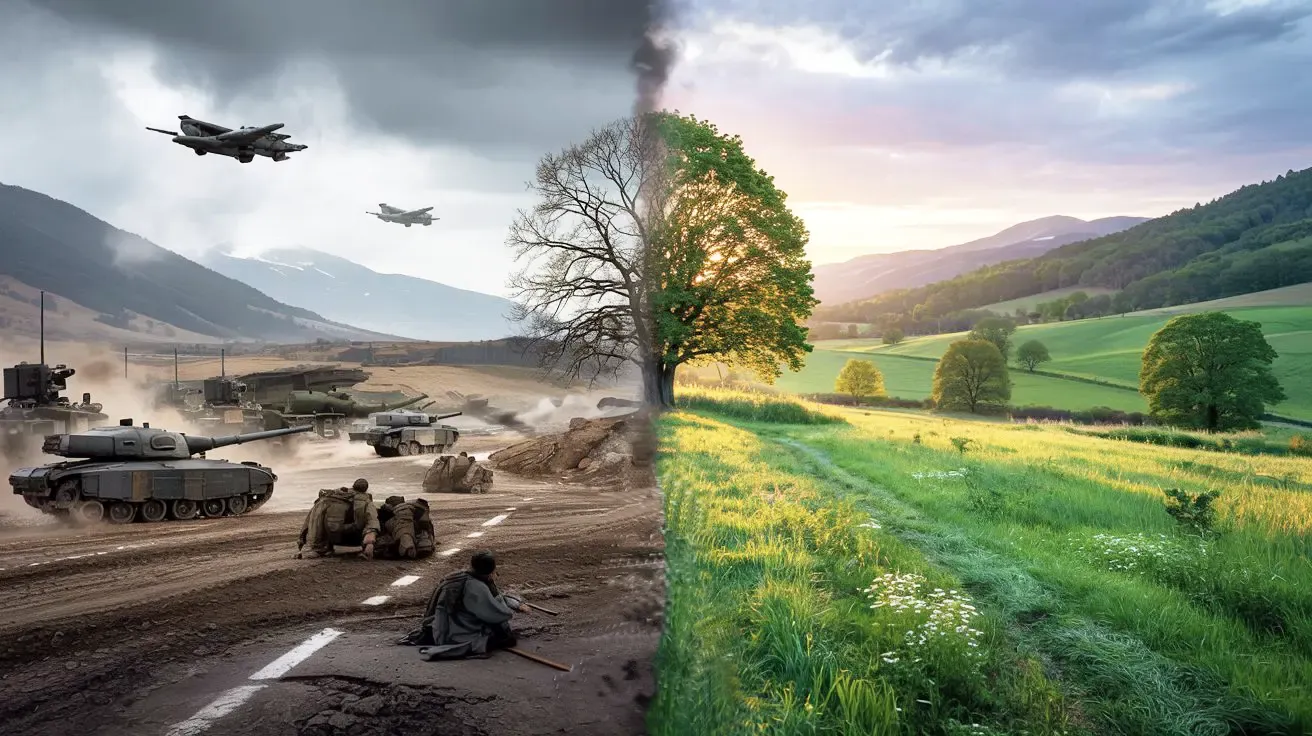
Green Deal versus military spending
Let us start with the European Green Deal, the sustainability framework that
remains to date the most comprehensive and structured in the world.
As we know, the European Green Deal aims to make the EU climate
neutral by 2050, focusing on reducing greenhouse gas emissions by 55%
by 2030 compared with 1990 levels.
It includes policies on renewable energy, the circular economy, sustainable
mobility, biodiversity and the elimination of pollution. Implementing them requires
massive, significant investment in green technologies, infrastructure and international
cooperation.
Now let us set alongside the Green Deal “package”, so to speak, the equally
sizeable one of the military activities of all the countries of the world.
Military activities are inherently resource-intensive, as well as harmful to
the environment. They are in fact responsible for around 5.5% of global greenhouse gas emissions, the
military being one of the largest consumers of fossil fuels
worldwide.
Take the US military, for example. Did you know that the US Army is the world’s largest
consumer of fossil fuels?
It is obvious, too, that the whole range of military operations carried out in the four corners of the world
generates chemical pollution, through the spreading of toxic substances, the use of
heavy equipment and the displacement of earth.
The war in Ukraine is, in its own way, a perfect and indisputable example of how geopolitical tensions
can hinder progress towards sustainability goals.
To date, its effects have been summarised as follows:
Environmental impacts
- Greenhouse gas emissions: the war has so far produced over 229 million tonnes of
CO2 equivalent, an increase of 31% in the last 12 months, equal to the
annual emissions of Austria, Hungary, the Czech Republic and Slovakia combined. - Forest fires: forest fires, often caused by explosions and drone attacks,
have burned twice the area of the average of previous years,
contributing to air pollution. - Water and soil pollution: the bombing of industrial sites and
explosions have released toxic chemicals into water and soil,
contaminating vital resources and putting human and animal health at risk. - Damage to protected natural areas: about 20% of Ukraine’s protected natural areas
have been damaged, with 3 million hectares of forest affected
directly or located in combat zones.
Impacts on sustainability
- Health risks: air, water and soil pollution increases the risks
to public health, both in the short and long term. - Food insecurity: the war has compromised Ukraine’s agricultural sector,
essential to the country’s economy and to global food security, because of
soil contamination and the destruction of infrastructure. - This last point also concerns us directly. We live thousands of
kilometres from the Ukrainian front, but we import food commodities from
those lands.
However hard the international authorities try to tell us that the Ukrainian grain – which we
continue to import – is absolutely free of contamination…
Military spending and spending on the environment
- There is also a clear (negative) correlation in public spending between wars and the environment.
The data are incontrovertible: the countries that spend most on the military tend to
allocate fewer resources to funding for the climate and environmental sustainability.
In other words, increased military spending takes funds away from other crucial sectors:
health, education and the ecological transition. The political clash of recent weeks after
the announcement of Rearm Europe is precisely about this.
As things stand – and in the midst of the debate on increasing funds for European “rearmament” –
Italian military spending for the current year is forecast at 32 billion euros, an
increase of 12.4% on 2024 and of 60% on the previous decade.
Staying with Italy, the comparison shows a stark disparity between military spending and
spending on the environment and sustainability. While military spending reaches
32 billion euros, as mentioned, specific incentives for energy sustainability amount to
only 232 million euros (to which must be added the environmental measures provided for in the
2025 budget law, which however have no precise overall budget). Less than one hundredth,
in proportion.
But there is more. It has now been proven that investing in weapons does not generate the same economic
return as other sectors.
Economists have calculated that a thousand million euros spent on weapons generate only 741
million euros of increase in domestic output.
Those who profit, of course, are always and only the arms industry, or the industries
linked to it.