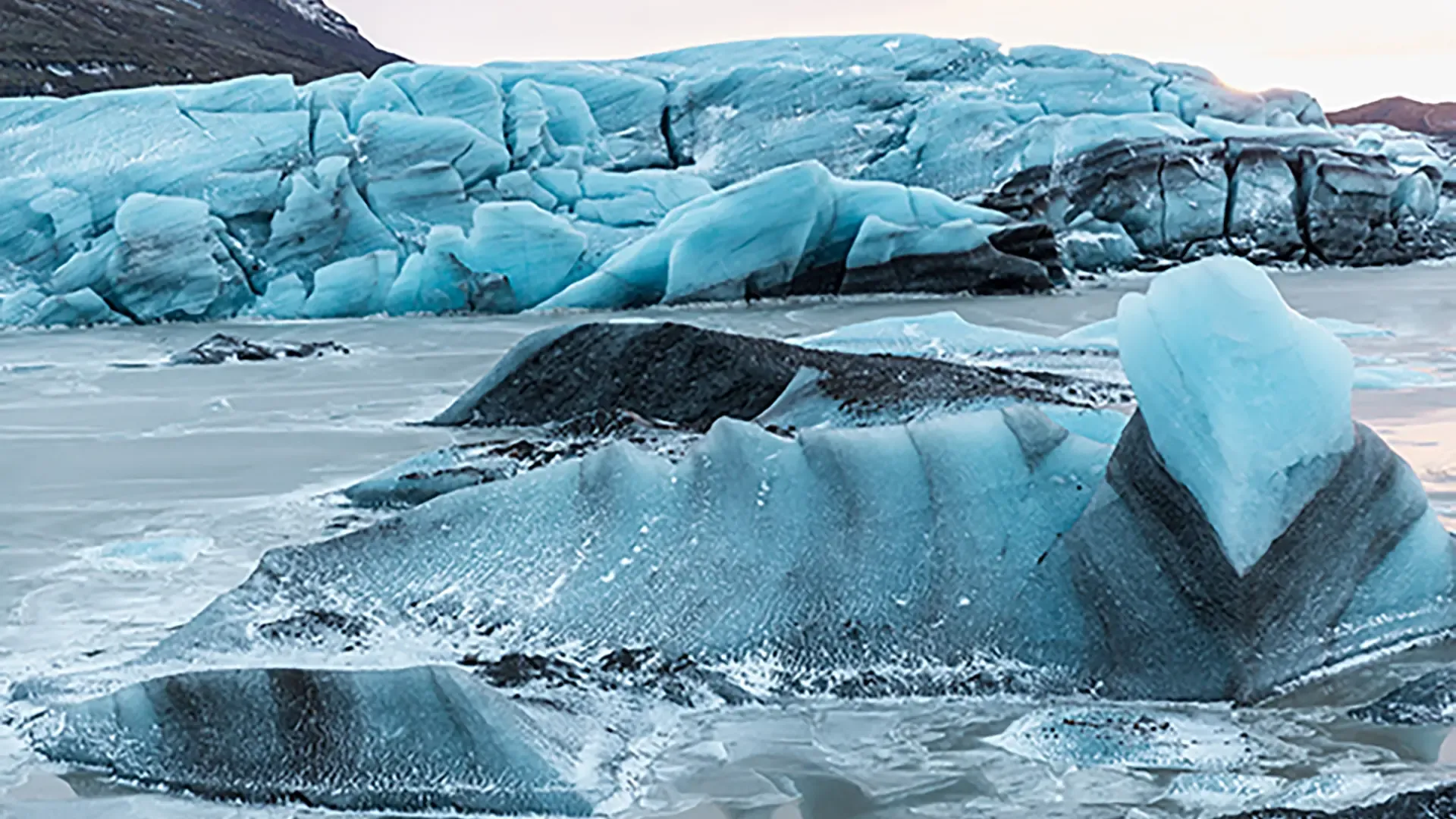
Glacier melt, in fact, contributes significantly to sea level rise, with direct implications for coastal communities around the world. In a study published in Nature Climate Change, scientists warn that accelerated ice loss could destabilise entire marine ecosystems, altering ocean currents and affecting the global climate.
Furthermore, the latest report by the Arctic Monitoring and Assessment Programme (AMAP), published in 2021, highlighted that the likelihood of an ice-free Arctic summer is ten times higher in a scenario of 2°C of global warming than in one of 1.5°C. According to most climate models, by 2050 we could see, for the first time, an Arctic almost free of sea ice in September.
Italian glaciers: a critical situation
In Italy, too, glaciers are undergoing a drastic reduction. Since the late nineteenth century, more than 200 Alpine glaciers have disappeared, giving way to debris and rock. Projections indicate that, by the end of the century, glacial surfaces could shrink to a quarter of their current size.
The loss of biodiversity is a direct consequence of this tragic situation: as the report ‘Carovana dei Ghiacciai 2024’ by Legambiente points out, the decline in the quantity and quality of available food is a particularly critical condition for Alpine wildlife, such as the rock ptarmigan, the mountain hare and the stoat.
The mismatch between the snow season and the moult makes these animals more visible, making it harder to find food and escape predators. Recent studies point to a loss of suitable habitat for the rock ptarmigan of between 17% and 59%, depending on the warming scenarios assumed.
Accounts from mountaineers and mountain guides unfortunately confirm this trend. Marco Confortola, an internationally renowned Italian mountaineer, has often said that in thirty years he has seen the glaciers retreat in an astonishing way, with areas that were once covered in perennial ice and are now just rock and debris. All this has a devastating impact not only on the landscape, but on all mountain life.
Snow in the Apennines: an uncertain future for winter tourism
Climate change is also affecting the Apennine mountain ranges, with significant repercussions for winter tourism. The snowfalls at the end of 2024 on Terminillo had raised the hopes of tourism operators, but rising temperatures made it impossible to keep the snow on the ground, undoing even the efforts of artificial snowmaking. All this highlights the vulnerability of Apennine ski resorts in the face of global warming.
According to the report ‘Nevediversa 2024’ by Legambiente, it snows less and less in the mountains, increasing the costs and consumption involved in artificially covering more than 5,000 km of ski slopes. The Ministry of Tourism has therefore decided to allocate 148 million euros to fund ski lifts… compared with 4 million earmarked for promoting ecotourism.
Wouldn’t it be appropriate to also increase funding for a different kind of tourism that could help change course, steering towards a new future for high-altitude winter tourism?
A study by the University of Turin has shown that, without structural measures, many ski resorts located below 1,500 metres could become economically unsustainable as early as 2040. It is therefore necessary and urgent to think about diversifying tourist activities, focusing on winter hikes, outdoor sports and cultural tourism.
Towards sustainable winter tourism
Ultimately, the climate crisis demands deep reflection on the future of winter tourism, especially in the Apennines and in low-altitude Alpine resorts. Artificial snowmaking, besides entailing high economic costs, has a significant environmental impact, requiring large quantities of water and energy. Moreover, it does not always guarantee satisfactory results, especially in adverse weather conditions.
Legambiente’s proposal is to move beyond artificial snowmaking, working towards a conversion of facilities and focusing on more sustainable winter tourism. By diversifying tourist activities and making the most of the natural environment, local skills and the historical and architectural heritage of mountain areas, we may perhaps find a way out of the tunnel and see the light.
A concrete example of this paradigm shift is the European project ‘Beyond Snow’, which aims to increase the socio-ecological resilience of ski areas located below 2,000 metres, the most vulnerable to climate change.
Through ten pilot areas spread across six Alpine countries, Beyond Snow develops sustainable development pathways and implementable solutions, involving citizens and policymakers through training and awareness-raising activities. One of the main outputs is the creation of an innovative digital tool to support decisions on resilience, made freely available to the Alpine community.
In short, the situation is tragic, but it is never too late to change course: promoting more sustainable and conscious tourism, capable of making the most of natural resources without compromising them further, can and must be done, because unfortunately we are already dealing with an unprecedented melting of glaciers.