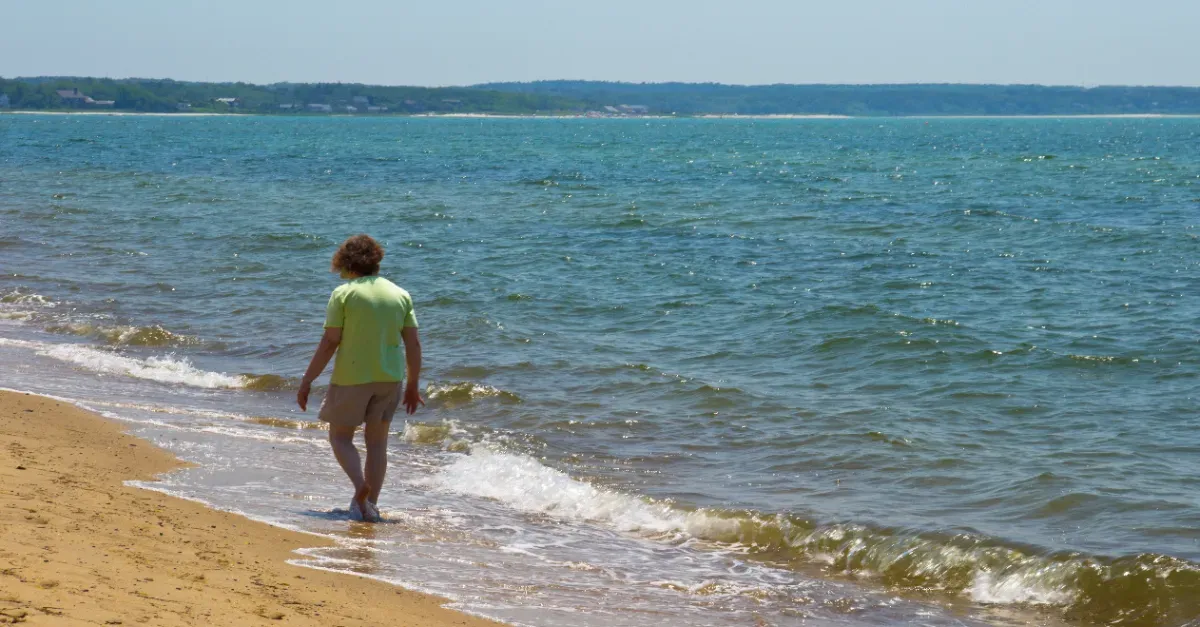
Originally from the suburbs of Cleveland, Ohio, Oliver in fact lived for forty years on Cape Cod with her partner, the photographer Molly Malone Cook. Her biography speaks of a simple daily life made up of habits such as walking in nature, with an inseparable notebook-diary in which she meticulously noted down all the richness of flora and fauna she came into contact with in the miraculously preserved lands of Massachusetts.
The comparison between Oliver and Thoreau, the great mentor of American nature poetry (and not only), is not at all arbitrary. The absolute capacity for observation, the essentiality of the description of every natural phenomenon, the “taxonomic precision that only those who truly know how to see and listen possess” (Nasi) are distinctive characteristics that the father of “green” literature has handed down to every later voice eager to engage with the ecological and holistic dimension of human experience in the physical world (think only of Gary Snyder).
And yet (or perhaps precisely for this reason) Oliver’s poetry is not exhausted in a “sensism” of impressions lived and drawn from contact with nature, probably in search of a panic, all-encompassing experience, of a samadhi sufficient unto itself.
There is a consequence of the love of nature in Oliver’s poetry that is properly existential, if not existentialist. Even metaphysical:
“Every year
everything
I have ever learned
in my life leads back to this: the fires of light
and the black river of loss
is salvation,
the meaning of which
none of us will ever know.”
Franco Nasi writes further on this: “Mary Oliver’s poetry offers a perspective different from that of traditional nature poetry; it is the fruit of a paradigm shift that places it in that movement of revision of the relationship between self and world found in much contemporary ecological thought, more or less radical, from Naess or Lovelock to Latour: an anthropocentric vision of the world is replaced by an ecocentric and relational vision between human and non-human.”
This is how Mary Oliver can be considered one of the most powerful voices of so-called contemporary ecopoetry, in some way a master (or a mistress of the craft). By overturning the human being-nature paradigm, one might say, the product does not change. The reflection, the focus, is still and always on the meaning of the human condition – inevitably – on its significance, as is proper to poetry. But starting from the external world rather than from the inner and interior one of the subject, from the non-self rather than from the self, can lead – if well handled, as Oliver does – to new and unexpected results, of pure and crystalline modernity.
And to cast a new light, from a vantage point shifted away from the traditional one, on the mystery of human incarnation in the here and now of the world: the arcane of earthly life, and of its mysteriously interconnected phenomena.
The journey:
“One day you finally knew
what you had to do, and began,
though the voices around you
kept shouting
their bad advice –
though the whole house
began to tremble
and you felt the old tug
at your ankles.
‘Mend my life!’
each voice cried.
But you didn’t stop.
You knew what you had to do,
though the wind pried
with its stiff fingers
at the very foundations,
though their melancholy
was terrible.
It was already late enough,
and a wild night,
and the road full of fallen branches and stones.
But little by little,
as you left their voices behind,
the stars began to burn
through the sheets of clouds,
and there was a new voice
which you slowly recognised as your own,
that kept you company
as you strode deeper and deeper
into the world,
determined to do
the only thing you could do –
determined to save
the only life you could save.”
The swan
Did you too see it, drifting, all night, on the black river?
Did you see it in the morning, rising into the silvery air?
An armful of white blossoms,
A perfect commotion of silk and linen as it leaned
into the bondage of its wings;
a snowbank, a bank of lilies,
biting the air with its black beak?
Did you hear it, fluting and whistling
A shrill, dark music, like rain beating on trees, like a waterfall
plunging like a knife from the black ledges?
And did you see it, finally, just under the clouds?
A white cross sweeping across the sky, its feet like black leaves,
its wings like the stretching light of the river?
And did you feel it, in your heart, how it pertained to everything?
And have you too finally understood what beauty is for?
And have you changed your life?”
Sources and further reading:
https://www.einaudi.it/catalogo-libri/poesia-e-teatro/poesia/primitivo-americano-mary-oliver-9788806259044
from the website of Giulio Einaudi Editore
https://www.doppiozero.com/mary-oliver-ecopoesia-e-ironia