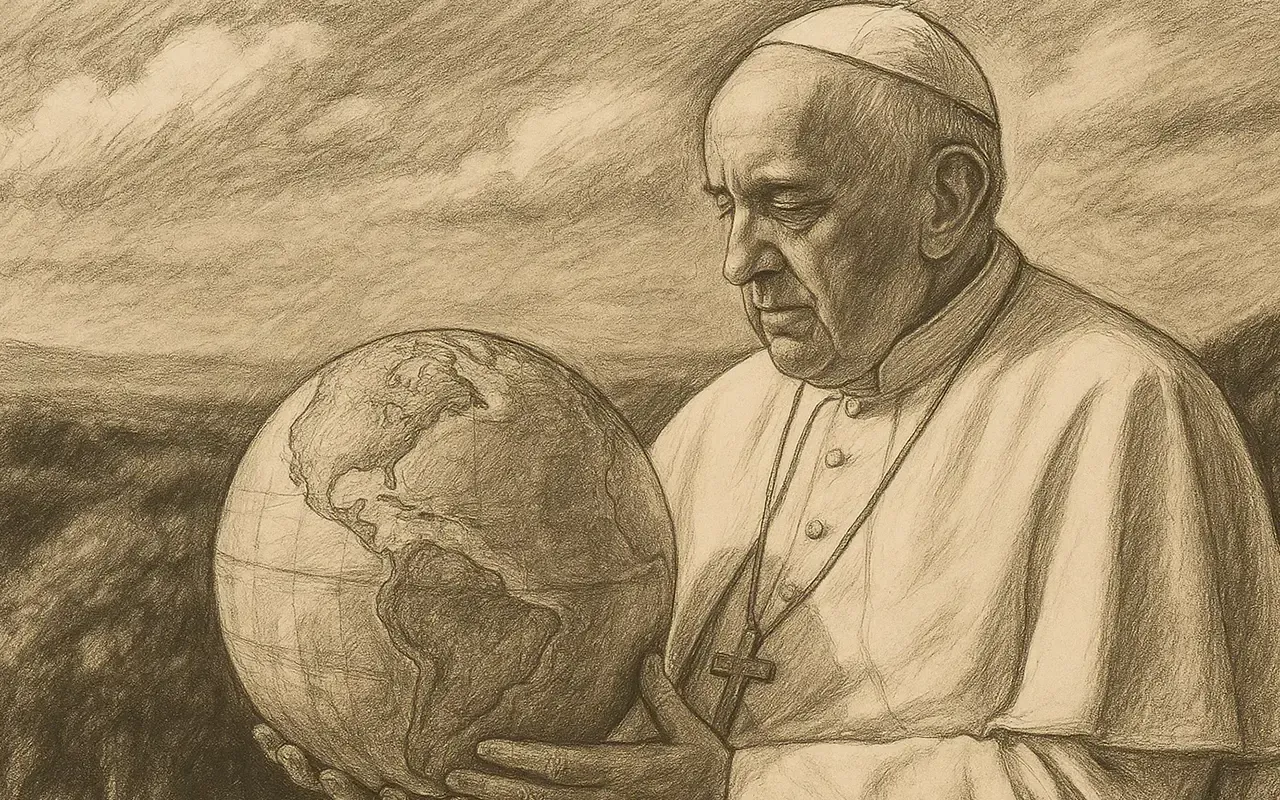
To explore the intersection between religion and ecology from the Christian perspective, we must first consider the Christian view of the world. The Christian Bible teaches that God created the universe and everything in it. This view is confirmed by the biblical story of creation, which states that God created all things. Consequently, human beings have a special responsibility to care for and preserve nature and the environment.
From the Christian perspective, then, nature is regarded as a gift from God. Preserving nature and the environment as a divine gift is a responsibility of human beings, since we are the guardians of the earth.
Safeguarding the environment
On safeguarding the environment as creation, Christianity is probably making up in recent years for a historical delay. So thinks, for example, a refined and sensitive theologian such as Enzo Bianchi. The attention paid to the subject, ‘prompted by the rise and spread of environmentalist movements’, says Bianchi in an article published in ‘Avvenire’, shows in some way that ‘theology – and with it the Church’s attention – in the 1950s to 1970s favoured themes not particularly conducive to a positive appreciation of nature: the interest, in fact, went above all to history’.
Bianchi also believes that ‘this interest in the ecological theme often seems a hasty attempt at recovery, at times even a confession of mea culpa, sometimes made with little discernment, for the sin of anthropocentrism: it must be said that for centuries animals and plants were considered a mere backdrop to human life, nothing more than instruments at its service’.
For Bianchi, the Christian reasons for a faith that is also ecological are ‘never separable from the theme of justice and peace’. ‘The Christian tradition, in fact, cannot and does not know how to separate justice from ecology, the sharing of the earth from respect for the earth, attention to the life of nature from care for the good quality of human life. The social question and the environmental question are two aspects of a single urgency: to counter disorder and the will to power, and to make justice, peace and harmony reign’.
In this regard Bianchi uses a beautiful and powerful image: ‘The Earth is desolate when the quality of human life and of the life of the cosmos fails, and the quality of human life also depends on the life of the cosmos, of which human beings are part and in which they have their dwelling’.
In the Christian perspective, Bianchi warns again, the aim is not to ‘deify’ nature. ‘Nature is not divine, God is not nature, there is otherness between God and his work; on the other hand, nature is not a mere given handed over to human dominion. The world is not God, but belongs to God; it is a creature that belongs to God and is given to human beings only to be looked after, as a gift entrusted to their responsibility: and human beings, in the image of God, must look after that world, created in freedom and out of love by God, and declared by him beautiful and good (Gen 1:4, 10, 12) in its existence and in its purpose.
If this, in broad outline, can be said on the theological level, the environmental question also carries considerable weight in Christian morality.
This, even more than the points above, seems to be a new development. It was the Final Document of the Synod for the Amazon, approved at the end of October 2019, that brought the notion of ecological sin to the attention of the Church and the world.
Ecological sin is defined ‘as an action or omission against God, against others, the community and the environment’. It is a sin against future generations and is manifested ‘in acts and habits of pollution and destruction of the harmony of the environment, in transgressions against the principles of interdependence and in the breaking of networks of solidarity among creatures (Catechism of the Catholic Church, nos. 340–344)’.
A few weeks after the conclusion of the Synod, on 15 November, Pope Francis himself adopted this expression in his Address to the participants in the 20th World Congress of the International Association of Penal Law, in the passages devoted to the criminal-law protection of the environment.
The encyclical Laudato si’
But the real ‘ecological’ turning point in Christian doctrine in recent years is certainly the publication of the encyclical Laudato si’, written by Pope Francis and published in June 2015.
The opening words of Laudato Si’ are a quotation from the ‘Canticle of the Creatures’ by St Francis of Assisi , in which the saint praises God while meditating on the goodness of the sun, the wind, the Earth, water and the other forces of nature.
The choice is clear, and so is the main message of the text: people of faith should not only respect the Earth, but also praise and honour God through their commitment to creation.
Laudato Si’ is divided into six chapters:
‘Chapter One: What is happening to our common home’ summarises the scale of current environmental problems: pollution, climate change, water scarcity, the loss of biodiversity and global inequality.
‘Chapter Two: The Gospel of Creation’ The creation stories of Genesis are interpreted as an incentive to responsible cultivation and the protection of nature. Past attempts to justify absolute human dominion over other species ‘are not a correct interpretation of the Bible’ (LS 67).
‘Chapter Three: The human roots of the ecological crisis’ describes the social attitudes and ideologies that have caused environmental problems: the reckless use of technology, the tendency to manipulate nature, the anthropocentric view, limited economic theories and moral relativism.
‘Chapter Four: Integral ecology’ Integral ecology holds that human beings are part of a wider world and calls for ‘integral solutions which consider the interactions of natural systems with one another and with social systems’ (LS 139). Integral ecology considers the ethical and spiritual dimensions of the relationship between human beings and the natural world, drawing on culture, family, community, virtue, religion and respect for the common good.
‘Chapter Five: Lines of approach and action’ The concept of integral ecology applied to political life entails international agreements to protect the environment and assist low-income countries, and new national and local policies that are inclusive, transparent and dedicated to the common good.
‘Chapter Six: Ecological education and spirituality’ The encyclical ends with practical guidance for personal life. It recommends a lifestyle less focused on consumerism and more on lasting values that go beyond time. It calls for environmental education, joy in the environment, civic love and participation in the sacraments, going so far as to speak of a true ‘ecological conversion’ in which the encounter with Jesus leads to a deeper communion with God, others and the natural world.
Read the text of the encyclical Laudato si’:
https://www.vatican.va/content/francesco/it/encyclicals/documents/papa-francesco_20150524_enciclica-laudato-si.html