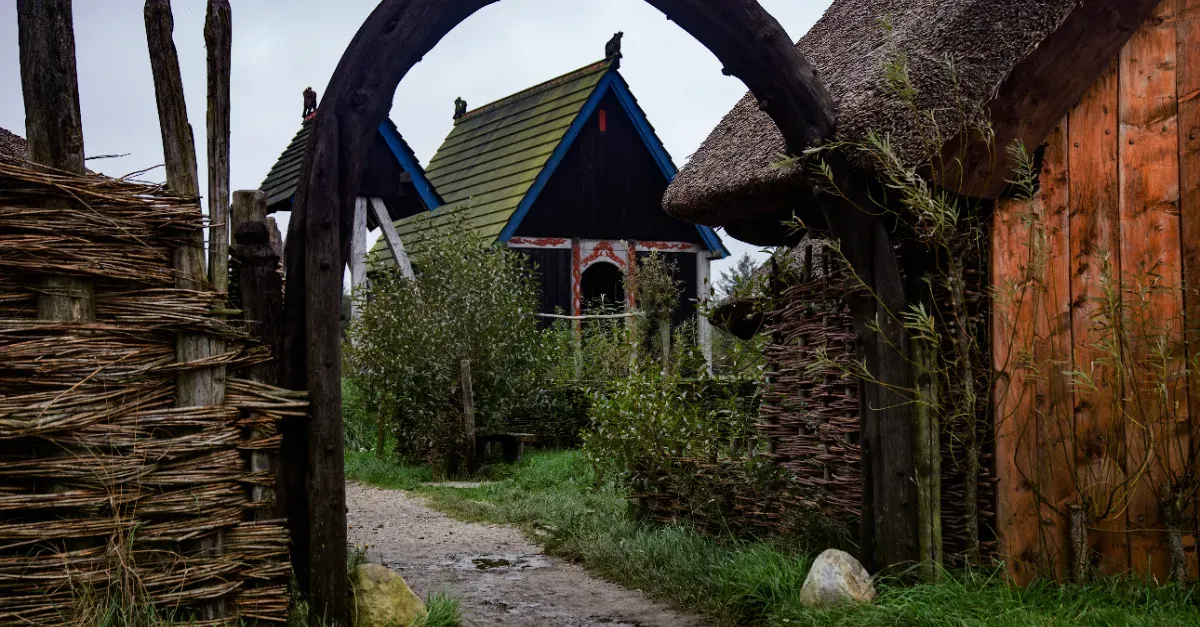
Until then, a ‘museum’ was generally understood to be an enclosed place, separate from the outside world, which one had to cross a threshold to enter; a ‘museum’ was certainly not a portion of territory: the idea of turning an entire area, without walls and in plain sight, into a museum was, in this sense, revolutionary.
Thus began the preservation of all those areas that carried important testimony of the past, reflecting traditional, historical and cultural living environments, with a view to protecting the landscape and traditions, for a more ecological society that could rediscover its own origins.
Ecomuseums: museums for a more ecological society
The term ‘ecomuseum’ was coined for these types of museum. It designates a museum no longer enclosed within four walls but spread over an entire territorial area, which has not only visitors but also inhabitants, and which reflects a community. As Georges Henri Rivière, the famous French museologist who reflected at length on the ecomuseum, wrote in 1985:
“The concept of the ecomuseum proposes a model of museum without boundaries: to be lived in rather than visited. A mirror in which the local population seeks an explanation of the territory to which it is bound. It is an expression of man and nature, and places man in his natural environment.”
With the ecomuseum, the world of culture responded to the need to reconnect with nature and traditions in a society to which the effects of industry were, unfortunately, beginning to be all too well known. Rediscovering the link with the past, with slower rhythms and with more ecological and sustainable ways of living is the aim of the ecomuseum.
From the 1970s onwards, a great many ecomuseums have sprung up across Europe: besides being places where one can admire traditional homes, historic buildings and evidence of past ways of life, they are also research centres on the territory they represent and its traditions. They also organise numerous activities that raise public awareness of respect for the environment in which people live. Several ecomuseums can also be found in Italy: let us look at a few examples.
The Ecomuseo delle Case di Terra of Villa Ficana
The Ecomuseo delle Case di Terra of Villa Ficana is located in Macerata, in the Marche, and is an entire neighbourhood of houses built from earth and straw during the 19th century (Ecomuseo Villa Ficana). The village fortunately escaped the rampant concrete development that devastated much of our country in the past, and reflects the history of the community of farmers who lived there.
Through educational workshops, guided tours and research and awareness-raising activities aimed at visitors of all ages, the Villa Ficana Ecomuseum sets out to protect and enhance the environmental, historical and cultural resources of the area, in order to promote sustainable local development.
The earth-and-straw houses of the Macerata ecomuseum are, moreover, a perfect example of vernacular architecture in Italy, and show how in the past very little was needed to build efficient, sustainable and long-lasting buildings. In short, they offer valuable inspiration for the architectural experiments of the future, which sometimes positively recover the link with tradition and with the territory.
The Ecomuseo della Valle d’Itria
The Ecomuseo della Valle d’Itria, the famous valley of the trulli in Puglia, also aims to preserve and enhance the cultural identity of the local community, in order to guide its development according to principles of sustainability and participation (Ecomuseo Valle d'Itria).
The activities the ecomuseum carries out are varied: through seminars, conferences, exhibitions and information campaigns, for example, it carries out research and promotes the historical and cultural roots of the Valle d’Itria and its inhabitants. There are also educational workshops for schools; guided tours; initiatives for adults aimed at raising awareness of the need for eco-sustainable tourism that respects the territory and its traditions; restoration and enhancement of ancient living environments; and, finally, work to recover traditional agricultural products and local crafts.
Ultimately, these open-air museums have revolutionised the way we understand the museum, which from an enclosed and elitist place has become an open and lived-in one, capable of reflecting a community and a territory in a participatory way, highlighting traditions, history and the natural environment.
Born as a response to the problems industry caused for the environment, ecomuseums have become genuine outposts for raising awareness of ecology and sustainable development, places that protect local resources and value the past and traditions.