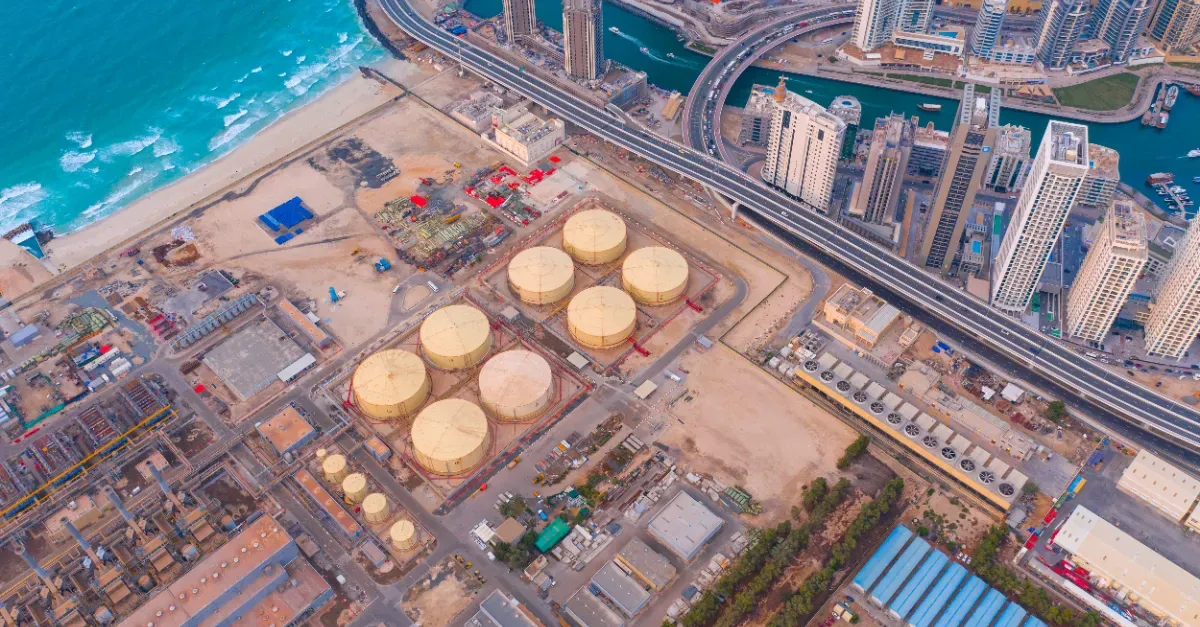
Leading the ranking of oil exports today is Saudi Arabia, with a total value of 138 billion dollars a year (2021 figure), a share representing 14.5% of the total.
It is followed by Russia (113 billion and 11%) and Canada (81.2 billion dollars and 8.5% of the total). Then comes Iraq (72 billion and 7.6% of the market), and right behind it the United States (67.6 billion dollars and 7.1%).
In sixth place are the United Arab Emirates: 58.5 billion and 6.2% of the market.
Those who have added it all up have no doubts: according to the Observatory of Economic Complexity, oil was the world’s best-selling product in 2021, with trade worth 951 billion dollars.
If we turn to the ranking of total greenhouse gas emissions, we find more or less the same nations on the podium – so to speak. The United States and China lead the ranking by a wide margin, with the latter first overall for total greenhouse gas emissions. But just below them we find (after India) Russia, the Arab countries and Canada too. Among the big emitters, Brazil also holds a notable place and, after Azerbaijan (another fossil fuel producer), will host Cop30 in 2025…
Al Jaber’s “proposal”
In the text being circulated these hours by the Cop28 presidency, however, the solution to all problems magically appears.
Namely the call to accelerate the development of “abatement and removal technologies, including carbon capture, utilisation and storage”.
If it is possible to capture the CO2 produced by burning oil and put it underground, why keep worrying about no longer having to use it? In the pavilion of Saudi Crown Prince Mohammed bin Salman, visitors could admire a model of carbon capture that was truly a jewel. But it was a model.
And in reality?
What is carbon capture?
Carbon capture is a technology used to remove carbon dioxide from the atmosphere or from gases emitted in industrial processes.
The aim of these technologies is to halt or at least mitigate climate change and cut the greenhouse gas emissions released into the atmosphere.
Carbon capture can be achieved through several strategies.
Types of CO2 capture
Pre-combustion technology makes it possible to sequester carbon dioxide before the fossil fuel is burned.
With this technique, carbon capture takes place after the combustion of fossil gases, in a process with five stages.
Oxy-fuel combustion technology is a process that involves burning fossil fuels in an oxygen-rich environment.
- Chemical looping combustion
The fourth and last carbon capture technology is “chemical looping combustion”.
This gas combustion technology removes the need for costly separation of carbon dioxide and simplifies the overall process.
Types of carbon dioxide utilisation and storage
Carbon capture processes can be used as a carbon offset strategy, thus giving rise to carbon credits.
- CCS Carbon Capture and Storage
Carbon Capture and Storage is a set of technologies divided into three stages: capture, transport and storage.
- CCU Carbon Capture Utilisation
CCU, also known as CO2 capture and utilisation, is a process that involves capturing carbon dioxide from the atmosphere or from industrial sources and using it for new products.
- CCUS Carbon Capture Utilisation and Storage
CCUS, or Carbon Capture Utilisation and Storage, is a comprehensive approach to carbon management.
Compared with classic CCS, in this strategy, once the CO2 has been captured, it can be stored or used.
CCUS extends the approach by including, besides underground storage, the possibility of use within industrial processes.
- BECCS Bioenergy with Carbon Capture and Storage
BECCS, bioenergy with carbon capture and storage, combines bioenergy with carbon capture and storage. The aim is to achieve a negative CO2 emissions balance, capturing more CO2 than is emitted.
The problems with carbon capture and storage (CCS)
CCUS technologies have the potential to capture over 90% of CO2 emissions within plants.
But there are several significant problems:
- the first problem is the high cost of installing and running these technologies;
- the second problem is the heavy energy consumption, which leads to high costs and a potential increase in CO2 emissions;
- the third problem is potential leaks from the capture process or from storage in natural reservoirs;
- a further problem is the availability of storage sites, which in some areas could be limited and could cause geological problems;
- finally, and most importantly and decisively, CCS needs a long time to be developed on a large scale and may not be sufficient for the climate emergency we are experiencing.