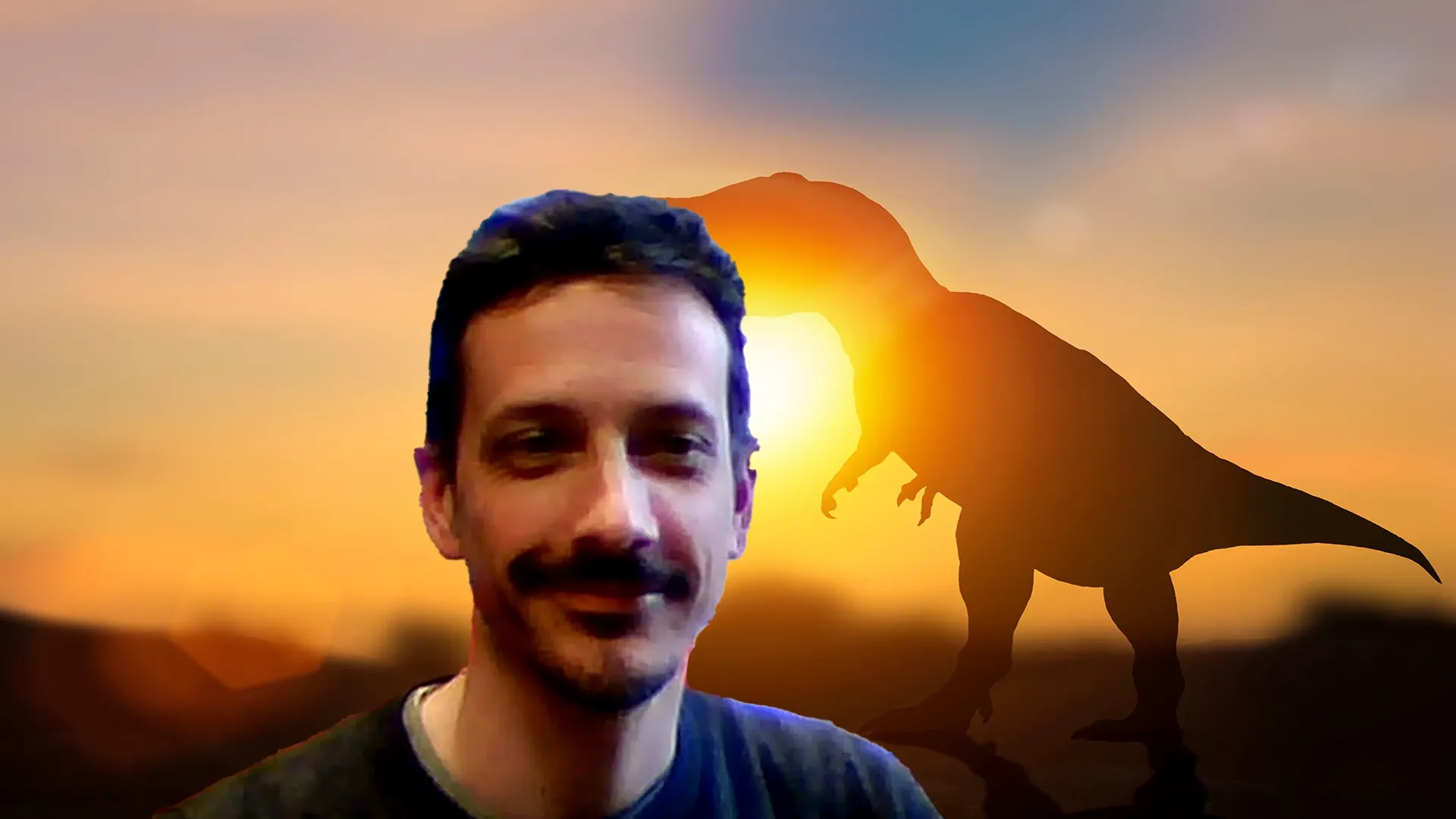
Professor Fanti also explores the role of adaptation and survival, discussing how some species managed to overcome these global crises and what we can learn from them. He highlights the importance of studying not only extinct species but also those that survived, thus offering valuable lessons on resilience and adaptation.
Another aspect of the interview is the inability of modern humans to adapt quickly to environmental change. Fanti criticises the current human approach, which often relies on justifications and procrastination rather than concrete action. This attitude, in his view, could lead to worrying consequences for humanity and for the planet. This is what he calls bargaining with the planet.
The interview ends with a reflection on the role of artificial intelligence and modern science in managing and interpreting large environmental datasets. Fanti emphasises the importance of the human role in science, arguing that despite the advantages of technology, responsibility and scientific integrity remain essential.
Below is the full transcript of the interview:
Alessandro Di Nuzzo: Good morning, Professor Federico Fanti. Thank you for accepting our invitation to Greentomeet.
Federico Fanti: Good morning. Good morning to you, thank you for the invitation.
Alessandro Di Nuzzo: Federico Fanti is an associate professor, geologist and palaeontologist at the Department of Biological, Geological and Environmental Sciences of the University of Bologna. So, Professor, I'll start straight away with a rather point-blank question. Is the sixth extinction under way or not? Is it real or just a hypothesis?
Federico Fanti: A question that goes straight to the heart of the matter. The quickest answer I can give is yes, the sixth mass extinction is real. We scientists say so because all the information, the monitoring and the concrete data we obtain by observing our planet give us very clear and unequivocal signals.
My approach, perhaps different from that of colleagues more focused on the future, is to support these interpretations with the view of a geologist and palaeontologist, looking back in time. As is rightly said, the heart of it is the sixth mass extinction, and we often forget that it was neither the first nor the second, but the sixth. There have already been five great extinctions that brought life on our planet to the brink.
People in my line of work are interested in these great past extinctions for two reasons. First, whenever we face epochal events such as mass extinctions, it is essential to understand what happened and which natural mechanisms triggered them. These events, which can also be called biological crises, affect all the creatures living on the planet. The second aspect, which I find even more interesting, is understanding not only who became extinct and who lost these challenges, but who survived.
This is particularly topical and concrete, because if, faced with adversities that wiped out hundreds of thousands of species, someone survived, then it might be useful to try to understand who made it, what their characteristics were and what strokes of luck they had.
By studying the past, we can quantify the damage that this extinction is doing to our planet and to ourselves. We do not talk about extinction to be alarmist, but because it is a documented natural event that can be compared with what has already happened on the planet, with the addition of a new element: human beings.
Alessandro Di Nuzzo: Professor, you often use three key words to describe three fundamental phenomena in these evolutionary processes: adapt, move or become extinct. Is it possible today for the human species to adapt to these extraordinary changes under way?
Federico Fanti: Here I give my personal opinion, combined with a little science. I believe that humans are one of the few species that is no longer able to adapt, having chosen another philosophy: bargaining. Humans are good at finding excuses and justifications and at procrastinating, so they bargain. This approach may work in our society, perhaps at a local, small scale, but the problem arises when humans try to bargain with planet Earth, which simply cannot work. It is like bargaining with someone who does not listen to you and who has their own rules.
The fortune and success of our species are tied to the ability to adapt, that is, to seize opportunities, to realise that there was something else out there, to start moving and finding new resources. At first we did this very well, benefiting from what the planet could offer us without having a negative impact on it.
However, after a tipping point, for every gain our species makes, the planet suffers very serious effects, making adaptation more and more difficult. For human beings, adapting would mean giving up things they care about, such as a certain kind of wellbeing, comfort, investments and money. Humans can adapt, like all the species on the planet, and they boast of being the most intelligent species and of having understood all the mechanisms. The problem is that when it comes to doing it, to compromising and therefore giving something up, it is hard.
This current situation, in which we have the tools and the knowledge but the application of good practice seems to be lacking, brings us to the other two words mentioned earlier. If we are unable to adapt, we move, looking for other forms of mitigation. Never before have we seen the human race moving across the whole planet, not for fun, but for sheer survival. This is a way of bargaining, mitigating and finding temporary solutions.
The end we all try to avoid is extinction, that is, paying the price for not having given anything up, improved or done anything. Sooner or later someone will demand a price. And planet Earth, not out of malice but for simple reasons of balance sheets, cannot always provide for everything and for everyone.
Alessandro Di Nuzzo: Professor, you are a palaeontologist as well as a geologist, right? Is palaeontology today still the discipline that deals with dinosaurs and species from a hundred million years ago, or are there new paths?
Federico Fanti: As far as I am concerned, palaeontology, which is my profession, at least I hope it is, can be divided into two fronts. One of them, paradoxically, has remained unchanged over time and is fascinating: it is the collection of data, the exploration, the search for and discovery of finds. Why? Because fossils, that is, the mineralised remains of living organisms of the past, are not found where we want them, but have to be sought out and won. Every time a new fossil is discovered, a new page opens to help us better understand our history. This is the phase I am most passionate about, since it is fascinating and provides the material needed to start real scientific research.
The other part of palaeontology is completely different. It is one of the disciplines that, in my view, has evolved the most within the sciences in general, thanks to new technologies, recent discoveries and brilliant contributions. We can now study the animals of the past, which lived millions or billions of years ago, with the same approach we use to study today's animals.
This is fundamental not only for unveiling the mysteries of individual animals, but also for understanding the challenges humanity is facing today. Palaeontology provides an essential archive that allows us to compare data from the past with current data, rather than basing our predictions on intuition. This is particularly useful when tackling current and urgent challenges, such as the present documented threat of extinction.
Federico Fanti: Exactly. The last time the planet found itself in a similar situation was during the fifth mass extinction, about 66 million years ago, which caused the disappearance of the dinosaurs. It is important to note that this extinction was caused by the impact of an asteroid 10-12 km in diameter, which makes us realise how serious the consequences of such events can be. The fifth mass extinction forced the planet and all forms of life to adapt quickly, find solutions or become extinct, as in the case of the dinosaurs.
Today we are facing a similar situation, albeit spread out over time, but the effects can be just as devastating. We should reflect on this idea: at the moment, we are faced with a situation as serious as that of the mass extinctions of the past.
Alessandro Di Nuzzo: Professor, how do you see the young people you meet in your teaching? Do you notice in them a will and a projection towards the future?
Federico Fanti: I am fortunate to work with young people who have consciously chosen to pursue a very specific and demanding career, which is not accidental. This shows strong motivation. Today's young people are very competent and sharp, and have access to a highly connected world, which makes them competitive and well informed about the issues in their discipline. They are also aware of the importance of communication in science and know how to critically evaluate information coming from the media.
This is a crucial aspect, since communication is fundamental to the impact of their research. Some of them stand out for their ability to maintain integrity and consistency in their positions, avoiding giving in to pressure to solve everything quickly. Direct dialogue and face-to-face discussion are values I particularly appreciate, because they highlight the competence of those who know how to face challenges responsibly.
Alessandro Di Nuzzo: Professor Fanti, can artificial intelligence make a significant contribution, in your view?
Federico Fanti: From a data-processing point of view, the management of so-called Big Data, that is, enormous datasets covering long periods of time, has certainly been a great help in our work. It has made our lives considerably easier, making more efficient analyses that in the past required months or years of work.
However, when it comes to the interpretation of data, I have some reservations about the excessive use of artificial intelligence. In my view, the role of the scientist is fundamental when it comes to discussing and interpreting research results. Personally, I believe it is important to get involved and to separate the raw results from the interpretive and communicative processes.
In this context, I believe that artificial intelligence has a limited role and should be used with caution. We should not rely on it entirely, offloading the personal responsibility that every scientist must take on when communicating a concept or defending a position. Science should not be based on results alone, but also on asking the right questions and moving forward in the search for information that is useful to everyone. I therefore believe that artificial intelligence should be used only to a limited extent in the sciences.
Alessandro Di Nuzzo: Thank you, Professor Fanti, for your valuable opinions and your contribution. It was a pleasure to have you on Greentomeet.
Federico Fanti: Thank you, the pleasure was mine.