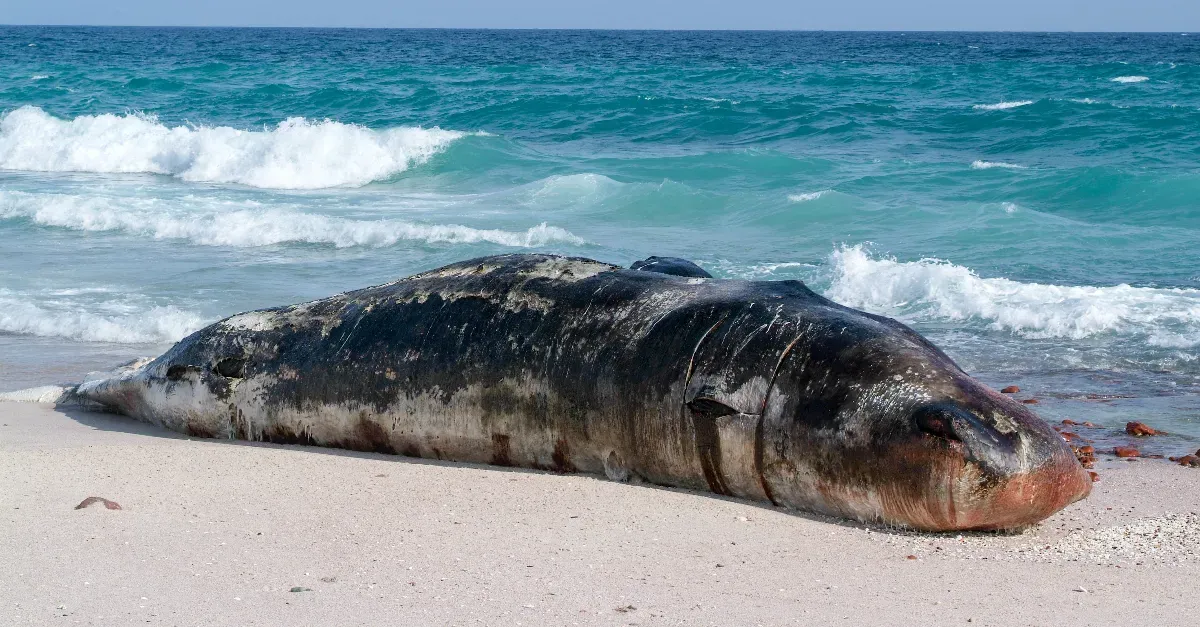
The pilot whales stranded in Scotland. A tragedy still without certainty over the causes
Certainly one of the most distressing sights of summer 2023. 55 pilot whales stranded on the coast of the Hebrides and then put down. Natural causes, or is there more to it?
Pilot whales stranded in Scotland: this too is undoubtedly one of the tragedies of summer 2023.
The 50 or more whales (to be precise, pilot whales) that died in a mass stranding on the Isle of Lewis in Scotland are a sad sight that has shocked and moved many television news viewers around the world.
At around 7 am on Sunday 16 July, marine rescuers called out to Traigh Mhor, a long strip of coastal sand (the name means ‘big beach’) on the Isle of Lewis (Outer Hebrides), were confronted with a dramatic sight.
Initial reports suggested that there were about 55 stranded whales. It soon emerged that only 15 were still alive.
The charity British Divers Marine Life Rescue (BDMLR) tried to refloat two of the whales that still seemed able to move. One managed to return to the sea. The other became stuck again after a short time and died, as did three others.
The animals were so-called ‘pilot’ whales. They are in fact large oceanic dolphins, which according to experts are the cetacean species most prone to mass strandings.
The most dramatic event, however, was yet to come. At around 3.30 pm it was decided that the remaining whales would be put down. ‘Considering how long the pilot whales had been out of the water, in addition to their very poor condition,’ the vets explained, ‘it was decided that they should be euthanised for their own good.’
Show moreShow less
The question of what caused the stranding was immediately raised. BDMLR officials stated that one of the dead whales appeared to have had a vaginal prolapse, so it is suspected that the entire pod became stranded because of a female giving birth. ‘Pilot whales are famous for their strong social bonds,’ they explained, ‘so often when one whale is in difficulty and strands, the rest follow.’
In a climate of military alert due to the war in Ukraine, however, many were reminded of studies carried out in recent years that have established a link between cetacean strandings and the activity of military sonar.
In the study ‘Blue whales respond to simulated mid-frequency military sonar’, published in 2013 and in which NATO’s own Sto-Creme of La Spezia took part, the team of researchers (American and British) noted that ‘mid-frequency military sonars (1-10 kHz) have been associated with lethal mass strandings of deep-diving toothed whales’, although they specified that ‘the effects on the extinction risk of baleen whale species are practically unknown’.
Was it useful? Pass it on to someoneSharing an investigation is worth more than a like.