It is not easy to give a clear and unequivocal answer to the question of who the first Italian environmentalists were. If, however, we speak of movements and associations for the defence of nature and the environment, then the historical picture becomes more precise, and it is possible to answer with a certain confidence.
The palm for the first environmental movement in our country undoubtedly goes to the Movimento Italiano per la Protezione della Natura (Italian Movement for the Protection of Nature), which arose in the immediate post-war period through the work of some genuine ‘pioneers’ of Italian ecologism: first among them, a figure insufficiently appreciated in contemporary Italian history – indeed, far too little known – Renzo Videsott.
Let us, then, try to get to know him a little better.
Veterinarian. Mountaineer. And hunter (until his conversion)
Renzo Videsott was born in Trento in 1904. In 1928 he graduated in Veterinary Medicine from the University of Turin. Ten years later, he obtained the libera docenza (university teaching qualification) in Special Pathology and Veterinary Clinical Medicine and the chair of Veterinary Pharmacology, which he held for 12 years. In 1943 he was appointed Director of the Institute of Pathology and Veterinary Clinical Medicine.
Show moreShow less
But his brilliant university career would not last until the end of his working life. In 1951, Videsott gave up all academic activity: his full-time ‘job’ had become something else. That of running the creation he had wanted with all his strength and not without great difficulty: the Gran Paradiso National Park.
The environment and the mountains, besides his love for animals, are the great passions of his life. The mountains, in fact, are far more than a passion. From 1922 Renzo was a member of the S.A.T. (Società Alpinisti Tridentini), and later became president of the S.U.S.A.T. (the university section of the S.A.T.). For the young Videsott was a great mountaineer, one of the best rock climbers of his generation. From the age of eighteen, Renzo climbed alone or in the company of names such as Domenico Rudatis, Pino Prati, Raffaello Prati, Giorgio Graffer and others. He was among the first in Italy to overcome the difficulties of grade VI; many of his ascents went down in the history of Italian mountaineering, such as the north-west ridge of the Busazza in the Civetta group, 1,100 metres of climbing.
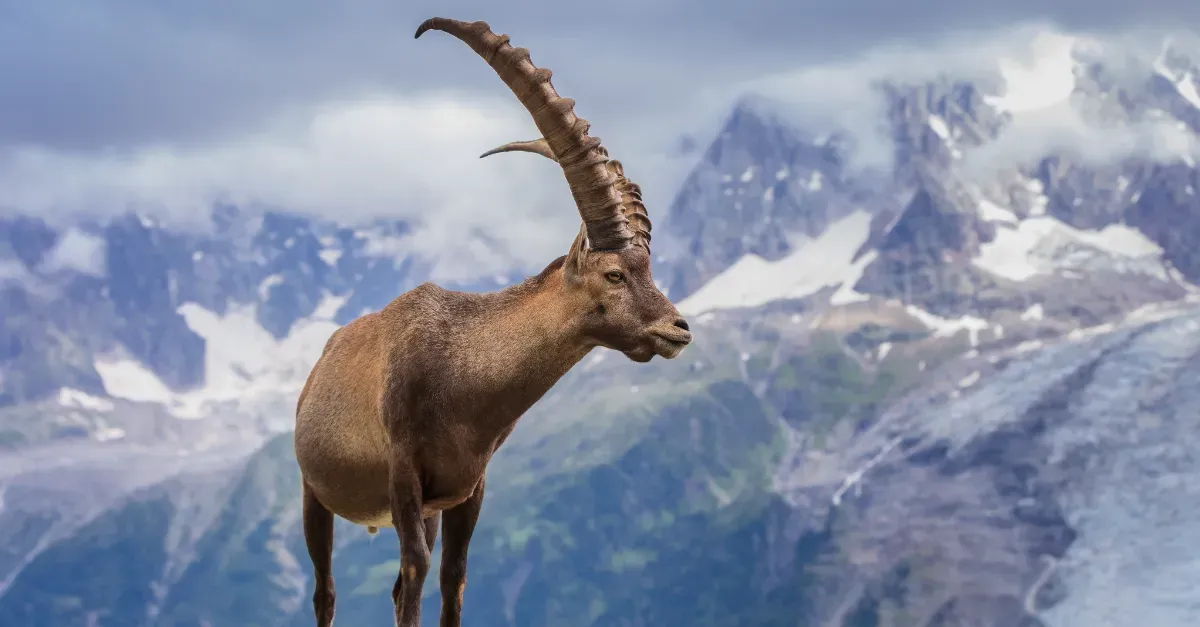
Years later, Videsott would admit the close link between his climbing and the formation of his environmental awareness: ‘Only because I had committed myself fully to new routes in the Dolomites did I then commit myself fully to the ibex species and to the establishment of the park.’
In his youth, Renzo was also a keen hunter. He would later write of himself: ‘From the age of 6 to 23 he killed high-mountain game; from 23 to 30 he specialised in exterminating chamois; but after 1947 I never killed a single animal in the high mountains.’
Renzo’s ‘conversion’
It is Videsott himself who recounts the ‘conversion’ of the hunter to the absolute protection of mountain fauna and of all the planet’s species, in moving words and images.
‘Few have, as I have, cut short the magical skill of the surviving chamois or the innocence of the roe deer browsing in the darkest wood,’ he would confess himself once he had put off the hunter’s garb.
In his diaries, Videsott relates that his fall on the road to Damascus took place on the Fanes plateau, in Trentino: a chamois he had mortally wounded stared at him intently before ending its life propped against a larch. ‘The gaze of that mortally wounded animal revealed the murderer in the man, and extinguished in him for ever all greed, pride, competitive drive, and the vanity of killing an animal of whatever class or size’ (Prati, 1972).
In 1942–1943 Renzo was in fact manager of the hunting reserve of the Milanese industrialist De Angeli, located in Marebbe in South Tyrol: there he had managed to bring 3 male and 1 female ibex from the Gran Paradiso.
With the occupation by the German army, Videsott was driven out of the reserve. He then moved to the Gran Paradiso, where he began, in secret, his campaign to save the ibex.
In 1943, however, the Aosta Valley–Piedmont massif was also a partisan zone. Thus Videsott had the extraordinary (and extremely risky) opportunity of combining two forms of militancy: one for the environment and one for freedom.
From 1943 until 1947 Renzo organised a surveillance service for the protection of the fauna and the ibex, together with a group of wardens, naturally in complete secrecy and at grave personal risk.
In 1945, at the Liberation, Videsott was appointed by the C.L.N. (National Liberation Committee) Extraordinary Commissioner of the Gran Paradiso National Park. Resistance to his activity began even then: it came first of all from the Allied Command, which did not want to recognise his appointment.
Amid so many difficulties, Videsott could nevertheless count on a group of friends, many of them inspired by his own ideals. In the Aosta Valley there were Carlo Passerin d’Entrèves, Severino Caveri, Federico Chabod (with whom Videsott would maintain an intense correspondence for years), Paul-Alphonse Farinet, Ernesto Page, Renato Nouchy, Celestino Dayné and others.
His relationship with Caveri, President of the autonomous Region, would be important in securing approval (not without difficulty and a laborious process) of the historic law of 1947, which established the Ente autonomo Parco Nazionale Gran Paradiso. It was a total refounding of the Park’s direction and purposes, as under Fascism all its premises had been ignored since its creation in 1922, leading, among other things, to the near disappearance of the ibex.
Videsott was appointed its Vice-President and Technical Director; in 1951 he would be appointed Superintendent Director of the park, a post he held until 1969.
An Italian among the fathers of (international) environmentalism
If we wished to summarise in a few lines the vast conservation work of Renzo Videsott, we would immediately discover that the essential points of this environmental ‘curriculum’ all correspond to battles he undertook, often against interests of various kinds and amid the incomprehension of many. The rescue of the ibex species in the Graian Alps, in the last place in the Alps where it still lived in the wild. The re-establishment of the Ente autonomo Parco Nazionale del Gran Paradiso. The many initiatives undertaken for Italian national parks, with reports, petitions, articles and speeches in favour of the parks. His part in the founding of the Union Internationale pour la Protection de la Nature. His work for the protection of birds.
And much more besides, over the decades of an extremely full life. That is enough to agree with those who place Renzo Videsott’s name among the great pioneers of nature protection not only in Italy but throughout the world: from Aldo Leopold to Julian Huxley, Rachel Carson, Jean Dorst and Aurelio Peccei.
What a national park is
We almost certainly owe to Renzo Videsott the clear definition of the nature and identity of what we are now used to calling a ‘national park’, which for many decades was a concept far from obvious (and even less widely shared).
‘Since 1943 I have based my activity on respect for the concept of the National Park,’ Videsott explained, ‘that is, of this institution created for the conservation and defence of nature and its resources, a concept that should admit no compromise of any kind.’ Without compromise: this means facing openly the inevitable struggles that the affirmation of such a reality imposes on those who devote their lives to it. ‘The park is a place where one fights, suffers and wins for the concrete protection of nature’ is one of his famous sayings.
In December 1945, Videsott wrote about the ‘philosophy’ of a Park: ‘We moderns desire small oases in the world, in which man is not the corrector of natural forces (…). In this way there will arise in us a renewed love for nature, and it is precisely this loving return to mother nature that is a path to the regeneration of mankind. Only thus will truth and the spirit prevail over the present false idol, which is human materialism, which through the machine, numbers and watertight categories leads to absurdity and death.’
A park that is well organised and run with clarity of purpose, according to Videsott, does not depress but rather enhances the economy of the mountain area. It supplements municipal budgets, helps to combat mountain depopulation, contributes to the pasture–forest–mountain system, promotes mountaineering aspirations, and is an ally of the law enforcement forces in controlling difficult terrain.
In 1955 Renzo Videsott organised in Cogne the 1st international congress of administrators and directors of national parks, with the participation of experts from Italy, France, Switzerland and Austria. His introductory report is still today a cornerstone of the theory and practice of national parks. On the one hand, he pointed out the obstacles and negative aspects: the fact that parks do not own their own land; the impossibility of complete leaseholds; the pressure of local populations on the establishment of parks. To overcome these problems, Videsott proposed, for the first time in Italy, an idea that would be fundamental in the future management of parks: zoning, that is, ‘the adaptation of various zones within the national park, in relation to naturalistic studies, visitors and local mountain people’. He suggested scientific zones, zones of regulated tourism, and pre-park zones divided into tourist pre-park, hunting pre-park and biological pre-park.
An obstacle course
Videsott faced many struggles and sufferings to give life to his creation. In 1951, shortly after the arduous gestation of the Park, Renzo was spectacularly stripped by the park Council of the task of defending the Valsavaranche from the construction of the power line by the Consorzio del Buthier, despite an international ruling, obtained thanks to his efforts, by the assembly of the International Union for the Protection of Nature in Brussels.
In 1969 his management came under violent attack from some local councillors, which forced him to resign early. From then began long years of damnatio memoriae of his figure and of his decisive work for the Park, which has found redress only in recent decades. A common fate, this, for many environmental activists, especially in our country.
The Movimento italiano per la Protezione della Natura
And so we come to the subject with which we opened this article: the birth of the first environmental movement in Italy. Proto-environmentalist associations arose spontaneously in Italy as early as the end of the 19th century. They were, however, groups made up of scientists with strictly naturalistic aims, or of personalities who wished to promote tourism in an area, mostly mountainous. They lacked a clear environmentalist approach: Fascism, moreover, with the centralisation of local functions in the state apparatus, in effect extinguished or emptied of meaning every initiative (as happened with the Gran Paradiso Park, see above).
It can be said that the need for a conservationist and environmentalist association in Italy had, on the contrary, been very present in Videsott’s mind since his youth, and that it should be modelled on those that already existed in almost all other countries of Europe and the world.
It was in 1947 that the intention became concrete, when Videsott took part in the International Conference for the Protection of Nature in Brunnen (Switzerland), representing the Regional Council of Valle d’Aosta, the Società degli Amici del Paesaggio and the International Committee for Bird Protection, Italian Section.
The following year, 1948, would see the birth of an international organisation for the protection of nature at the historic conference in Fontainebleau. Renzo Videsott therefore devoted himself, with all his strength as always, to creating an Italian association that could rightfully sit alongside the others at that important gathering.
On 29 May 1948 Videsott was finally able to send out the official invitation for the founding of the Movement. It was a historic event that would take place in two stages: a preliminary meeting at Oreno on 24 June, in the park of Villa Gallarati Scotti, and the founding assembly at Sarre Castle in the Aosta Valley on the following day, 25 June. Here too there was no shortage of controversy and outright clashes: such as the one between Renzo and Guido Bertarelli (representing the Touring Club Italiano), who had a very different conception of parks.
The founding assembly at Sarre Castle was, however, a moment of great unity and ideal fervour. Those taking part included people from Valle d’Aosta such as Jules Brocherel, Albert Deffeyes and Mario Stévenin; from Piedmont such as Fausto Penati and Celestino Durando; and from Trentino such as Renzo Videsott, his brother Paolo (another figure of extraordinary human and ethical worth), Benedetto Bonapace, Raffaello Prati, Fausto Stefenelli, Bruno Betta and Nino Betta. In all, there were 12 people. Almost all of them were teachers: of science, literature and philosophy, economics and music education, as well as university lecturers in medicine and veterinary science. The others were writers and officials of public and private bodies.
The Movimento Italiano per la Protezione della Natura lasted until 1953, with sections in Turin, Milan, Trento and Vicenza. When the Turin Section decided to change its name to Pro Natura (which later contributed to the establishment of Federnatura), the Movement practically vanished from the national scene, with only the Trento Section surviving until 1971.
Shortly afterwards, in 1955, a group of intellectuals including Umberto Zanotti Bianco, Elena Croce, Desideria Pasolini dall’Onda and Antonio Cederna would found the association Italia Nostra in Rome. The path of Italian environmentalism was by now laid out.
For those who wish to read further:
Primo di cordata. Renzo Videsott dal sesto grado alla protezione della natura. Luigi Piccioni, 2010, forewords by Armando Aste and Fulco Pratesi.