Back in the 19th century, the treaty granted the Māori tribes rights and protections over their land in exchange for ceding government to the British Crown. A sort of “compensation” for the loss of sovereignty and at the same time a form, albeit a very partial one, of recognition of autonomy.
Today’s bill aims to extend these rights to all citizens. It comes from the ACT party – a “libertarian and free-market” formation that is part of the centre-right governing coalition – with the aim of cancelling established principles in favour of a total redefinition of them.
Hence the anger of the Māori communities.
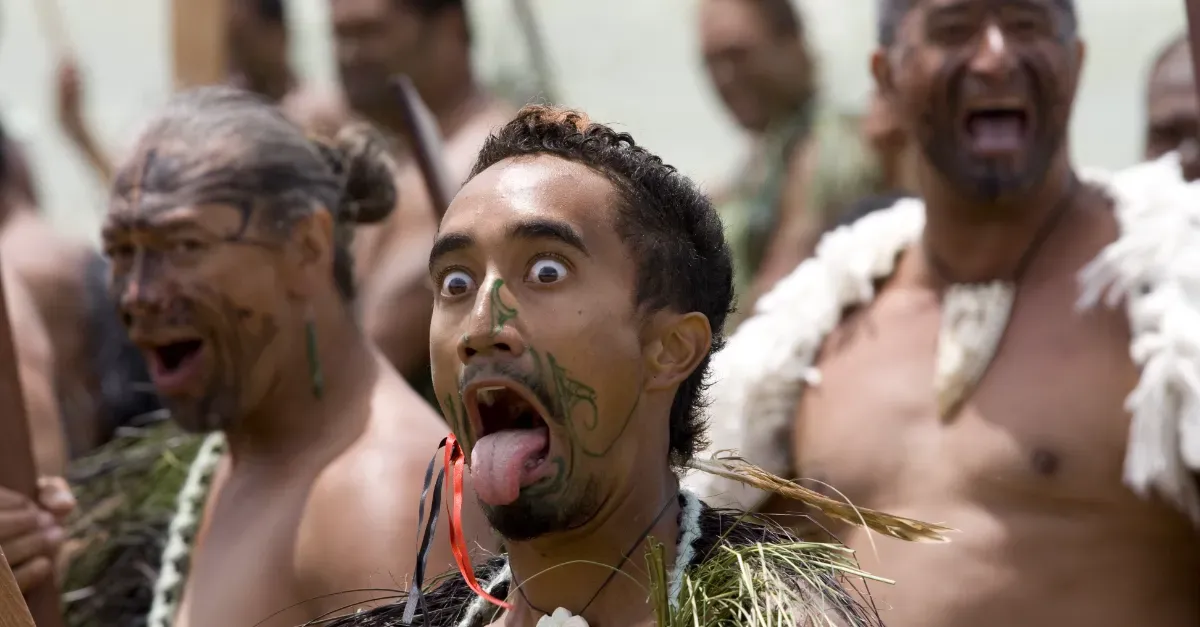
Two MPs were expelled and the session was suspended. But the haka continued to echo in the chamber.
Not only that. The striking demonstration gave rise to a large procession: indeed, a genuine nine-day march towards Wellington, due to end with a major demonstration.
The protest march, one of the largest in New Zealand’s history, reached Parliament on Tuesday: according to the organisers, it was an extraordinary demonstration of unity. New Zealand police estimated the turnout at 42,000 people, but according to the organisers there were many more.
When the first group of protesters reached Parliament, the crowd stretched for about 2 km across the whole city. Everywhere there were the red, white and black of the Māori national flag.
The placards raised called on the government to continue to honour the treaty and to “kill the bill”. Chants and hakas filled the streets throughout the march.
“Today the Māori nation was born,” Eru Kapa-Kingi, leader of the protest movement, shouted to the crowd. “Each of you who joined this march today, I hope you realise what you have committed to today. You have committed to a future in which we return to the reality of our rangatira”.
But what does rangatira mean? In the Māori language, the term refers to people of great practical wisdom who held authority (mana) on behalf of the tribe and maintained the boundaries between the land of one tribe and that of other tribes.
In a broad sense, then, returning to the rangatira certainly does not mean regressing to a tribal state, but rather claiming autonomy in the management of the territory, inspired by moral principles of solidarity and good governance rather than the exploitation of land and the subjugation of native peoples.
Among the marchers there were also several non-Māori. The activist Alice Soper explained that the protest concerns not only the bill in question, but the whole range of government policies aimed at rolling back Māori rights: first of all, the abolition of the Māori Health Authority.
“It is a question of power,” she added. “What is at stake here is not only Māori rights, but those of all of us”.
Among the protesters, the presence of the Māori queen, Nga Wai hono i te po, stood out. Aged 27 and recently succeeded her father, Ngā Wai hono i te pō is the second queen in Māori history and is already at the forefront of defending her people’s rights against what many regard as an operation to scale them back, devised around the tables of politics.
“The Māori queen is willing to help lead a conversation about the nation and national unity,” said her spokesman, Ngira Simmons. “But she will not accept a one-sided process that undermines the treaty”.
Video sources:
CLICK HERE TO WATCH THE VIDEO OF THE MĀORI PROTEST