‘The Little Prince’: not only a masterpiece of poetry and storytelling, but also a ‘green’ book. Let’s reread it in a new edition
‘The Little Prince’ is not just a splendid fable-cum-apologue able to ‘bewitch’ child and adult readers alike (it is estimated to have sold no fewer than 150 million copies worldwide).
Anyone who hasn’t read The Little Prince, raise your hand…
Since its publication in 1943, Antoine de Saint-Exupéry’s masterpiece has won over entire generations of readers of every age: it is estimated to have sold no fewer than 150 million copies worldwide.
But beware: the work of the French writer and aviator is not just a splendid fable-cum-apologue able to ‘bewitch’ child and adult readers alike.
It is also – in its own way – a green book, imbued with a very lively sensitivity towards the environment and the care of our planet.
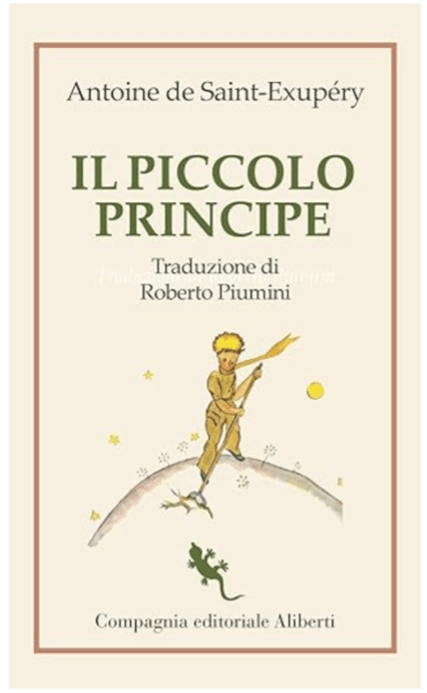
This is recalled by the introduction to a new 2023 edition, now in bookshops, with a translation by Roberto Piumini and an ‘environmental’ introduction by Alessandro Di Nuzzo. It is an invitation to reread it (or to read it to our children) with an ear attentive to the many messages of love for the world we live in that Saint-Exupéry scattered through its pages. What emerges is an incredibly topical, almost prophetic text, which deserves a place among the precursors of environmentalist literature in the strict sense.
Show moreShow less
By kind permission of the publisher, we reproduce below the introduction to the edition.
The Little Prince, translated by Roberto Piumini, Compagnia Editoriale Aliberti, 2023
Introduction by Alessandro Di Nuzzo
‘Quand on a terminé sa toilette du matin, il faut faire soigneusement la toilette de la planète’.
‘When you have finished washing yourself in the morning, you must carefully clean the planet’.
The ‘ecological’ sense of a work like The Little Prince, which does not seem to deal with ecology proper, is probably all in this sentence. If we were to count how many readers of all ages, from 1943 to today and regardless of the number of copies actually sold worldwide (more than two hundred million, so it is said), have served their literary (and sentimental, and human) apprenticeship on these pages, we would almost certainly reach an exorbitant figure, second only to the Bible and – in our view – far greater than the readership of The Lord of the Rings or Harry Potter. For The Little Prince is one of those books you cannot fail to have encountered or come across at least once in your life – perhaps even by chance, whether through a relative, a friend, or some teacher at school or in life. And it is one of those books that, besides binding you to its simple, absolute poetry, made of post-impressionist touches and an almost oriental lightness, ‘conveys’ to you a whole series of messages that we might call educational.
First of all it is a sentimental education. Here, as is universally known, it concerns the care the prince lavishes on his rose: or rather, on Rose with a capital R, since, as emerges from the biographies of the author Saint-Exupéry and his wife Consuelo, the flower is purely symbolic, and is to be identified with a woman of flesh and blood, the Consuelo loved and loathed, honoured and betrayed in real life (‘Les fleurs sont si contradictoires! Mais j’étais trop jeune pour savoir l’aimer’.)
But, if we are talking about care, the message of The Little Prince can easily be extended from the person and the individual ‘you’ to the unity of the whole. And so from the most inspired pages there arises that attitude of respect, of care for nature – for creation, if you like – that makes us speak of an environmentalist and ecological character, in a broad sense of course, in our Prince.
Let us try to list some aspects of it:
the sense of responsibility: which in The Little Prince is essentially responsibility towards a task or towards a person, or both. Do you remember the ‘allumeur’, the lamplighter (if not, turn straight to p. 110 of this book) and his orders? Putting the lamp out and lighting it again, for no other reason than because ‘c’est la consigne’. The little prince respects and admires him more than the powerful figures he has met on his tour of the universe. ‘C’est, peut-être, parce qu’il s’occupe d’autre choses que de soi-même’. The same is naturally true of the protagonist’s beloved rose. ‘C'est le temps que tu as perdu pour ta rose qui fait ta rose si importante’, says the fox. ‘C’est le temps que j’ai perdu pour ma rose, fit le petit prince, afin de se souvenir. Les hommes on oublié cette vérité, dit le renard. Mais tu ne dois pas l’oublier. Tu deviens responsable pour toujours de ce que tu as apprivoisé. Tu es responsable de ta rose’.
the primacy of being over having, above all when having is the fruit of a drive to accumulate and an attachment to material goods (‘Le quatrième planète était celle du businessman…’);
self-awareness (‘Il est bien plus difficile de se juger soi-même que de juger autrui…’);
interconnection, whereby our being is constitutionally made of relationships – with both human and natural elements (the little prince and his rose; the little prince and the fox).
And then, as was recalled at the beginning, there is love for planet Earth, which shines clearly through the poetic images and is the very lyrical substance of the text (‘La Terre n’est pas un planète quleconque!’). It is from this filial love that the moral imperative of cleanliness is born: that is, of care for one’s inner and outer environment, which must be practised first of all by removing impurities, whatever may infest and alter, if not outright destroy, the balance of the good components. Isn’t this the clearly metaphorical meaning of the news that on the Little Prince’s planet the seeds of the baobab are ‘terrible’, and if you do not pull them up, or act too late, the bad plant clutters the whole planet and makes it burst? How can we fail to read in it (beyond the literal interpretation, that of the poor baobab that harms no one) the metaphor of what infests and pollutes our planet through its proliferating and harmful excess… Waste, plastic: take your pick, there are unfortunately many contemporary references to our ill-treated Earth.
Here, then, is the call for ‘cleanliness’: a gesture and a practice that are rightly described as daily and daily necessary. And that start from the self, from one’s own conscience, and move outwards to clean and purify the planet. Or vice versa: the order of the factors does not change the final result.
This, without doubt, is the ecology professed by The Little Prince. An ethical and sentimental solicitude, in which reason and feeling coexist and harmonise in a shared striving for the good. A love for creation, which underlies any environmentalist and green practice. And without which every action becomes mechanical, a pure response to emergency: lacking, therefore, the awareness needed to truly stir the conscience to safeguard everything we have inherited, and which we shall have to pass on to those we love and who will follow us in the adventure of earthly life.