Passages of landscape, nature and starry skies have certainly been present in works of art since the Middle Ages, but they always played a marginal role, as a backdrop to the true subject of the painting. If we look, for example, at the Last Supper that Pietro Lorenzetti of Siena frescoed in the lower basilica at Assisi around the 1320s, we notice a starry sky complete with a crescent moon, which is nonetheless nothing more than a splendid setting for the last meal of the Messiah and the Apostles.
Or again, nobody would dream of saying that the subject of the Birth of Venus, painted in the late fifteenth century by Sandro Botticelli, is the slightly rippled sea behind the goddess, the true protagonist of the work.
It was only in the early seventeenth century that landscape became an autonomous genre in its own right, and moreover one that was immediately much loved and fashionable. There were several reasons for its full establishment; among them, without doubt, the change in taste and in the social position of the artist were crucial.
Compared with the earlier tradition, which laid down rigid rules for the composition of paintings, painters in the modern age began to be freer to experiment. Their work also began to be seen as a liberal art and no longer a mechanical one; artists, until then regarded as artisans, finally became intellectuals and creative figures, whose talent and ideas were respected and celebrated.
Alongside this growing freedom of the artist, there was a change in the taste of collectors who, over the course of the seventeenth century, began to prefer and to request, for their homes, scenes of a more popular and natural character, less moralising, including landscapes and pastoral scenes.
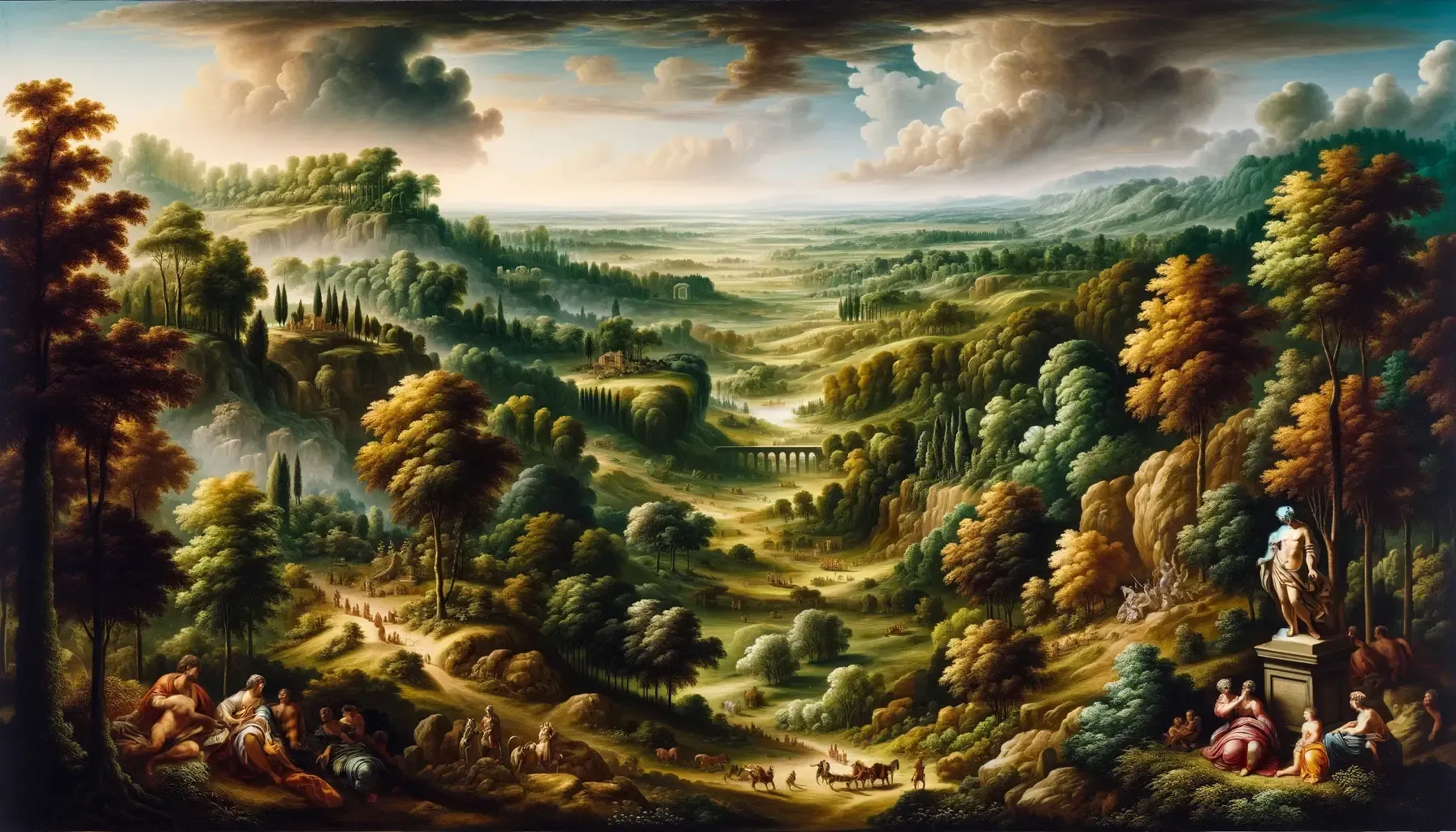
Among the very first brilliant interpreters of this genre in Italy was the Bolognese painter Annibale Carracci (1560-1609), whom Cardinal Pietro Aldobrandini commissioned, in the early years of the seventeenth century, to paint lunettes for the chapel of his Roman palace, now preserved in the Galleria Doria Pamphilj in Rome. Given the setting for which they were intended, they depict biblical scenes, but anyone admiring them can see that something is amiss. The figures appear tiny, overwhelmed by a lush landscape that is none other than the Roman countryside of the time. For the first time, therefore, nature overshadows history, and the figures become a secondary element in a composition dominated by a view that is not idealised but realistic.
After Annibale Carracci’s untimely death, the idea was carried forward by his pupils, such as Guido Reni and Domenichino, who also produced landscapes inspired by the surroundings of Rome, entirely lifelike and of a gentle, poetic character.
This calm, idyllic vision of landscape, promoted by Carracci’s followers, is only one of the many forms the genre took over the course of the seventeenth century. Increasingly sought after and appreciated, it was in fact interpreted in various ways, depending on the differing sensibilities of artists and the demands of the market. Some proposed a more analytical and less bucolic depiction of nature, some continued in a lighter and more delicate tone, creating little pastoral scenes, and others, finally, arrived at the true “veduta”, that is, an exact transposition of what lies before one’s eyes.
The veduta genre enjoyed enormous popularity in eighteenth-century Venice and counted among its greatest exponents Antonio Canal, known as Canaletto (1697-1768). The precision with which the artist set down views of his city on canvas is extreme, to the point that even today, standing before his works, it is possible to recognise churches, streets and palaces. The veduta, after all, is nothing other than a postcard or a photograph from a few centuries ago, which the many foreign travellers journeying through Italy could buy and take with them as a memento of the places they had visited.
Views, landscapes and pastoral idylls were thus appreciated and successful genres which, from the seventeenth century onwards, definitively changed the approach and sensibility towards nature, not only of artists but also of collectors and art lovers. Who knows, perhaps it is also thanks to their legacy that we, still today, are amazed before a panorama or pause to admire the beauty of an unspoiled place?