Telmo Pievani: Nature is bigger than us – The truth about the climate crisis
An unmissable video interview with Telmo Pievani on the climate crisis and ‘cathedral thinking’ as a solution to climate change. But it takes ‘a dose of humility for humanity’."
Telmo Pievani (1970) is a Full Professor in the Department of Biology at the University of Padua, where he holds the first Italian chair in Philosophy of Biological Sciences. In the same department he also teaches Bioethics and Nature Communication.
Since 2016 he has been the Rector’s Delegate for Institutional Communication and Science Communication at the University of Padua. From 2017 to 2019 he was President of the Italian Society of Evolutionary Biology, the first philosopher of science to hold that office. He is a full member of many scientific institutes and academies. After doctoral and post-doctoral studies in the United States, from 2001 to 2012 he worked at the University of Milan-Bicocca.
Since September 2022 Pievani has been the national lead of Spoke 7 (Biodiversity and Society: Communication, education and social impact) of the National Biodiversity Future Centre (National Centre 5 of the PNRR). Pievani’s research focuses on various aspects of biological evolution, including the theory of evolution, biodiversity, anthropology and the epistemology of the life sciences.
Show moreShow less
Among his best-known books are La vita inaspettata. Il fascino di un'evoluzione che non ci aveva previsto (Unexpected life: the appeal of an evolution that did not foresee us), which explores the evolution of life on Earth in a way that is accessible to a wide audience, and Introduzione alla filosofia della biologia (Introduction to the philosophy of biology), a key text for those interested in the philosophy of biological science.
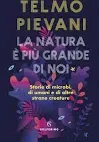
In his latest book, La natura è più grande di noi. Storie di microbi, di umani e di altre strane creature (Solferino, 2022), Pievani writes: “If one day humans were to disappear for some mysterious reason, in a short time the biodiversity of wildlife would take back its spaces”, and adds, “it is a reassuring thought”.
Are we on the threshold of the sixth mass extinction? We discuss it in this video interview that Professor Pievani kindly granted us.
Interview transcript
Alessandro Di Nuzzo: Professor Telmo Pievani, in your latest book, La natura è più grande di noi, you write: “If one day humans were to disappear for some mysterious reason, in a short time the biodiversity of wildlife would take back its spaces. And, you add, it is a reassuring thought”. So, Professor, are we really on the threshold of what they call the sixth extinction?
Telmo Pievani: We know that the human species is in a critical phase of its relationship with the environment. So imagining the absence of the human species is obviously not a wish; I am neither a nihilist nor a misanthrope. On the contrary, it is a provocation, a game that great writers have already played, think of Leopardi’s Operette morali, of Guido Morselli, and many others.
This time, however, we can do it with scientific data: so it is important to understand that the absence of the human species would be entirely irrelevant to the planet, in the sense that nature was not made for us, and evolution was not a long preparation for the arrival of us Homo sapiens. This gives us a good dose of humility, in my view, which is very important for establishing the right environmentalist or ecological attitude too.
We need to understand that nature is bigger than us, that it was here before us and will be here after us. To me this is neither disorienting nor negative, because if you understand that you are not indispensable, you also understand how very lucky you have been, the luck the human species has had to be born on this marvellous planet and to have a chance to know it, to study it, to live, and to pass on its knowledge to later generations. Let us say it is a provocative exercise to encourage a far-sighted ethical commitment for future generations.
Because it is true, we are in the midst of a great extinction of biodiversity. Some metaphorically call it the sixth extinction, because there have already been five very serious ones in the past. In those cases they were due to natural phenomena: asteroid impacts, changes in the Earth’s orbit, volcanic eruptions. That was nature in its violence, in its power, occasionally bringing about these great upheavals that caused the extinction of as much as two thirds of all forms of life.
Something similar is happening now, because if we compare the current rates of extinction, we see that they are equivalent to those of the great extinctions of the past. With two fundamental differences. First, today’s extinction is much faster: the one that wiped out almost all the dinosaurs, except those three families that became birds, lasted thousands of years, 300,000 years. Whereas now this reduction is taking a few decades, a few centuries, so it is happening at a staggering speed never seen before. And second, unlike all those in the past, it is due to the activities of a single species, ours. These are two important differences that we must always keep in mind.
Alessandro Di Nuzzo: In your book you write that pandemics are a chapter of the environmental crisis.
Now, in these years of Covid we actually heard many people who strongly denied this link.
Telmo Pievani: Yes, there is no doubt; the world’s leading scientific journals say so, and they have repeated it many times. Why? Because during the emergency it is clear that what must be done is to tackle the emergency itself: so hygiene, social distancing and so on. After nine months the blessed vaccines arrived and we came out of it, with great suffering and great effort.
Let us always remember that we did not vaccinate everyone, only the richest part of the world; so there is also an element of injustice that must be kept in mind. But now we are making a very serious mistake, which is to forget the deep, ecological reasons for what happened. Because it is true that pandemics have always existed, and always will. They have existed since the Neolithic, because they are linked to contact between animals carrying microbes, viruses and bacteria, and human beings. But let us not forget the other side of the matter: since the 1980s or so, the number of pandemics has increased exponentially.
It cannot be a coincidence. Why have they increased so much? Because there are further reasons that make pandemics more likely. What are these reasons? Deforestation; wet markets, that is, markets where hygiene conditions are dreadful, terrible, with live and dead animals mixed together and bodily fluids mingling, a disaster from the hygiene point of view; the illegal trade in exotic animals; the replacement of forests with plantations. These are all contributing causes that make zoonoses, that is, jumps between species, more likely. So the pandemic has to do with climate change and is yet another symptom of an unhealthy relationship between the human species and the environment.
Let us remember that the probability of another pandemic has not decreased since we came out of the Covid-19 pandemic: it remains the same as it was in 2019. That is why we should learn to be more far-sighted, better at prevention, and not wait every time to be faced with a fait accompli and then find vaccines, but work in advance to reduce the risk of it happening again. And we are not doing this.
Alessandro Di Nuzzo: Professor, you remind us in your book that Italy miraculously remains the country with the highest biodiversity of plants and animals in all of Europe. For millennia we have been a laboratory of diversity. So, tell us three fundamental advantages of biodiversity for our lives, or even four or five.
Telmo Pievani: This is a fundamental subject. First of all, let us remember why we are so lucky: it is not to our credit. We live in a country with astonishing, very high biodiversity, which easily beats that of countries such as France, Germany, even the Nordic countries. Why? Because we are a very particular country. We have two mountain ranges almost perpendicular to each other: this means many ecological barriers, many differences. From the tip of Sicily to the Belluno area we have 132 different ecosystems, which means different soils, different plants, different animals, an enormous and marvellous diversity of ecosystems and therefore of living beings.
And in addition, another reason for marvellous diversity, we are a zone of passage. There have always been migrations, from south, from north, from east to west. So if we put all these ingredients together, the result is a place extremely rich in biodiversity.
And why is this biodiversity so good for us, and why should we not reduce it? For many reasons. First, because it gives us ecosystem services that guarantee our life and our health and that we do not pay for. The nutrients in the soil, soil fertility, the pollinating insects that make possible a large part of our crops, almost two thirds.
These are free services that nature offers us. Then, because within biodiversity there are inestimable riches: active ingredients for new medicines, new sustainable materials that we can discover. The latest eco-friendly rubber to be discovered, which we use to make eco-friendly jeans, was found in a plant, not in Italy, in this case in Brazil, but it does not matter; the principle is that biodiversity is full of resources that are good for us.
And then because biodiversity is the main defence against climate change: if we preserve plants, which are machines that absorb CO2, and keep ecosystems healthy, we can also cushion, mitigate and somewhat reduce the costs of global warming. I have chosen three, but I could have chosen many more. In short, it is not in our interest to reduce this marvellous wealth on which we so often walk unawares.
Alessandro Di Nuzzo: There is a very beautiful image in your book, where you say that, to emerge from the dramatic environmental crisis, we need national and international decision-makers who have cathedral thinking, that is, the thinking of the medieval builders.
Now I ask you: do you think that humanity, today’s political leaders, for example, are capable of having or rediscovering this cathedral thinking?
Telmo Pievani: Well, cathedral thinking is indispensable, and it is something we have never really lost, even if it has remained somewhat below the surface. It means committing yourself to completing a work that, like the architects of medieval cathedrals, you know full well you will not see finished. Perhaps their children, perhaps their grandchildren, would see it finished, because it required a transgenerational effort. Well, climate change and the defence of biodiversity are cathedrals: they require commitment today so that the positive effects may be enjoyed by our children and grandchildren.
Cathedral thinking requires foresight, selflessness and generosity: it means that I will not enjoy the fruits of my commitment and my actions, but those who come after us will. Of course, it is politically difficult; but let us remember that Italy, with all its faults, displayed some cathedral thinking last year. In February 2022 the Italian Constitution was amended, in Article 9 and Article 41, the one that governs freedom of enterprise.
For the first time in the history of the Republic, a fundamental article was changed, with the addition of an essential paragraph: the Italian Republic protects the environment, ecosystems and biodiversity, also in the interest of future generations. This is cathedral thinking: writing an article of the Constitution that says I must defend the environment in the interest of those who are not yet here, of those who are not yet a legal subject. A wonderful example of cathedral thinking. So, if we want to, we are capable of it.
Let me give another simple example, which came to fruition a few months ago. Today almost nobody talks about the hole in the ozone layer any more. Why? Because in the 1980s international politics drew up a protocol, the Montreal Protocol, which, albeit with great difficulty, was accepted by almost all the nations of the world. That protocol told companies: you must stop releasing certain types of gas into the atmosphere, chlorofluorocarbons, such as those used in aerosol cans or in refrigerators.
It took time, industrial supply chains were changed, we learned to make aerosol cans and refrigerators in a smarter way; more than thirty years went by, and in 2022 science finally tells us that the problem of the hole in the ozone layer has been largely solved. Thirty-five years. That is seven parliamentary terms, on average.
That is cathedral thinking. A decision was taken, and politics shaped the market. We had to wait 35 years, but in the end we are seeing positive results. Where there is a will, there is a way.
Of course, we need politicians with foresight and a great deal of selflessness towards future generations: and at the moment, unfortunately, we do not see them.
Alessandro Di Nuzzo: Professor, is there possibly a link between climate change and evolution? I mean, can the evolution of the human species, for example, interact with climate change?
Telmo Pievani: Human evolution has always interacted with climatic warming and cooling, with changes in the climate. This is a paradoxical fact, but a very interesting one.
We would not be here if the climate had not changed. We are truly the children of an evolutionary history, that of the last two and a half million years, in which the climate has always changed. Cold phases, glacial phases, interglacial phases, continual oscillations that made the vegetation belts shift. We followed the resources, in order to adapt to climate change. So, for example, we were born in Africa and we travelled around the world.
We colonised the whole of Eurasia because of warming periods, because of climate change. We are the children of this ecological instability that has affected the planet, I repeat, for a very long time: two and a half million years. And much of our creativity, our flexibility, our adaptability, and even mobility itself, that is, migrating, are a fundamental adaptation to climate change.
None of this, however, should lead us to think that what is happening today has, after all, always happened, and so who cares, it is a normal evolutionary dynamic. Because, as we said earlier, what is happening now has particular features: the climate is changing much faster than in the past, and moreover, whereas in the past it changed of its own accord, now it is changing because of human activities.
Now I am going to say something that seems like a paradox, but it is true. The fact that this time climate change depends on us is, on the one hand, a negative thing, because it means we are the ones responsible: but try to think about it, it can also be our hope. Because if, as some people say, thinking they can get away with it, climate change were due to natural cycles, to the sun, to volcanoes, to the Earth’s orbit, there would be nothing to be done. We would be in despair: since we cannot change volcanoes, the sun or the Earth’s orbit. It would mean that we could do nothing.
Instead, the fact that science tells us it is due to human activities means that we can do something. If we change those activities and carry out a genuine ecological transition, the climate will stop heading towards unsustainable warming and we will stop at one and a half, two degrees. So we can make a difference. In this evidence, namely that current warming is anthropogenic, lies the difference from the past, and also a hope for the future.
Alessandro Di Nuzzo: One last question, a more personal one, if you like. Why do you think that, beyond words, statements of intent and declarations in favour of the environment, we – I mean the human species – find it so hard to put into practice the behaviours and decisions in favour of the environment, of safeguarding nature – and therefore of safeguarding ourselves? Why are we so self-destructive?
Telmo Pievani: The environmental challenge is objectively a difficult one. I do not want to justify anything or anyone: but it objectively is. On the one hand, science shows you evidence telling you that you must change your life, that you must change your values. Nothing revolutionary or terrible: but it means you have to be prepared to change the way you eat, the way you buy things at the supermarket, the way you travel, the car we use, how much red meat we eat, and so on and so forth. Science, so to speak, comes into our homes and pokes its nose into our business a little. This objectively annoys us, we must be honest. But we absolutely must listen to it if we want, I repeat, to safeguard our children’s future.
Then there are very powerful economic interests threatened by this change: but which in my view will gradually be overcome, because companies too are beginning to understand that in ten years’ time consumers’ tastes will be different, and their awareness will be different. So they are preparing, well before politics in my opinion, to make this transition. In the meantime, though, there are very powerful interests in fossil fuels, which slow things down and sow unjustifiable doubts: this is also why we are struggling so much.
And then, the last reason: this is a big, complex problem, and one that presents itself in a non-linear way. It is cold, it is hot, it rains a lot, it rains little, long periods of drought, then floods. These are things that shake us, that disorient us, that sometimes affect distant countries, sometimes us, that happen suddenly and unpredictably. In reality we know that the probability of their happening is ever greater. In short, as my colleagues say, climate change is a strange object: it is a hyperobject, difficult to grasp all at once.
It takes imagination, it takes the capacity for abstraction and foresight about the future. It is a challenge for our minds too, for our cognitive abilities.
If you put all these aspects together – the economic ones, those concerning our lives, the cognitive ones – in the end it is difficult. But we have to manage it.
After all, we have survived even more difficult moments in the past, and we brought out the best of Homo sapiens: namely, its imaginative capacity.