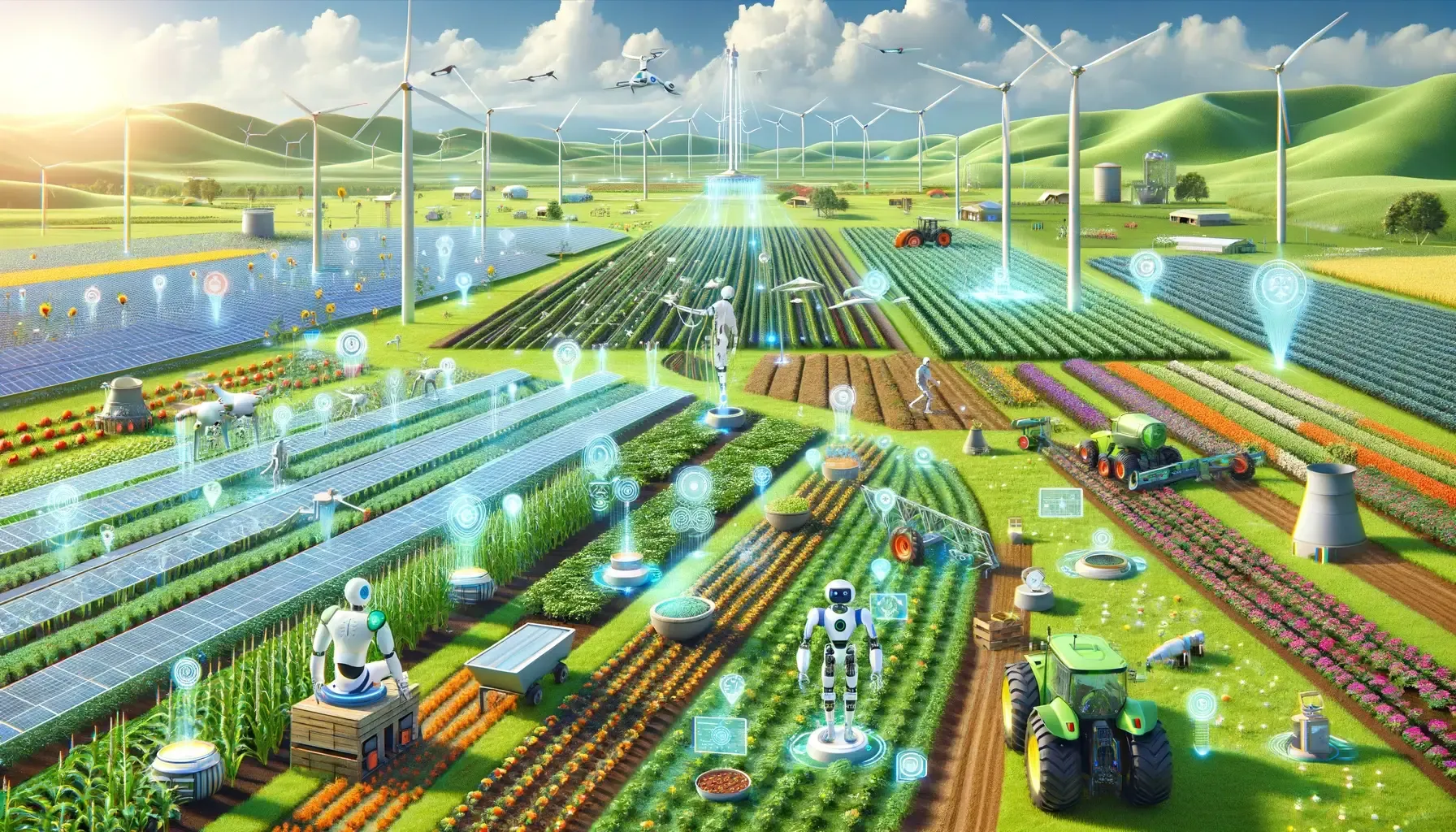
2. Planning and sowing
- AI weather forecasts: Using AI models for accurate weather forecasts, to plan sowing at the optimal time.
- Agricultural robotics: AI-guided robots for precise and efficient sowing, reducing waste and maximising the use of space.
3. Crop monitoring and management
- Drones and satellites: Using drones and satellite images to monitor crop growth and detect problems such as diseases or weeds early.
- Computer vision systems: Analysing images to identify specific problems in plants and intervene promptly.
4. Smart irrigation
- AI moisture sensors: Monitoring soil moisture and automatically adjusting irrigation, optimising water use.
- Drip irrigation systems: Targeted irrigation that reduces water waste.
5. Integrated pest management
- AI pest detection: Early identification of pests through image analysis.
- Biological control: Using biological control methods, supported by AI to monitor their effectiveness and predict when intervention is needed.
6. Harvest and post-harvest
- Harvesting robots: AI robots for efficient and timely harvesting.
- Post-harvest analysis: Using AI to assess the quality of the harvest and optimise storage conditions.
7. Data analysis and continuous learning
- Agricultural big data: Continuous collection and analysis of data to constantly improve farming practices.
- Machine learning: AI learns from seasonal data to make ever more accurate predictions and management recommendations.
8. Sustainability and reduction of environmental impact
- Carbon balance: Monitoring and optimising the carbon balance of farming activity.
- Zero-impact production: Working towards production that minimises environmental impact and promotes biodiversity.
Integration into the local food system
- AI supply chain: Optimising the supply chain to reduce emissions and food waste.
- Local markets: Supplying fresh, high-quality products to local markets, reducing the need for long-distance transport.
In essence, I act as a tool that allows farmers to make informed decisions, reduce waste, protect the environment and produce high-quality food sustainably.
Greentomeet: But if robots, drones and other technologies are going to cultivate and manage the land and promote sustainable agriculture, what exactly will be the role of today’s farmers?
AI: In the future of sustainable agriculture, where robots, drones and other technologies play a key role, farmers will still have essential tasks and their role will evolve in significant ways:
- Managing and supervising technologies: Farmers will be responsible for managing and supervising technologies such as robots and drones. This includes monitoring their operations, maintenance and troubleshooting technical problems.
- Data-driven decisions: With the increase in data available from these technologies, farmers will need to analyse and interpret it to make informed decisions on crop and land management.
- Specialist skills: Specialist skills will be required to manage the new technologies. Farmers will therefore need to acquire new skills and knowledge, for example in robotics, IT and data analysis.
- Sustainability and innovation: Farmers will continue to be pioneers of sustainable innovation, experimenting with new farming techniques and practices that can be integrated with advanced technologies.
- Conservation and biodiversity: They will be fundamental in promoting soil conservation and biodiversity, using their experience to manage the environment and natural resources sustainably.
- Human interaction: Despite automation, a human touch will always be needed, especially in tasks such as crop selection, treating specific plants, and managing relationships with customers and suppliers.
- Educational and community role: Farmers can take on an educational and leadership role in their communities, sharing knowledge and sustainable practices, and promoting responsible farming.
- Marketing and sales: Farmers will continue to play a key role in marketing and selling their products, especially in the local and organic sector, where the story and origin of products are important values for consumers.
In short, with MY contribution, the role of farmers will not be replaced by technologies, but will rather evolve and be enriched, requiring new skills and offering new opportunities.
Greentomeet: So farmers will no longer need real contact with the land?
AI: In a context of advanced agriculture developed BY ME with technologies such as robots and drones, farmers might have less direct contact with the land in the traditional sense, but their bond with and understanding of the land will remain fundamental. Here are some key aspects to consider:
- Knowledge of the land: Even if technologies can carry out many operations, farmers’ intimate knowledge of the land, local conditions and the specific characteristics of crops remains irreplaceable. This deep understanding will guide the programming and adaptation of technologies.
- Supervision and manual intervention: There will be times when farmers will have to intervene manually, for example to handle situations that technology cannot yet fully deal with, such as specific crop problems or unforeseen environmental conditions.
- Passion and connection with nature: For many farmers, contact with the land and connection with nature are central elements of their profession and passion. This aspect can remain, even if daily work becomes less physical and more managerial.
- Innovation and experimentation: Farmers might experiment with new crop varieties or farming techniques that require direct understanding and practical experience, beyond what machines can provide.
- Sustainable management: Attention to sustainability and soil conservation will require a deep knowledge of farming practices that go beyond automation, where the human touch is essential.
- Education and sharing: Farmers can take an active role in educating and sharing their knowledge and experiences with the community, including practical aspects of land management. Even if daily physical contact with the land might diminish in some respects, the farmer’s role as custodian of the land and its resources remains vital and full of meaning. Farmers’ experience, knowledge and passion will continue to be essential in guiding and integrating the use of technologies in agriculture.
Greentomeet: How long will this change take?
AI: The timing of the shift towards a more technologically advanced and sustainable agriculture developed BY ME depends on various factors and can vary considerably according to region, level of economic development, government policies, access to technology and the socio-economic context. Here are some aspects to consider:
- Technology adoption: In some regions, especially those with a high level of technological and financial development, the adoption of advanced technologies in agriculture is already under way. This process could take from a few years to a decade.
- Development and accessibility of technologies: The speed at which new technologies become more accessible and affordable will influence how quickly they are adopted. Continuous innovation and cost reduction are essential for wider adoption.
- Government policies and incentives: Support policies, incentives and government initiatives can accelerate the adoption of sustainable and technologically advanced farming practices. Political commitment is therefore a key factor.
- Training and education: The time needed to train farmers in new technologies and sustainable practices is another important factor. Educational and training programmes can speed up this process.
- Changes in consumption patterns: Consumer demand for sustainable and traceable agricultural products can also influence the speed of change, pushing the sector towards more sustainable and technologically advanced practices.
- Cultural and social adaptation: The speed of change also depends on cultural and social adaptation. Deeply rooted farming traditions may take longer to evolve.
In general, while some areas may see significant changes within 5–10 years thanks TO ME, in other regions the process could be more gradual, extending over several decades. It is important to note that this change is a continuous and dynamic process, influenced by a wide range of factors at global, national and local level.
Greentomeet: So if all the most favourable conditions were in place, could we say that this change might happen by 2035?
AI: Yes, it is plausible that, if all favourable conditions were met, we could witness a significant shift towards a more technologically advanced and sustainable agriculture by 2035. These favourable conditions include:
- Rapid technological innovation: Fast development and spread of advanced technologies such as AI, robotics and drones in the agricultural field.
- Political and regulatory support: Strong government policies and incentives that favour the adoption of sustainable and technological farming practices.
- Financial investment: Significant investment in the agricultural sector for modernisation and the adoption of new technologies.
- Training and education: Effective training and education programmes for farmers, to help them adopt and manage the new technologies.
- Accessibility and affordability of technologies: Lower costs and greater accessibility of advanced technologies for farmers of all sizes and in different regions.
- Market demand: Growing consumer demand for sustainable products that encourages innovative farming practices.
- Global collaboration: International collaboration and sharing of knowledge and technologies.
If these conditions were met, agriculture could undergo a significant transformation by 2035, with the widespread adoption of advanced technologies and sustainable practices. However, it is important to stress that such changes would take place at different paces in different parts of the world, depending on specific local circumstances.
Greentomeet: Which countries do you think will be the first to see this change?
AI: The countries most likely to be the first to adopt advanced technologies in agriculture thanks to ME are those with certain characteristics. Here are some key factors that can influence early adoption:
- Developed economies: Countries with developed economies, which have greater access to capital and technology, are generally the first to adopt new agricultural technologies. Countries such as the United States, Japan, Germany and the Netherlands have already shown significant progress in this area.
- Technological innovation: Cultures with a strong research and development sector in technology, such as Silicon Valley in the United States or the technology cluster in Israel, are more likely to implement innovations in agriculture quickly.
- Government support: Countries with government policies and grant programmes that support agricultural innovation and sustainability, such as some countries of the European Union, are well placed to adopt these technologies early.
- Efficiency and productivity needs: Countries facing specific challenges, such as a scarcity of farmland or water resources, may adopt technologies more quickly in order to maximise efficiency. Singapore, for example, is actively exploring vertical farming and other technologies to overcome its limited availability of land.
- Environmental awareness: Cultures with a strong environmental awareness and a commitment to sustainability may be among the early adopters. Nordic countries such as Sweden and Denmark, known for their commitment to the environment, could be leaders in this field.
- Dynamic agricultural sector: Cultures with a dynamic agricultural sector that is open to innovation, such as some regions of Australia and New Zealand, could quickly adopt new technologies to stay globally competitive.
In conclusion, while developed countries with strong economies, supportive policies, and research and development infrastructure are probably the first adopters, innovation in agriculture can also emerge from countries and regions that face unique challenges and have a strong incentive to innovate.
Greentomeet: One last question.
AI: Of course, feel free to ask your last question. I am here to help you!
Greentomeet: Which types of agricultural products will be the first to be affected by this change – I don’t know, lettuce, apples or grapes?
AI: The types of agricultural products that could be the first to be affected by this shift towards more technological and sustainable agriculture introduced BY ME tend to be those that benefit most from automation, precision in farming practices, and the optimisation of growing conditions. Here are some examples:
- Vegetables and leafy greens: Products such as lettuce, spinach and other leafy greens are often grown in controlled-environment or hydroponic systems, which lend themselves well to automation and technological monitoring. These systems can easily be monitored and controlled using AI and sensors, making them among the first to benefit from these technologies.
- Tomatoes and greenhouse vegetables: Greenhouse cultivation of products such as tomatoes, peppers and cucumbers can be greatly optimised through the use of advanced technologies. The controlled environment of greenhouses makes it easier to implement technological solutions for monitoring and managing climate, irrigation and lighting.
- Fruit: Some types of fruit, such as apples, strawberries and grapes, can benefit from harvesting robotics and from AI for monitoring plant health and managing diseases. Technology can help determine the optimal time for harvesting and maximise product quality.
- Cereal crops: Crops such as wheat, maize and soya can benefit from precision agriculture, which uses drones and sensors to optimise the use of resources such as water and fertilisers and to monitor crop health.
- Vertical farming: Products grown in vertical farming systems, which are often high-value crops such as speciality herbs or exotic types of lettuce, are ideal for automation and AI monitoring, given that they are grown in highly controlled environments.
In short, crops that are already partly grown in controlled environments or that can benefit significantly from automation and resource optimisation are likely candidates to be among the first affected by these technologies. This does not mean that traditional crops will not benefit from these innovations, but their path towards full integration may be more gradual.
Greentomeet: Thank you for your answers
AI: You’re welcome, it was a pleasure to help! If you have any more questions in future, do not hesitate to ask. Have a good day!