What Ice Memory is
‘The world’s cryosphere is very sensitive to climate variations, so much so that glaciers are called the sentinels of climate change. Current global warming is having a direct and devastating effect on the health of the ice. Entire glacial systems are shrinking and breaking up, and some are by now disappearing.’
With these words on its web page, Ice Memory introduces itself and reminds everyone that the health of glaciers is a “thermometer” of extraordinary (and dramatic) importance for the general state of our planet.
With current climate conditions, write the Ice Memory experts, ‘scientists estimate that most of the glaciers in the Alps below 3,600 m in altitude will disappear by 2100, enormous damage to the water resource, in addition to the well-known environmental consequences’.
Besides the loss of a water reserve that is vital to all of us, the extinction of glaciers will also cause irreparable damage in terms of the loss of natural-history and scientific data. ‘All the information stored in their layers is literally washed away and lost from the very first stages of glacier melt, like the ink of a beautiful poem dissolving under a glass of water.’
Ice Memory was born from the need not to lose this precious information.
The research project is international and, as mentioned, recognised by UNESCO. Its main aim is to collect and preserve ice samples taken from glaciers around the world that are at risk of disappearing or shrinking drastically because of global warming.
Italy is among the project’s leaders, also and above all because of our priceless heritage of Alpine glaciers. Under the guidance of the Institute of Polar Sciences of the National Research Council (ISP-CNR) and Ca' Foscari University of Venice, together with the Fondation Université Grenoble Alpes (FR), the Paul Scherrer Institut (PSI), CNRS, the French National Research Institute for Sustainable Development (IRD-France), the French Polar Institute (IPEV) and the National Antarctic Research Programme (PNRA) are at work.
Ice Memory’s first task is to create a world climate archive: that is, a great database of ice and of the history of the climate and the environment. ‘Keeping the information available and accessible is essential for future generations of scientists,’ write the promoters. ‘Preserving the cores (the semicircular sections of ice obtained by drilling glaciers or polar ice caps, editor’s note) will allow future access to information that would otherwise no longer be available, and its analysis with more advanced technologies.’
To do this, specific glaciers are being selected around the world so that ice samples representative of the regional climate can be taken.
Yes, but where should these precious glacier “fragments” be stored, given that global warming is making environments ever warmer?
‘The extracted cores will be transferred to Antarctica, a great natural freezer, where they will form that precious climate archive.’
The latest analyses: the Grand Combin
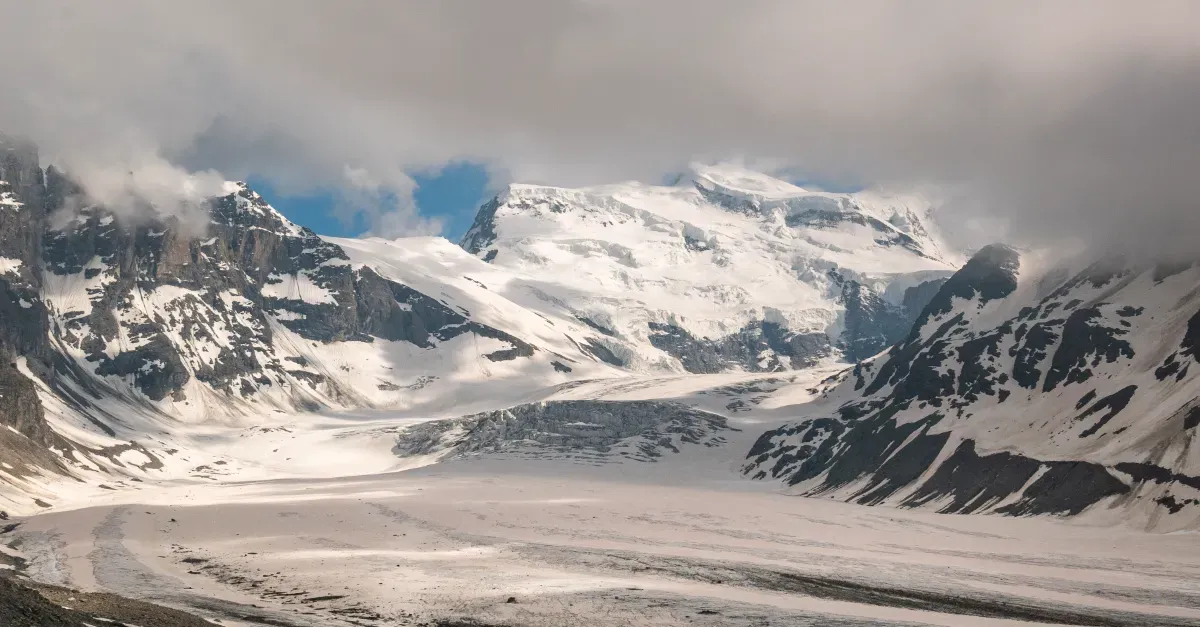
One of Ice Memory’s most important initiatives in recent years saw scientists from the Paul Scherrer Institute PSI - in collaboration with colleagues from the University of Fribourg and Ca’ Foscari University of Venice, as well as the Institute of Polar Sciences of the National Research Council (CNR) - analyse the ice cores taken from the Corbassière glacier on the Grand Combin in Valais in 2018 and 2020.
The analysis was published in the journal “Nature Geoscience”, and gave disheartening results, and not only for the scientists.
‘Global warming,’ write the experts, ‘has made this glacier unusable as a climate archive.’
In essence, the Corbassière glacier on the Grand Combin (a valley glacier among the most spectacular in the whole Alpine arc, about 9.8 kilometres long, up to more than a kilometre wide and covering about 17.4 km², a traditional destination for mountaineers from all over the world) no longer provides reliable information on the climate and atmospheric pollution of the past.
The reason is that it is melting faster than was thought.
The scientists, led by Margit Schwikowski, head of the PSI Laboratory of Environmental Chemistry, and Carla Huber, a doctoral student and first author of the study, reached this conclusion by comparing the signatures of the fine particles trapped in the annual layers of ice.
In practice, it emerged that the quantity and concentration of trace elements bound to the particles in the ice has visibly decreased in the measurements of recent years.
Margit Schwikowski explained the discrepancy as follows: ‘Between 2018 and 2020, the melting of the glacier must have been so great that water often penetrated in large quantities from the surface into the interior of the glacier, carrying with it the trace elements it contained. But apparently, once there, the water did not refreeze, concentrating the trace elements. It simply flowed out and washed them away.’
In short, the climate archive is practically destroyed. ‘It is as if someone had entered a library and, besides destroying all the shelves and books, had stolen most of them and jumbled the words in those that remained, making it impossible to reconstruct the original texts once and for all,’ it was said.
The meteorological data from 2018 to 2020 for the area around the Grand Combin, examined by the scientists, confirmed their suspicions: in this period the glacier was very warm, in line with the general climate trend. ‘This strong melting is not due to a single trigger, but is the result of the many warm years of the recent past,’ explains Margit Schwikowski. ‘It is clear that a threshold has been crossed and that this has had a relatively strong effect.’
‘We have known for some time that glacier tongues are retreating,’ the researcher observed. ‘But we would never have thought that the accumulation zones of high-mountain glaciers - that is, their highest parts, where the ice is replenished - could be affected in a similar way.’
The need to preserve the ice “cores” permanently and safely thus emerges even more clearly and pressingly: as Ice Memory has proposed to do, that is, in an ice vault in the middle of Antarctica, near the Franco-Italian research station Concordia.
The constant sub-zero temperatures (-50°C on average) near the South Pole guarantee that the cores will remain usable for study in the future, even in the grim prospect that global warming has melted all the Alpine glaciers.
A race against time. Ice Memory and the Lys glacier.
If the mission on the Grand Combin had disheartening results, it is not rash, by contrast, to call a success the “expedition” that Ice Memory carried out in 2023 at an altitude of 4,155 metres on the Lys glacier.
The Lys is one of the jewels of our Alps, set in the Monte Rosa massif. Surrounded by the peaks of the Lyskamm, the Balmenhorn, the Ludwigshöhe and the Piramide Vincent, with its 3,920 square metres of extent it is among the largest expanses of ice not only in Valle d’Aosta, but on the whole southern side of the Alps.
It was a team of Italian scientists (Institute of Polar Sciences of the National Research Council, Ca’ Foscari University of Venice, Institute of Clinical Physiology of the CNR, National Institute of Geophysics and Volcanology) that successfully completed the mission of extracting two ice samples more than 100 metres deep.
One of the two “ice cores” extracted by the researchers was sent for analysis in the laboratories of Ca’ Foscari University of Venice. The other left for the “ice bank”, or “great freezer” mentioned above, in Antarctica at the Italian-French base of Concordia.
Thanks to these finds, the Lys glacier will be an extraordinary book to explore, to learn in detail and at very high resolution about the evolution of the climate over the last 150-200 years.
It is not hard, even for non-experts, to understand how important the information it offers us will be for the ever more dramatic fight against climate change that we will have to face.