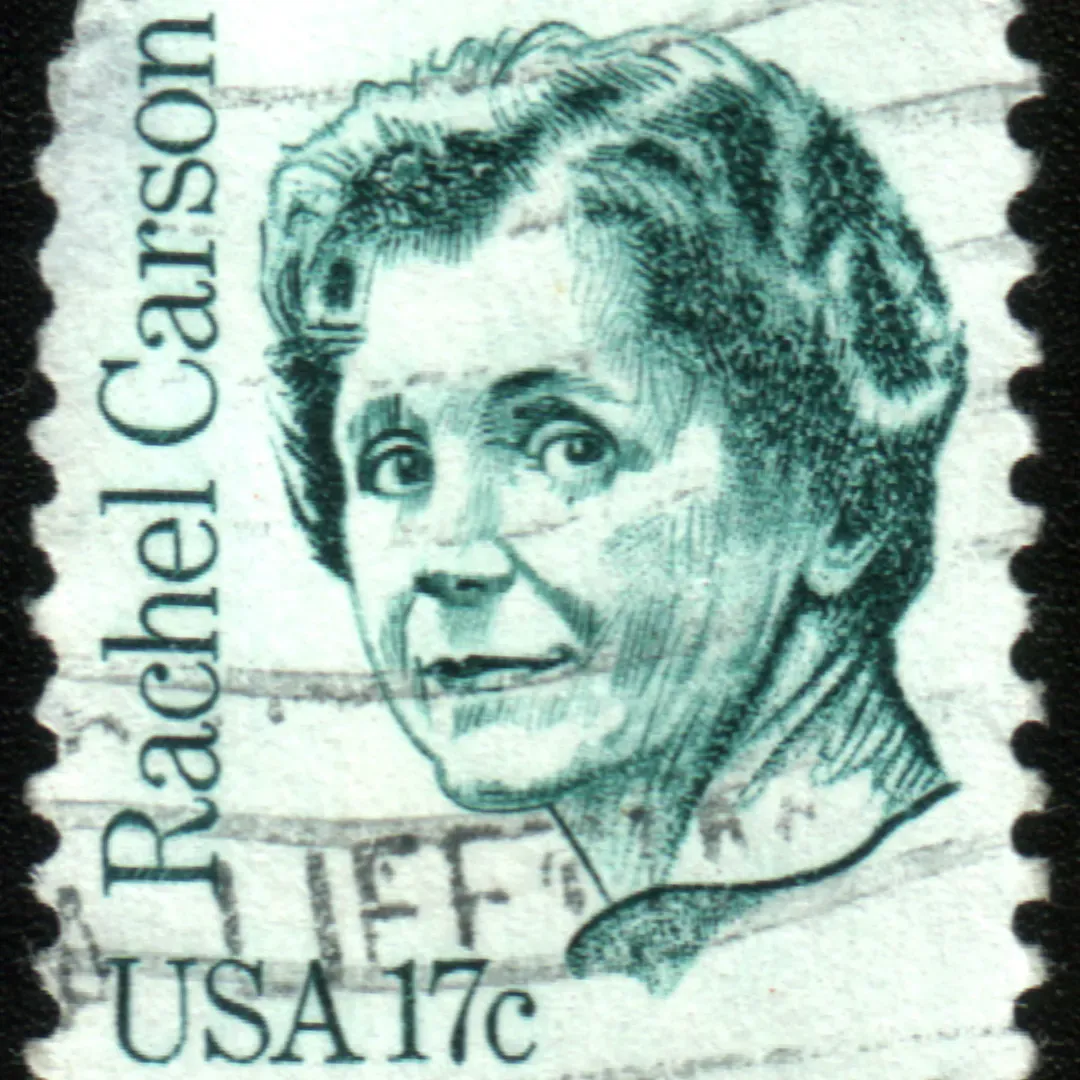
At the beginning of 1963, Rachel Carson was invited to give the opening address at the annual symposium of the Kaiser Foundation Hospitals and the Permanente Medical Group in San Francisco.
Carson was already seriously ill, but she accepted the invitation all the same, aware that the symposium represented a unique opportunity to reach a prestigious and influential audience.
She appeared before the audience with a walking stick, officially explaining that her difficulties were due to arthritis. An audience of fifteen hundred doctors listened to her in reverent silence for an hour.
This speech, known by the title The pollution of our environment, is the first document in which Carson publicly describes herself as an ecologist. The focus of the text is on the links between species and their biological and physical environment, as well as on the dynamic systems that govern the ecosystem.
The themes that inspired Silent Spring are clearly present throughout this intense speech, the last given by Carson. Her stances of social criticism are also clear-cut, directed at a system that culpably did not intend to assess the risks connected with technology. Also notable is the warning against turning the sea into a dump for the ‘poisonous refuse of the atomic age’.
The Pollution Of Our Environment
The pollution of our environment
Excerpts:
[...] I suppose it is a rather new thought, and almost a humbling one, and certainly born of this atomic age, that man can work against himself. Despite our rather boastful talk about progress and our pride in the devices of civilisation, I believe there is a growing suspicion – indeed, perhaps an uneasy certainty – that at times we have been a little too clever for our own good.
Despite the truly marvellous inventiveness of the human brain, we are beginning to ask ourselves whether our power to change the face of nature should not have been tempered with wisdom for our own good and with a greater sense of responsibility for the well-being of generations to come.
The subject of man’s relationship with his environment has been at the top of my thoughts for many years. Contrary to the beliefs that often seem to guide our actions, man does not live apart from the world; he lives in the midst of a complex and dynamic interaction of physical, chemical and biological forces, and between him and this environment there are continuous and endless interactions.
I have thought a great deal about the most useful thing to say this evening on the subject assigned to me: ‘The pollution of our environment’. Unfortunately, there is so much that could be said.
I fear it is true that, since the beginning of time, man has been a very untidy animal. But, in times past, this perhaps mattered less. When men were relatively few, their settlements were scattered; their industries undeveloped; but now pollution has become one of the most vital problems of our society.
I do not want to waste time this evening drawing up a catalogue of all the various types of pollution that today contaminate our land, our air and our waters. I know this is an informed and intelligent audience, and I am sure all these facts are known to you. I would rather present a point of view on pollution, one that seems to me useful and necessary for the control of an alarming situation. Since the concept of the environment and its relationship to life will underlie everything I have to say (and indeed, I think it is central to the entire symposium), I should like at the outset to remind you of part of the early history of this planet.
I should like to speak of that strange and apparently hostile environment which, nevertheless, gave rise to an event perhaps unique in our solar system: life. Naturally, our thoughts on this must be speculative hypotheses; but there is nonetheless fairly broad agreement among geologists, astronomers, geochemists and biologists on the conditions that must have prevailed shortly before life appeared on earth.
They were, of course, very different from those of our own day.
We must remember, for example, that the atmosphere probably contained no oxygen; and for this reason there could have been no protective layer of ozone in the upper atmosphere. Consequently, all the energy of the sun’s ultraviolet rays must have fallen on the sea; and there in the sea, as we know, there was an abundance of simple chemical compounds. These included carbon dioxide, methane and ammonia, at hand for the complex series of combinations and syntheses that must have taken place. (…)
As far as our present knowledge goes, nowhere else in the solar system have conditions equally hospitable to life occurred. This earth, then, presented an environment of extraordinary suitability; and life is a creation of that environment. As soon as life was created, it began to act upon the environment. The first virus-like organisms must have rapidly reduced the stocks of nutrients adrift in that primitive ocean.
But more important was the change that took place as soon as plants began the process of photosynthesis. A by-product of this process was the release of oxygen into the atmosphere. And so, gradually, over millions, indeed billions, of years, the nature of the atmosphere changed; and the air we breathe today, with its rich percentage of oxygen, is a creation of life.
(…) From all this we can generalise that, since the beginning of biological time, there has been the closest possible interdependence between the physical environment and the life it sustains. The conditions on the young earth produced life; life, then, immediately modified the conditions of the earth, so that that single extraordinary act of spontaneous generation could not be repeated. Since then, in one form or another, the action and interaction between life and its surroundings have gone on.
This historical fact has, I believe, more than an academic significance. Once we accept it, we see why we cannot with impunity make repeated assaults on the environment as we do now. The serious student of the history of the Earth knows that neither life nor the physical world that sustains it exists in small isolated compartments. On the contrary, he recognises the extraordinary unity between organisms and environment. For this reason he knows that harmful substances released into the environment return in time to create problems for man.
The branch of science that deals with these interrelationships is Ecology; and it is from the point of view of an ecologist that I wish to consider our modern problems of pollution. To solve these problems, or even simply to avoid being overwhelmed by them, we need, it is true, the services of many specialists, each concerned with some particular aspect of pollution.
But we must also see the problem as a whole; look beyond the immediate and single event of the introduction of a pollutant into the environment, and trace the chain of events this sets in motion. We must never forget the totality of this relationship. We cannot think only of the living organism; nor can we think of the physical environment as a separate entity. The two exist together, each acting upon the other to form an ecological complex or an ecosystem.
There is nothing static in an ecosystem; something is always happening. Energy and materials are received, transformed, emitted. The living community maintains itself in a dynamic, rather than static, equilibrium. Yet these concepts, which sound so fundamental, are forgotten when we tackle the problem of disposing of the myriad wastes of our modern way of life. We behave not as people guided by scientific knowledge, but more like the proverbial bad housekeeper who sweeps the dirt under the carpet in the hope of losing sight of it.
We pour wastes of every kind into our waters, with the aim of having them carried far away from our shores. We discharge into the atmosphere the smoke and fumes of a million chimneys and heaps of burning rubbish, in the hope that the ocean of air will somehow be vast enough to contain them. Now, even the sea has become a dump, not only for assorted refuse, but also for the poisonous waste of the atomic age. And this is done, I repeat, without recognising the fact that the introduction of harmful substances into the environment is not a single-stage process. It is changing the nature of the complex ecological system, and changing it in ways that we usually do not foresee until it is too late.
This lack of foresight is one of the most serious complications, I believe. I recall that Barry Commoner pointed out, in a masterly speech at the Conference on Air Pollution in Washington last winter, that we rarely, if ever, assess the risks associated with a new technological programme before it is put into effect. We wait until the process has become integrated into a vast economic and political commitment, and then it is practically impossible to modify it.
For example, it would surely have been possible to determine in the laboratory how detergents would behave once released into public water systems; to foresee their almost indestructible nature. Now, after years of use in every woman’s dishwasher and washing machine, the process of conversion to ‘soft’ detergents will be long and costly.
So our approach to the whole problem is full of errors. We have persisted too long in the kind of thinking that may have been appropriate in pioneer times, but is no longer: the assumption that rivers, the atmosphere and the sea are vast enough to hold whatever we pour into them. I remember that not long ago I heard a supposedly capable scientist, the director of one of our agricultural institutions, speak casually of the ‘dilution of pollution’, repeating this magic phrase as if it provided the answer to all our problems. It does not. (…)
The question of genetic damage from harmful elements in the environment is a subject that interests me particularly. Elsewhere I have suggested that chemical pesticides should be viewed with great suspicion as possible agents of genetic damage to humans. This suggestion has been challenged by some on the grounds that there is no evidence that these chemicals are having such an effect. I do not believe that we should wait for some dramatic demonstration before making a thorough study of the potential genetic effect of all the chemicals that are widely introduced into the human environment.
When such a discovery is made in some way, it will be too late to eradicate them. Some of the chemicals currently in use as herbicides and insecticides have mutagenic effects on lower organisms. Others have the capacity to cause chromosome damage or a change in the number of chromosomes and, as you know, this type of chromosomal abnormality can be associated with a wide variety of congenital defects in humans, including mental retardation. I think we should test chemical pesticides on many of the organisms that reproduce rapidly and therefore lend themselves to genetic experiments. If the chemicals then prove to be mutagenic, or otherwise harmful to the genetic systems in a variety of experimental organisms, then I think we should withdraw them from use.
I am not impressed by the argument that they may not have similar effects in humans. After all, the science of genetics was founded when an obscure Austrian monk carried out some experiments on garden peas; and the fundamental laws of heredity that he discovered have proved to be generally applicable to both plants and animals.
(…) I ask you to remember the uproar that followed Charles Darwin’s announcement of his theories of evolution. The concept of the origin of man from pre-existing forms was warmly and emotionally denied, and the denials came not only from the lay public, but also from Darwin’s colleagues in science. Only after many years did the concepts set out in The Origin of Species become firmly established. Today it would be difficult to find an educated person who would deny the facts of evolution. Yet many of us deny the obvious corollary: that man is influenced by the same environmental influences that control the lives of all the many thousands of other species to which he is bound by evolutionary ties.
I find it rather fascinating to speculate about what hidden fears in man, what long-forgotten experiences, have made him so reluctant to recognise first his origins and then his relationship with that environment in which all living things have evolved and coexist. The Victorians eventually freed themselves from the fears and superstitions that made them recoil, shocked and dismayed, from Darwinian concepts. And I look forward to a day when we too can accept the reality of our true relationship with our environment. I believe that only in that atmosphere of intellectual freedom will we be able to solve the problems that now face us.
Thank you.
image: [canebal] © 123RF.com