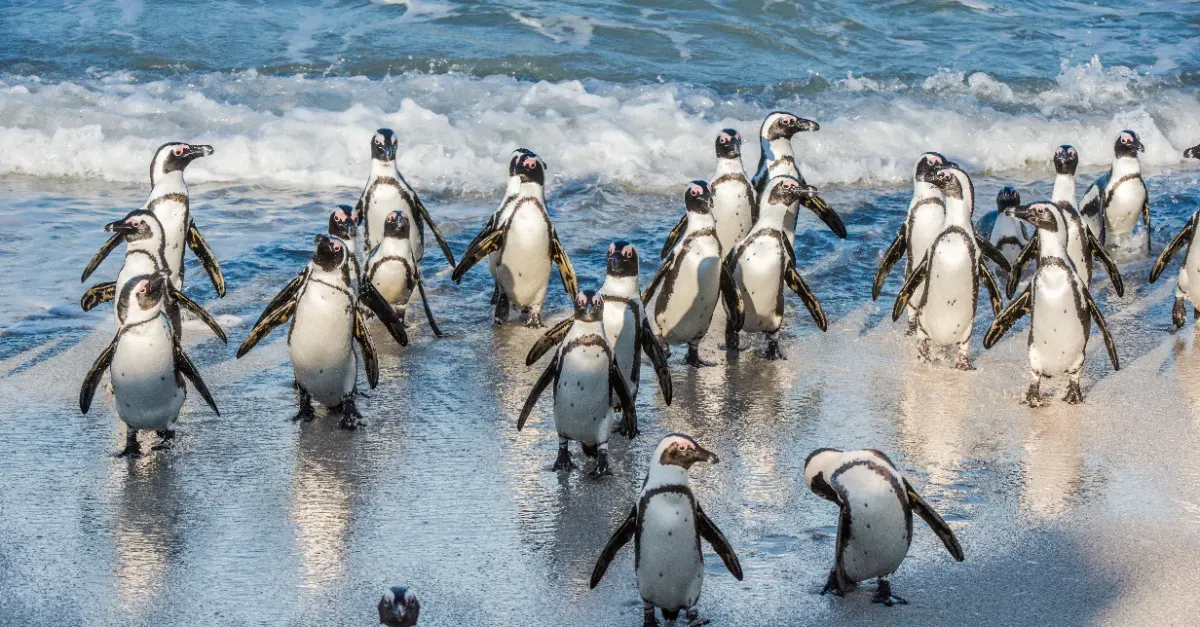
Environmental and ornithological associations have no doubts. Two NGOs – BirdLife South Africa and the Southern African Foundation for the Conservation of Coastal Birds – have taken South Africa’s minister for forestry, fisheries and the environment, Barbara Creecy, to court, arguing that she has not implemented ‘biologically meaningful closures’ to fishing around six penguin colonies that are home to 76% of the global African penguin population.
It is, therefore, a matter of stopping fishing around the colonies.
The species’ food requirements are certainly considerable. According to biologists, penguins can put on up to a third of their body weight in a single day of foraging.
‘But there are no fish out there any more’, says one of the scientists fighting for the cause.
Once again, the accused is fishing carried out with invasive and unsustainable methods.
Alistair McInnes, who heads BirdLife South Africa’s Seabird Conservation Programme and is the author of the complaint submitted to the court, explains that the big problem concerns the so-called ‘purse seine nets’ used to catch small species in open waters such as sardines and anchovies.
Purse seine nets, marine environment experts explain, are like ‘giant drawstring bags that sweep up entire shoals’. African penguins feed mainly on these species, and the availability of sardines and anchovies for them in South Africa has plummeted to record lows.
Penguins are not the only ones suffering from this situation. Cape cormorants, too, which feed mainly on small pelagic fish (the technical term for species such as tuna, swordfish, sardines, anchovies and so on), are at risk of extinction because of the food shortage.
Minister Creecy had in fact appointed a panel of experts to address the problem, and as early as July 2023 she received from them a report recommending, as a matter of urgency, targeted fishing closures around the penguin colonies, which would have benefited penguin conservation.
The report’s recommendations were reportedly accepted formally by the minister: in reality, Creecy substantially kept the existing closures, merely making them somewhat more limited.
At the Stony Point colony, for example, the area closed to purse seine fishing is three times smaller than it would be had the expert panel’s recommendations been followed. The result is that, according to biologists, penguins have the same difficulty finding food as before. The situation is similar in three other colonies, where 50% or less of the penguins’ main foraging area is protected by current rules.
On the other side, as happens at every latitude, there are the arguments and protests of the economic and productive sectors involved. The body representing South African fishermen strongly opposes the legal action, claiming that ‘contrary to what environmental NGOs have stated in the media, according to which the main driver is the purse seine fishing industry, the impact of fishing [on penguin numbers] is minimal’.
According to the fishing associations, it is the environmental NGOs who are obstructing ‘the process of establishing the main factors causing the decline in penguin numbers’.
In reality, the fact that fishing is not the only cause of the population’s decline is accepted by biologists too. ‘African penguins are probably the most studied seabird in Africa’, says McInnes. ‘A great deal of research has been carried out on the various threats to their survival’.
The contributing causes are the climate crisis, with extreme heat and heavy rain that can prove disastrous during the nesting season; land predators that have found their way into the colonies in recent years; and, not least, noise pollution caused by ‘bunkering’, that is, the process of ship-to-ship refuelling, which, for example at the St Croix colony, takes place regularly.
The availability of prey to feed on nevertheless remains a decisive factor for the survival of penguins, as of all predatory species. Experts cite as an example the fact that the only penguin colony in South Africa with a relatively stable population – Boulders, near Cape Town – is in an area where purse seine fishing has been banned for decades.
That must mean something: as it always does in these cases.