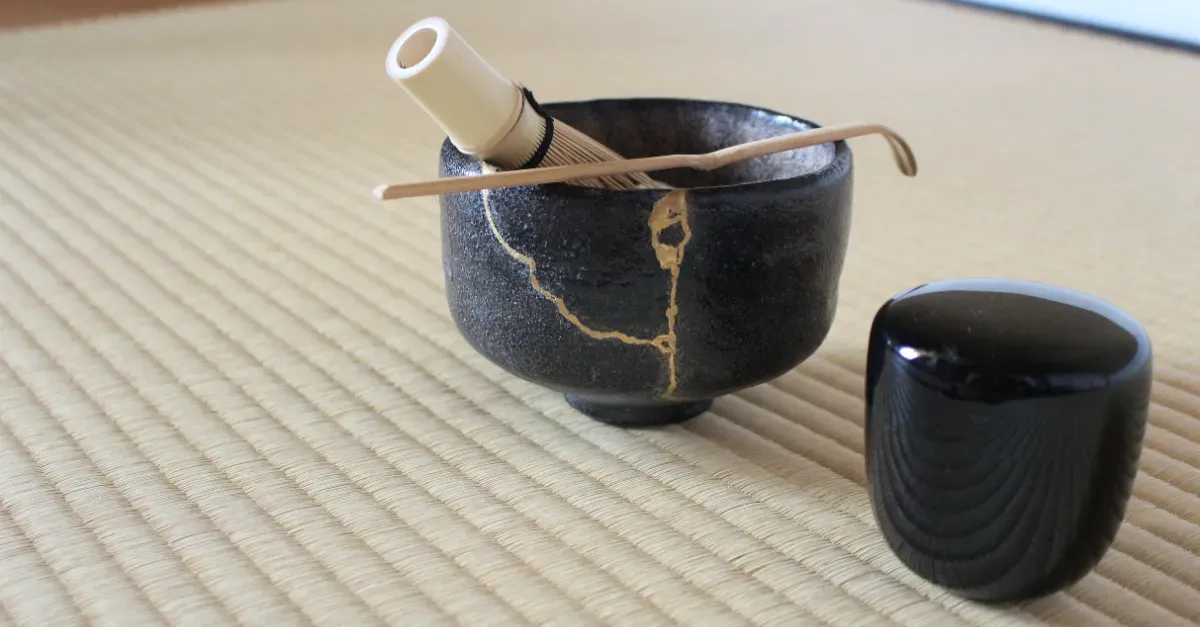
Kintsugi is an ancient Japanese art that consists of repairing broken objects using a paste, urushi lacquer, enriched with gold or silver powder. This technique originated for repairing porcelain vases and plates, but it can be applied to other objects too.
Repaired vases even become more beautiful, because they show the lines of their history and reveal their uniqueness. This ancient art teaches that beauty can come from what has been broken.
Urushi lacquer is used to repair the shards
Urushi lacquer, a natural product obtained from the bark of certain plants, is very sticky and has been used for centuries in Japan to repair objects made of wood or ceramic. The lacquer is used as an adhesive, while gold or silver powder is then used to embellish these scars. The drying time is 3 to 7 days.
The history of this art dates back to the 1400s
The art of Kintsugi dates back to the 1400s, when it was invented in Japan. The name “kintsugi” literally means “repairing with gold” and was born from the ingenuity of ancient ceramicists, who were tasked with repairing a cup broken by Yoshimasa, the eighth shogun at the time. When he saw his repaired cup, he was struck by its uniqueness and beauty.
Show moreShow less
The philosophy behind kintsugi
The philosophy behind kintsugi is to embrace imperfection and find beauty in the uniqueness of imperfect things. It also reminds us that everything is destined to break and come to an end, but this does not mean it will no longer be useful, that it will not have a new life. We can also see this as a symbol of rebirth and resilience, of getting back up after a fall, of seeing how our wounds can enrich us and give us uniqueness. Another point is the Japanese concept of “mono no aware”, which can be translated as sensitivity to things, a melancholy feeling which, while admiring the beauty of an object, also understands that one day it is destined to be no more.
Kintsugi is an excellent example of reusing objects
If we look at this ancient art from an environmental point of view, we can find in it a green “philosophy” that is not to be overlooked. Repairing broken objects is a valuable action from the environmental point of view too. We recycle something we were about to throw away, we choose to give new life to something we thought was lost and which can instead even become better. It is the principle of the circular economy, applied even to seemingly insignificant objects. But the intention and the purpose can help us develop the right awareness and the right mindset to face far more important challenges.
Was it useful? Pass it on to someoneSharing an investigation is worth more than a like.