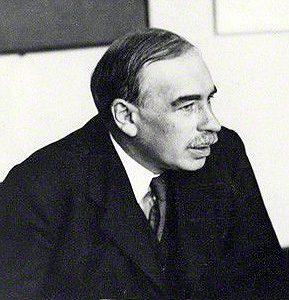
It would obviously be arbitrary and forced to place John Maynard Keynes even on a list of proto-environmentalists. It is equally true, however, that although he never dealt with the environment and ecology in the strict sense, Keynes’s thought has, at least since the Second World War, had an enormous, incalculable influence on every aspect of the economy and of Western capitalist society.
It cannot be a coincidence that in the United Kingdom, the economist’s homeland, the historic victory of the Labour Party in the 1945 elections paved the way worldwide for welfare policies, with the Beveridge Plan. Nor is it a coincidence that the programme presented by the Labour Party itself for those elections included a ‘White Paper on National Parks’, a forerunner of the passing, in 1949, of the ‘National Parks and Access to the Countryside Act’, the first framework law on what would become the national parks.
It cannot be denied, moreover, that on a personal level Keynes was ‘in love’ with his Grantchester, which he often celebrates in his writings as a healthy green oasis in which nature offers human beings the deepest inner peace.
That this environmental sensibility led Keynes to recognise the ‘economic’ value of the services provided by nature is not, however, a mere hypothesis. At least to judge from the lines of the Keynesian passage we reproduce in this anthology.
It is indeed not difficult to glimpse, in these words, the reflection of that extraordinary capacity for intuition and for foreseeing future scenarios that made the great economist a bulwark of the thought of the second half of the twentieth century.
For Keynes, free trade, unrestricted free exchange, would sooner or later lead to a future scenario of war, dictatorship and lack of freedom. Finance, based on the exclusive criterion of ‘the accountant’, reduces the whole world to a commodity (dividing the world into what ‘pays’ and what ‘does not pay’). Everything is reduced to marginal profit. We destroy everything that has no immediate economic value – and Keynes’s example turns to the world of agriculture, to traditional methods of cultivation – we ruin men and things ‘to get a loaf one-tenth of a penny cheaper’.
The reference to agriculture is neither rhetorical nor, still less, casual. Further on Keynes explains and clarifies:
‘We destroy the beauty of the countryside because the unappropriated splendours of nature have no economic value. We are capable of shutting off the sun and the stars because they do not pay a dividend.’
John Maynard Keynes
National Self-Sufficiency
A nation’s self-sufficiency
In The Yale Review, vol. 22 no. 4 (June 1933)
I was brought up, like most Englishmen, to respect free trade not merely as an economic doctrine which a rational and instructed person could not doubt but almost as a part of the moral law. I regarded departures from it as being at the same time an imbecility and an outrage. I thought England’s unshakeable free-trade convictions, maintained for nearly one hundred years, to be both the explanation before man and the justification before heaven of her economic supremacy.
Looking back today at the statements of these fundamental truths that I made then, I do not find myself disputing them. Yet the orientation of my thought has changed; and I share this change of opinion with many others. In part, indeed, my background of economic theory has changed. I should not now accuse Mr Baldwin, as I did then, of being a ‘victim of the protectionist error in its crudest form’, because he thought that, under existing conditions, a tariff could do something to diminish British unemployment. But principally I attribute my change of outlook to something else: to my hopes, fears and anxieties, together with those of many or most, I believe, of this generation all over the world, which are different from what they were. It has been a long labour to escape from the mental habits of the nineteenth-century world, the world before the war. But today, at last, a third of the way into the twentieth century, most of us are leaving the nineteenth for good; and when we reach its midpoint, it is likely that our mental habits and what interests us will be as different from the methods and values of the nineteenth century as any century has been from the one that preceded it.
(…)
There is another explanation, I believe, for this reorientation of our minds. The nineteenth century carried to extraordinary lengths the criterion of what may be called, in short, financial results, as a test of the advisability of any action promoted by private or collective action. The whole conduct of life was turned into a sort of parody of an accountant’s nightmare. Instead of using their enormously increased material and technical resources to build a city of wonders, they built slums; and they thought it right and advisable to build slums because slums, on the test of private enterprise, ‘paid’, whereas the city of wonders would, they thought, have been an act of foolish extravagance, which, in the imbecile idiom of financial infatuation, would have ‘mortgaged the future’; although the building today of great and glorious works might impoverish the future, nobody can see it so long as his mind is besieged by false analogies from an irrelevant accountancy.
Even today we spend our time – half vainly, but also, I must admit, half successfully – in trying to persuade our countrymen that the nation as a whole will assuredly be richer if unemployed men and machines are used to build needed houses than if they are maintained in idleness. For the minds of this generation are still so clouded by bogus calculations that they distrust conclusions which should be obvious: this is because they rely on a system of financial accounting which always asks whether such an operation will ‘pay’. We must remain poor because it does not ‘pay’ to be rich. We must live in hovels, not because we cannot build palaces, but because we cannot ‘afford’ them.
The same rule of self-destructive financial calculation governs every walk of life. We destroy the beauty of the countryside because the unappropriated splendours of nature have no economic value. We are capable of shutting off the sun and the stars because they do not pay a dividend. London is one of the richest cities in the history of civilisation, but it cannot ‘afford’ the highest standards of achievement of which its own citizens who live there are capable, because they do not ‘pay’.
If I had the power today, I would set about endowing our capitals with all the appurtenances of art and civilisation on the highest standards of which the citizens of each are individually capable, convinced that what I can create I can afford – and being sure that the money thus spent would not only be better than any dole, but would make any dole unnecessary. For with what we have spent on the dole in England since the war, we could have made our cities the greatest works of man in the world.
To say it once more: until recently we conceived it an amoral duty to ruin the tillers of the soil and destroy the age-old human traditions bound up with agriculture, in order to be able to get a loaf one-tenth of a penny cheaper. There was nothing which it was not our duty to sacrifice to this Moloch and Mammon in one; for we believed with absolute faith that the worship of these monsters would overcome the evil of poverty and lead the next generation safely and comfortably, on the back of compound interest, to economic peace.
Today we suffer disillusion, not because we are poorer than we were – indeed even today we enjoy, at least in Great Britain, a higher standard of life than in any previous age – but because other values seem to have been sacrificed, and, what is worse, sacrificed unnecessarily. For our economic system, put to the test of facts, does not allow us to exploit to the full the possibilities of economic wealth offered by the progress of our technique, but falls well short of this, leading us to think that we might have used the margin in more satisfying ways.
image: public domain, from wikipedia