Is Marx an environmentalist? How to reread communism (according to a Japanese philosopher) through a green lens
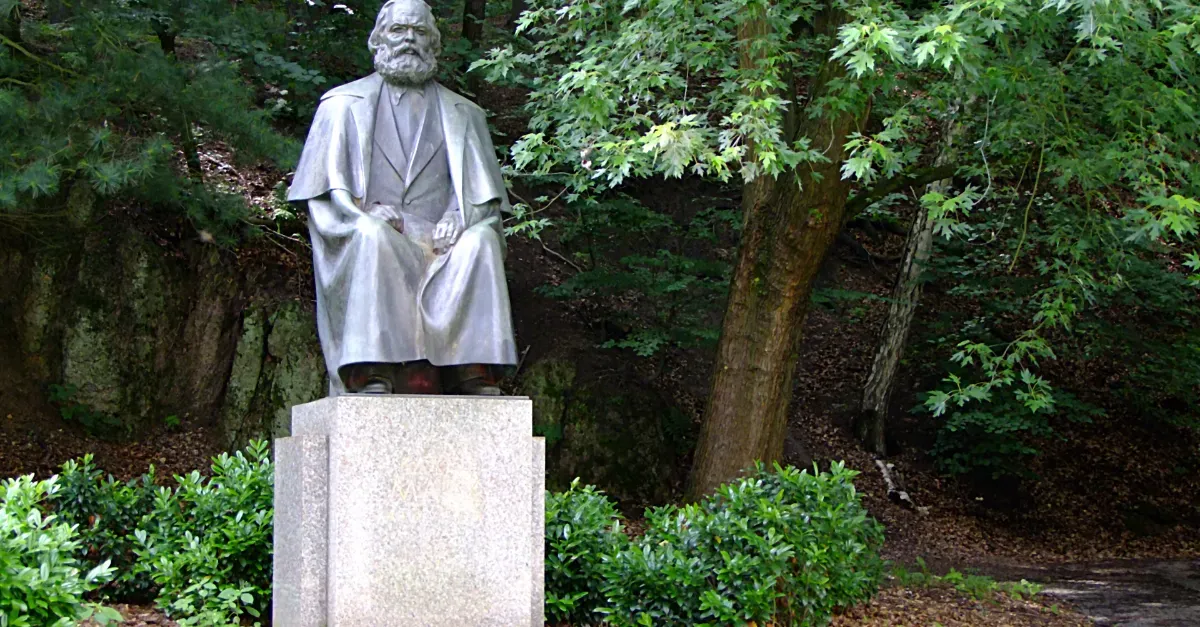
Can Karl Marx be considered one of the forerunners of environmentalist thought? And can “classical” communist doctrine be read as an ecological critique of capitalism too?
Can Karl Marx be considered one of the forerunners of environmentalist thought? And can “classical” communist doctrine be read as an ecological critique of capitalism too? The subject is undoubtedly interesting, and not only for students of political theory or those fond of twentieth-century ideologies.
Kohei Saito is a thirty-six-year-old professor of philosophy, currently an associate professor at the University of Tokyo, who became passionate about the question as early as his doctoral thesis in 2017, devoted precisely to Marx’s “ecological writings” (as he calls them).
In 2020, with the slightly more developed fruits of his research, he made, as they say, a “splash” by publishing Capital in the Anthropocene, which sold half a million copies in Japan alone (so much for those who think the Japanese are completely resistant to Marxism and communism). Now the publishing world is waiting for the new book that will presumably make him an international star. Title: Marx in the Anthropocene. Towards the Idea of Degrowth Communism. It will also be published in Italy, it is said, within the year.
Show moreShow less
“In the face of the global climate crisis, Karl Marx’s ecological critique of capitalism shows its importance more clearly than ever,” Saito argues. “My book explains why Marx’s ecology had to be marginalised and even suppressed by Marxists after his death throughout the twentieth century.”
Today, as humanity ventures ever deeper into a thoroughly unsustainable Anthropocene, according to Saito, the Marxist ecological critique regains all its strength and, in some way, its urgency.
The focal point of Saito’s analysis lies in the pages of the new materials (preparatory writings for the major works, the complete correspondence, notebooks considered until now to be of lesser interest, etc.) published in the monumental complete edition of Marx’s writings (the so-called MEGA, Marx-Engels-Gesamtausgabe -2) begun in 1998. It is by reading and rereading those thousands of pages, not always pleasant or easy to understand, that Saito formed an idea, original and new by his own account, of Marx’s alternative to capitalism as degrowth communism.
The key word, then, that Saito brings into play to argue for a (new) critical-ecological vision of Marxism is the much-debated, loved-and-hated degrowth. The declared aim of the young Japanese philosopher is indeed to “overcome the gap between Marxism and degrowth”. Given that “infinite accumulation on a finite planet is the main cause of climate collapse”, as Saito writes, the only possible way to stop climate collapse is to reduce consumption. On this point, in truth, Saito explicitly cites Jason Hickel, the anthropologist author of the bestseller Less Is More: How Degrowth Will Save the World, rather than Marx.
As the argument unfolds, Saito cannot avoid the classic criticism of degrowth theories: namely the real risk, indeed the near certainty, that applying them would deny many countries of the Global South the chance to develop as the North did, and plunge them into absolute poverty even more than they are now.
“Like many people engaged in degrowth, I limit the scope of the argument to the global North, to developed countries such as the United Kingdom, Japan and the United States,” Saito defends himself. “Of course I am in favour of growth for those poor countries of the Global South.”
In reality Saito’s vision revolves around what he calls “a new idea of abundance and progress”. While it is obvious and right that all the planet’s inhabitants should have access to fundamental goods – electricity, water, education – the point is to “develop a vision in which mass production, mass consumption and mass waste can be avoided”.
Perhaps the most interesting, and undeniable, aspect of Saito’s work is his emphasis on how Marx cultivated, throughout his life as a scholar, interests of a scientific and naturalist kind, almost on a par with his philosophical and economic ones.
“If you read all his notebooks,” says Saito, “you realise that Marx studies natural science and capitalist society together.” While he was supposed to be finishing volumes II and III of Capital, “in reality he was studying natural sciences, chemistry, geology”. Saito even speaks of Marx’s “growing interest in ecology”, at the height of which “Marx came to see the plundering of the natural environment as a manifestation of the central contradiction of capitalism”.
Alongside this strand of thought, which many may find surprising, another powerful vein of interest and inspiration runs through Marx’s notebooks: that for pre-capitalist and non-Western societies.
“Pre-capitalist society had a unique way of regulating the land in common,” says Saito, “and it also imposed various rules on its production and consumption that achieved a more stable state of sustainable production.”
How can all these different stimuli, often complex as is the case in Marxian theory, be brought together into a synthesis that can be popularised and used, perhaps even at the political level? At this point Saito returns to the centre of the discussion the well-known Marxian concept of the metabolic rift: that is, the disconnection or imbalance in the metabolic interaction between humanity and the rest of nature resulting from capitalist production, as in the modern split between city and countryside.
Nothing particularly new, in fact, given that the theme of the “rupture in the interdependent process of social metabolism” has long been the pivot of the debate on the points of contact and “virtuous” affinities between Marxism and environmentalism.
Capitalism organises “human interactions with their ecosystems” in such a way as to create “a great chasm in these processes and threatens both humans and non-humans”, says Saito.
But is it legitimate, in a Marxian view, to consider nature as an autonomous subject and not as an entity now completely transformed by capitalism?
According to Saito, yes. If the Anthropocene is a certain and incontrovertible fact, so that “the whole planet is now completely transformed by our economic activities”, the lack of distinction between nature and society may lead us to believe that environmental problems can be overcome through a, so to speak, more human intervention.
According to Saito, it is necessary to keep clear the distinction between “what we cannot change” – such as the temperature rises caused by CO2 and the natural chain reactions that follow – and “what we can and must do urgently. For example with regard to the fossil fuel industry”.
This appears, in fact, to be the most innovative aspect of the Japanese philosopher’s Marxist (and not only Marxian) rereading. If the form Marxism took in the political and government systems of the twentieth century preached and practised “domination over people and nature”, creating systems in which “technology is for discipline and monopoly”, “open” technologies, that is, democratically used and managed, may be the far preferable solution.
How can this vision be reconciled with the classical statism that Marxism carries with it, and without which it would seem to lose its very identity? On this Saito does a bit of what in the football of old was called “stalling”. He is more interested in calling for ever more radical protest from the political and civil organisations already fighting for the environmental challenge.
“I hope the 2020s and 2030s become much more turbulent as the crisis worsens,” says Saito, showing a certain combative and almost revolutionary spirit, perhaps mixed with some samurai-like flavour. And he hopes that “the amount of radical protest will grow and that changes in our values will continue to accelerate”.
His work as a philosopher and Marxian populariser aims at precisely this: “I want to offer something to these protest movements for change. I have tried to show why it is necessary to criticise capitalism, and why socialism or communism can be a more solid foundation for their struggle too.”
Kohei Saito
Marx in the Anthropocene. Towards the idea of degrowth communism