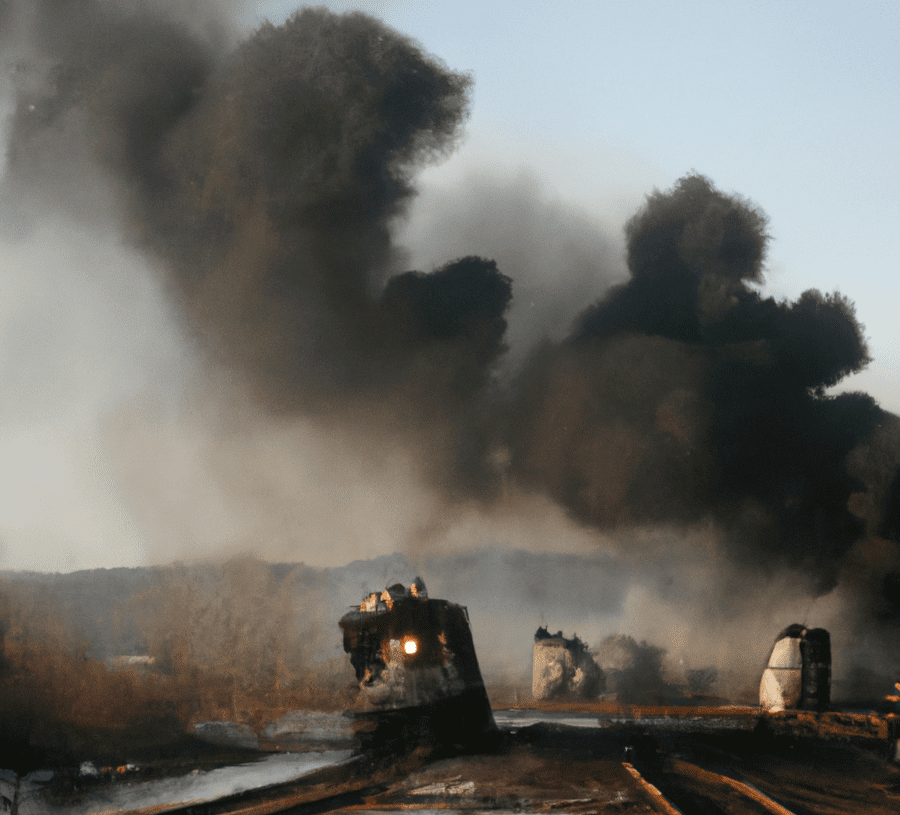
A controlled detonation, the operation was called. In reality, the consequences that the burnt vinyl chloride gas would have, in East Palestine and beyond, do not seem to have been controlled or assessed at all.
Because while it is true that the Ohio accident is not, for the moment, an environmental disaster on the scale of Chernobyl, the BP oil spill or the lead poisoning in Flint, Michigan – to cite only the most devastating man-made events for human health and the environment in recent decades – it is equally true that the long-term effects of this ‘controlled explosion’ are an obscure threat whose consequences are entirely unknown.
First of all, because the substances involved in the East Palestine accident are rather unusual chemicals. Scientists cannot say with acceptable certainty what level of exposure to vinyl chloride and the other compounds released by the train is safe, nor how they interact with one another. On top of this, the sensors used to measure concentrations have poor sensitivity, according to the experts themselves.
The (provisional) conclusion is therefore: we do not know. We do not know what quantities of these substances could harm people. And this is by no means reassuring, as the authorities would have it.
East Palestine is a town of about 4,700 inhabitants on the border between Ohio and Pennsylvania, not far from Pittsburgh. The government website, which to this day makes no mention of what happened on 3 February, opens with the classic welcome slogan of small US communities. East Palestine, the place you want to be. Not right now, the residents might reply, with an irony they would no doubt gladly do without.
While travelling east through Ohio, 38 cars of a Norfolk Southern freight train derailed. Eleven of them contained hazardous chemicals: some spilled onto the ground and into waterways. Others were set on fire by the authorities.
Five of the derailed cars were carrying vinyl chloride, a colourless gas used to make PVC pipes. Another car contained butyl acrylate, a clear liquid used to make glue, paint and other products.
Exposure to vinyl chloride can cause a range of symptoms, including headaches. With high exposure, it can cause a rare form of liver cancer. The problem is that, when the gas is burnt, as it was here, chemists explain that vinyl chloride releases hydrogen chloride and phosgene, two other harmful chemicals, as well as a number of other toxic combustion compounds. We almost forgot butyl acrylate: it can cause a range of respiratory disorders.
The American media report that in the days following the disaster a number of residents complained of headaches, breathing problems and dizziness. But the point is that it is unclear how many chemicals were actually released into the environment. Also because, as mentioned, they are not easy to measure.
Delphine Farmer, a chemist at Colorado State University interviewed about the effects of the disaster, wanted to reassure citizens and local residents. ‘The air in East Palestine today is not going to send you to the emergency room,’ she said. Monitoring by health officials has not detected harmful levels of air pollutants from the wreck up to Friday, including vinyl chloride and hydrochloric acid. ‘The great thing about outdoor air is that the atmosphere is very large,’ Farmer added. ‘These chemicals break down in the environment, some within a few days.’
No problem, then? A groundless alarm? Farmer herself admits that many of the sensors used to measure air quality are not very sensitive. ‘They can identify a leak at a factory or the presence of chemical weapons, but not detect traces of chemicals in the air.’ Even more worrying is the admission Farmer made immediately afterwards: ‘Scientists do not really know what level of exposure is safe in the long term. These are strange compounds that are not well tested.’
As for the water, the health authorities ‘are much better equipped to sample harmful chemicals in wells and waterways than in the air’, again according to Farmer. So far, tests have confirmed that the municipal water wells are safe to drink. Even so – to be on the safe side – citizens who draw water from private wells have been asked to keep drinking bottled water until their wells have been tested.
Meanwhile, however, things do not seem to be quite so for wildlife. Shortly after the disaster, the death of about 3,500 fish in the area’s waterways was reported.
For the moment, the only solution to the damage done seems to be cleaning up.
Officials from the health agencies are busy digging up contaminated soil, damming contaminated streams and removing as much of the pollutants from the water as possible. ‘If they do not clean up [the spill], it starts to migrate,’ admitted an environmental engineering expert.
And so, while the farsighted American authorities – not so farsighted when deciding to set fire to the vinyl chloride – have already set up a medical clinic in East Palestine to deal with any health emergencies that may affect the population, the only sensible thing to do seems to be to clean everything.
‘Clean your home thoroughly,’ Farmer recommended, ‘especially if you are in the evacuation zone. Clean counters, floors and walls. Wash every piece of fabric, including clothes and sheets. And open all the windows and doors.’
Household tips, however, do not seem to be enough for worried and above all furious citizens. On 16 February the head of the federal Environmental Protection Agency (EPA), Michael Regan, went personally to the small community to try to reassure residents. It did not go well for him: the visit was met with scepticism and anger.
At least eight lawsuits, class actions, have already been announced by citizens, who complain, besides possible harm to their health, of a state of intense and understandable personal and collective psychological stress.