How Ferragosto began
With the advent of Christianity, many pagan festivals were reinterpreted and absorbed into the Christian calendar. This process was not immediate but happened gradually, often superimposing Christian feasts on existing pagan ones, and Ferragosto was no exception.
The tradition of honouring the Assumption of Mary already existed in the early centuries of Christianity, especially in the East. The first documented traces of this celebration date back to the 4th–5th century AD. In the East, the feast was known as the ‘Dormition of Mary’ (in Greek, Koimisis tis Theotokou). This celebration also spread to the West, where, over the centuries, it became increasingly popular.
In 431 AD, the Council of Ephesus defined Mary as Theotokos (Mother of God), further strengthening her role within Christian theology. In the Catholic religion, the feast of the Assumption of Mary, celebrated on 15 August, is one of the most important Marian solemnities. Its official celebration in the West began in the 7th century, in a context in which the cult of the Virgin Mary was gaining ever greater importance in Christian spirituality.
Over the centuries, the feast of the Assumption continued to grow in importance. It was celebrated with great solemnity in churches throughout Europe and became a day of both religious and popular festivity, becoming deeply integrated into local traditions.
‘Modern’ Ferragosto
On 1 November 1950, Pope Pius XII proclaimed the dogma of the Assumption of Mary with the Apostolic Constitution Munificentissimus Deus. Ferragosto had already been officially recognised as a civil public holiday in Italy by Law no. 260 of 27 May 1949, consolidating a tradition that was already widespread and widely celebrated.
In the 1950s, Italy was going through a period of profound transformation and reconstruction after the devastation of the Second World War. The decade was marked by the economic boom, modernisation and social change, which deeply influenced Italians’ daily lives, including the celebration of Ferragosto.
The historical context of its birth
In 1950, Italy was still grappling with the challenges of post-war reconstruction. The economy was beginning to recover, thanks also to Marshall Plan aid and strong industrialisation. The 1950s saw the start of the ‘Italian economic miracle’, a period of unprecedented economic growth that led to a significant improvement in the standard of living.
In this historical context of growth and change, Ferragosto too began to be experienced differently. Before the war, Ferragosto was mainly a religious festival, celebrated with processions, masses and community activities. However, from the 1950s, with rising prosperity and the spread of paid holidays, Ferragosto began to turn into a day devoted to rest and fun.
Holidays and day trips:
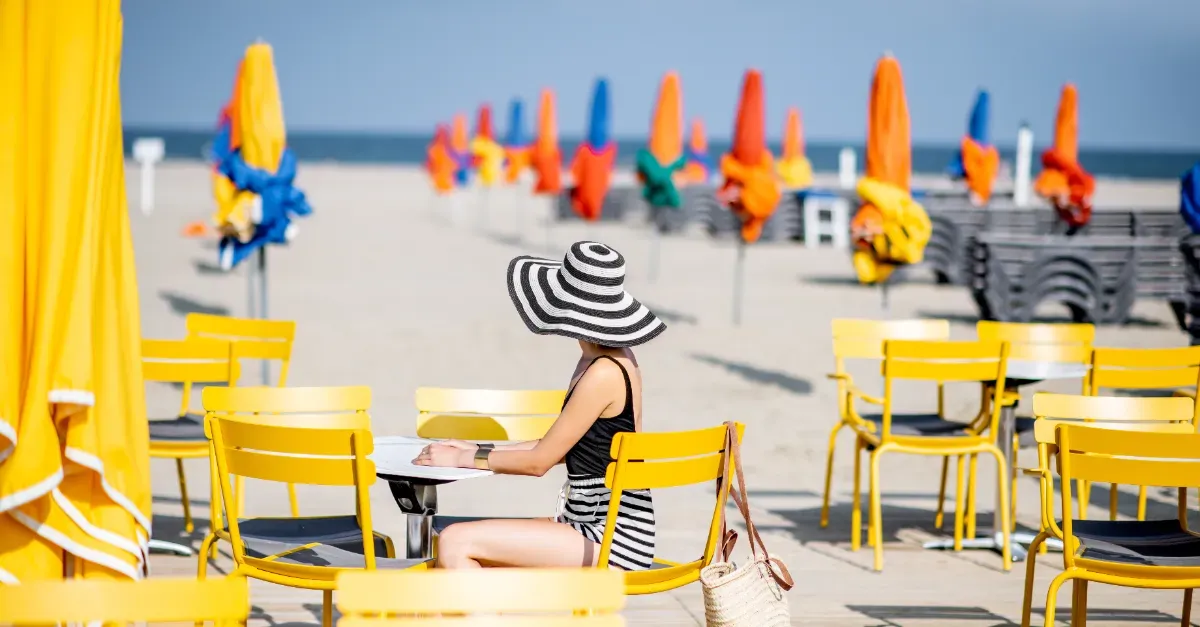
Italians began to use Ferragosto for day trips out of town, often to the sea, lakes or mountains. The ‘Ferragosto outings’ became a popular tradition, made possible also by improved infrastructure and greater mobility thanks to the spread of cars. For many at that time, there was only one car, perhaps a Fiat 600, packed to bursting to reach the seaside.
Picnics: food as a symbol of a better future
Another tradition that took hold in this period was that of picnics and outdoor lunches. Italian families gathered to share a meal in the countryside or by the sea, bringing food prepared at home with care by the mothers in the preceding days: trays of lasagne, grilled meat cooked on the spot, aubergine parmigiana and, of course, the inevitable watermelon. These moments of conviviality were a real breath of fresh air for Italians, who found peace away from work. After the difficult post-war years, that moment was one of the symbols of the new prosperity advancing and of optimism for an ever better future.
Television and mass culture
3 January 1954 officially marks the start of television broadcasting in Italy. RAI’s first regular broadcast began with an announcement by Fulvia Colombo. Television began to spread, even though it was considered a luxury, and in the following years it became ever more rooted in Italian homes. Ferragosto television programmes, often featuring music, comedies and variety shows, began to become an important part of the schedule of the time, offering those who stayed in the city an alternative form of entertainment and, at the same time, consolidating the culture of Ferragosto.
Leisure culture and economic status
In the years of the economic boom, Ferragosto became not only a traditional holiday but also an indicator of Italians’ economic and social well-being. The length of holidays and the way they were spent reflected improving living conditions, with summer holidays becoming a status symbol and a sign of a new lifestyle oriented towards leisure and consumption.
Even today, although the concept of holidays and leisure time has changed for economic and lifestyle reasons, Ferragosto remains deeply rooted in Italian culture; indeed, for many Italians, Ferragosto is still the high point of the summer holidays.