Some areas remain under Danish control: above all foreign policy, defence and national security.
Why does it interest the superpowers so much?
A strategic interest
Greenland’s geographical position makes it crucial for Arctic shipping routes. With the ice progressively melting, these routes are becoming more and more viable.
From a military point of view, Greenland hosts strategic bases, such as the United States’ Thule Air Base, which is fundamental to NATO operations. The United States has a long history of ‘interest’ in this region, dating back as far as the 19th century. Trump, then, has rekindled a political and strategic controversy at least a century and a half old.
China, too, has repeatedly shown a strong interest in Greenland, investing in infrastructure and mining projects. Through its ‘Polar Silk Road’ initiative, Beijing is seeking to establish closer links with the Arctic and gain access to the region’s resources.
Greenland and climate change: what is the link?
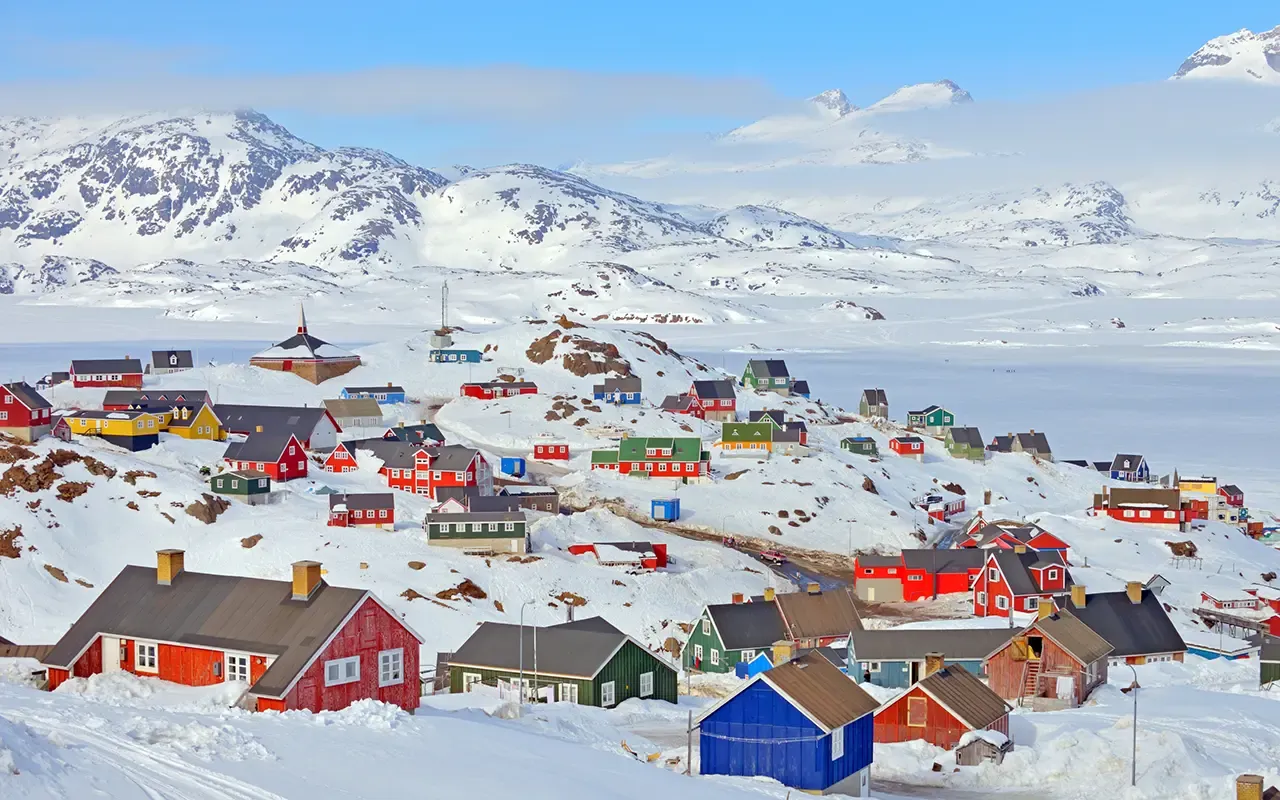
Greenland, which is about 80% covered by ice, is undergoing profound environmental changes because of global warming and human activity. These changes not only affect local biodiversity but also have significant repercussions on the global climate and sea level.
In recent decades, Greenland has seen an unprecedented acceleration in the melting of its ice. According to measurements, the rate of melting has increased fivefold compared with the 1990s, with an annual loss of around 270 billion tonnes of ice.
Note. This is not just a Greenlandic problem. This melting contributes about 30–40% of global sea-level rise. Scientists estimate that over the course of this century Greenland could lose more ice than it has lost in the last 12,000 years.
Over the last 30 years, 1.6% of Greenland’s surface has turned green, that is, vegetation has replaced the ice. This phenomenon alters the flow of sediments and nutrients in coastal waters, with negative consequences above all for indigenous peoples who depend on stable ecosystems for their livelihood.
Natural resources and the superpowers’ interest
White gold: Greenland’s minerals
As temperatures rise, new areas rich in minerals and rare earths are becoming accessible. This is the main reason for the Trump administration’s interest: mineral resources.
New, massive pressure for mining could cause irreversible damage to the environment and further compromise natural habitats. Against this prospect, part of the population made its voice heard in the recent general election. Environmentalist parties opposed to such exploitation, in order to protect the environment and local culture, did indeed see a significant increase in support.
Greenlandic oil: a submerged treasure
And then there is the question of oil.
Trump’s mantra ‘drill baby drill’ is by now well known: drill as much as you can, without regard for the possible consequences, perfectly in line with the turbo-capitalism of MAGA. But is there really oil in Greenland?
The answer is yes. According to estimates by the US Geological Survey, Greenland’s subsoil could contain at least 17.5 billion barrels of oil and 148 trillion cubic feet of natural gas.
The fact is that, to date, not a single barrel of oil has been extracted from Greenland’s subsoil. Exploration activities have been suspended by the government, which has adopted a moratorium on new hydrocarbon extraction licences. There is therefore a considerable question of sovereignty and political autonomy.
Geopolitical tensions continue
Trump, for his part, has said that the people of Greenland ‘want to be with us’. In an interview aboard Air Force One, he declared: ‘I think we’ll get it done’ in reference to controlling Greenland, adding that the island’s 57,000 residents had expressed a desire to join the United States.
Danish prime minister Mette Frederiksen immediately picked up the phone to reiterate, in a heated conversation with the US president, that the island is part of the Kingdom of Denmark and is not negotiable.
But Donald seems to have no intention of giving up. We shall see how things develop.