Today is monday 9 november 2026
Webzine of ecological news

Climate emergency · Glaciers · Ecosystem

Greenland has shrunk on me. At a rate of 30 million tonnes of ice an hour.

The figure is all the more striking when you consider that, compared with the forecasts of previous decades, the extent of the melting is 20% greater than was thought.

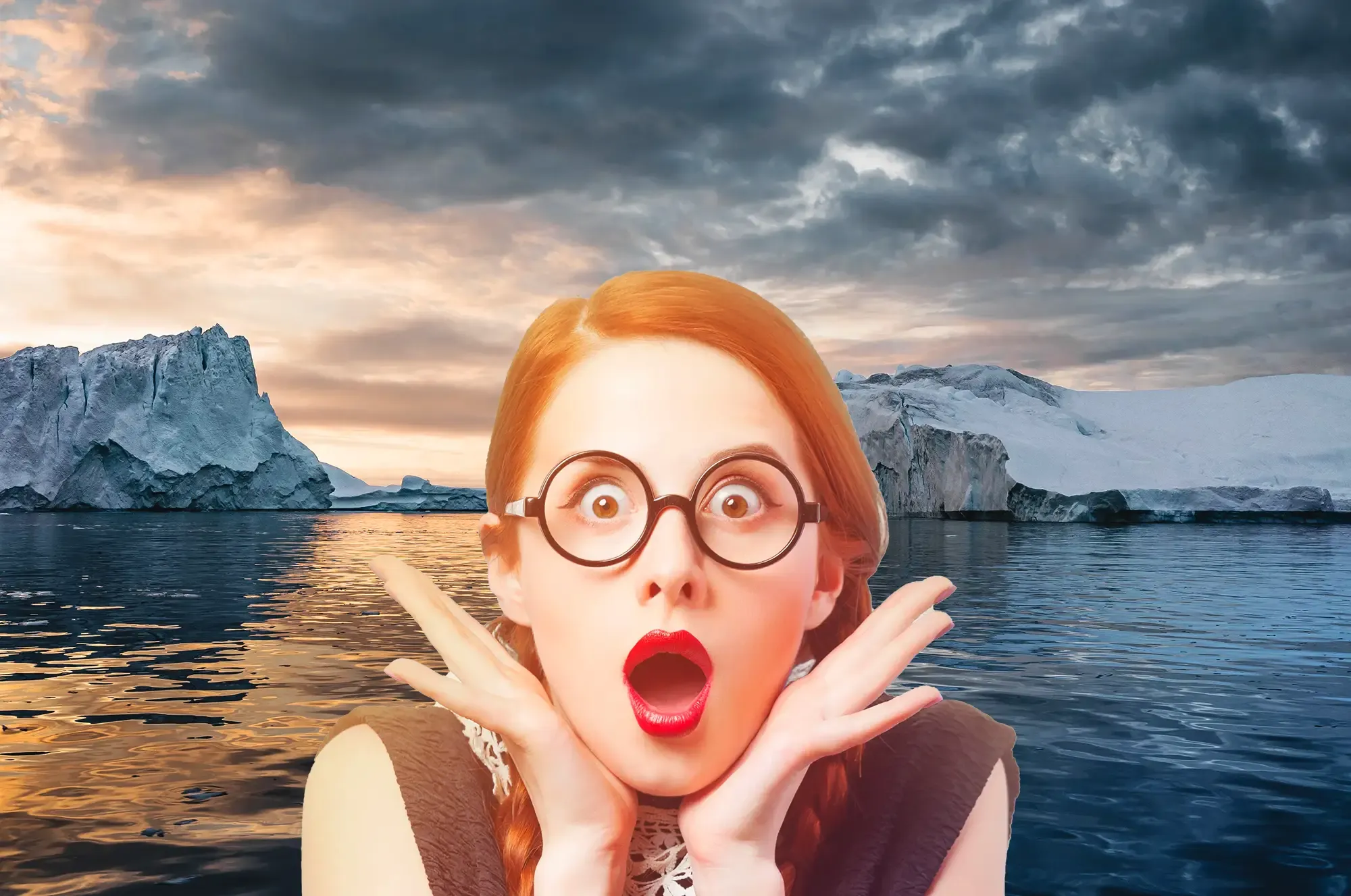
[massonforstock] © 123RF.com]. Woman [mathiasberlin] © 123RF.com] background photo

Despite the sceptics, for whom the planet’s glaciers are not really shrinking all that much, and in any case not in a worrying way, new dramatic data are emerging, and this time they concern none other than Greenland, the largest Arctic land and the biggest island on Earth.
Its ice sheet is losing an average of 30 million tonnes of ice an hour – yes, you read that correctly, every hour. The cause, according to the scientists monitoring the phenomenon, is of course the climate crisis.

The figure is all the more striking when you consider that, compared with the forecasts of previous decades, the extent of the melting is 20% greater than was thought.

And if anyone were to reply that, all things considered, it doesn’t seem all that serious since there is still a lot of ice in Greenland, scientists warn us that all this fresh water pouring into the North Atlantic could soon lead to a genuine collapse of the ocean circulation system that regulates the climate of Europe and North America: the so-called AMOC (Atlantic meridional overturning circulation), a sort of invisible conveyor belt that sends the warm, light, salty waters of the Gulf Stream towards the North Atlantic and redistributes the colder, heavier polar waters southwards.
Show more Show less

In studies over recent decades, scientists have mainly relied on satellite images to determine the final position of Greenland’s glaciers every month from 1985 to 2022.
The result was crystal clear before their eyes: a wide and widespread shortening, with trillions of tonnes of ice lost.

“It stands to reason that if you discharge fresh water into the northern Atlantic Ocean, you will certainly get a weakening of the AMOC, although I have no intuition of how much weakening,” said Dr Chad Greene, who works at NASA and is the coordinator of the research.

It was already known that the AMOC was at its weakest in 1,600 years: but in 2021 researchers detected signs of a genuine collapse, which could occur as early as 2025 in the worst-case scenario.

What is happening, essentially? The inflow of less dense fresh water into the sea slows the normal process by which heavier salt water sinks in the polar region, which is what drives the AMOC.

According to scientists’ predictions, this phenomenon would have profound impacts on the climate of the United Kingdom, western Europe, parts of North America and the Sahel region, where the West African monsoon could be severely disrupted.

As if that were not enough, researchers believe that a significant part of the Greenland ice sheet is close to a tipping point, beyond which the melting would be irreversible.

Here too, AI supported the study, which was published in the journal Nature. More than 235,000 final glacier positions over 38 years were mapped, at a resolution of 120 metres. Ultimately, the Greenland ice sheet has lost an area of about 5,000 sq km of ice at its margins since 1985, equivalent, as mentioned, to a trillion tonnes of ice.

The discovery of the enormous ice loss is also important for calculating the Earth’s energy imbalance, that is, how much extra solar heat the Earth is trapping because of human-caused greenhouse gas emissions.

“It takes a lot of energy to melt 1 trillion tonnes of ice,” the team’s researchers explain. “So, if we want very precise models of the Earth’s energy balance, this must be taken into account.”

Scientists also analysed the extent of Antarctica’s ice shelves over time, in a study published in 2022. They found that the total loss of ice shelves since 1997 has doubled to about 12 trillion tonnes.

openingglaciersdissolution

Machine translation

We respect your privacy

When you use this site, we and the third-party providers listed in the preferences may use cookies and similar technologies for the following purposes:

  • Necessary: Core functions: security, session and storing your choices.
  • External services: Embedded third-party content such as videos. It only loads if you allow it: the provider then receives your IP address and may set cookies of its own.

Only necessary cookies are active without consent. Some providers may transfer data outside the EU. You can change your choices at any time from the «Privacy settings» link at the bottom of the page; closing with the X continues with necessary cookies only.

Customise