Larderello, already known for its geothermal features such as the boric steam vents (soffioni boraciferi), was about to enter history as the site of the world’s first production of geothermal electricity.
Ginori Conti, a visionary industrialist and member of the Italian aristocracy, experimented with using natural steam from underground to generate electricity. His experiment consisted of a small generator that powered five light bulbs, thus demonstrating the potential of geothermal energy as a power source.
This experiment marked the beginning of the modern era of geothermal energy. Its success inspired further research and development, leading to the creation of a large-scale geothermal power station in that same area, contributing significantly to the Italian electricity grid.
Ginori Conti’s success at Larderello not only demonstrated the technical feasibility of geothermal energy, but also paved the way for the exploration of this renewable resource in other parts of the world, cementing his name in the history of sustainable energy.
Let us now turn to the present day, in a residential setting. And here comes the first disappointment, and unfortunately it will not be the last in this article. Generating geothermal electricity requires high-temperature geothermal resources, typically found only in specific geographical areas (such as near volcanoes or tectonic faults).
It also requires “major” infrastructure, such as deep wells to reach hot water or steam and turbines to convert the heat into electricity. The costs are therefore high. This makes such systems economically viable only on a large scale (such as for communities or utilities) and not for individual homes.
For homes, therefore, geothermal energy is more commonly used for heating and cooling by means of geothermal heat pumps. These heat pumps do not generate electricity but rather transfer heat from the ground to the house or vice versa, using a relatively small amount of electricity to run.
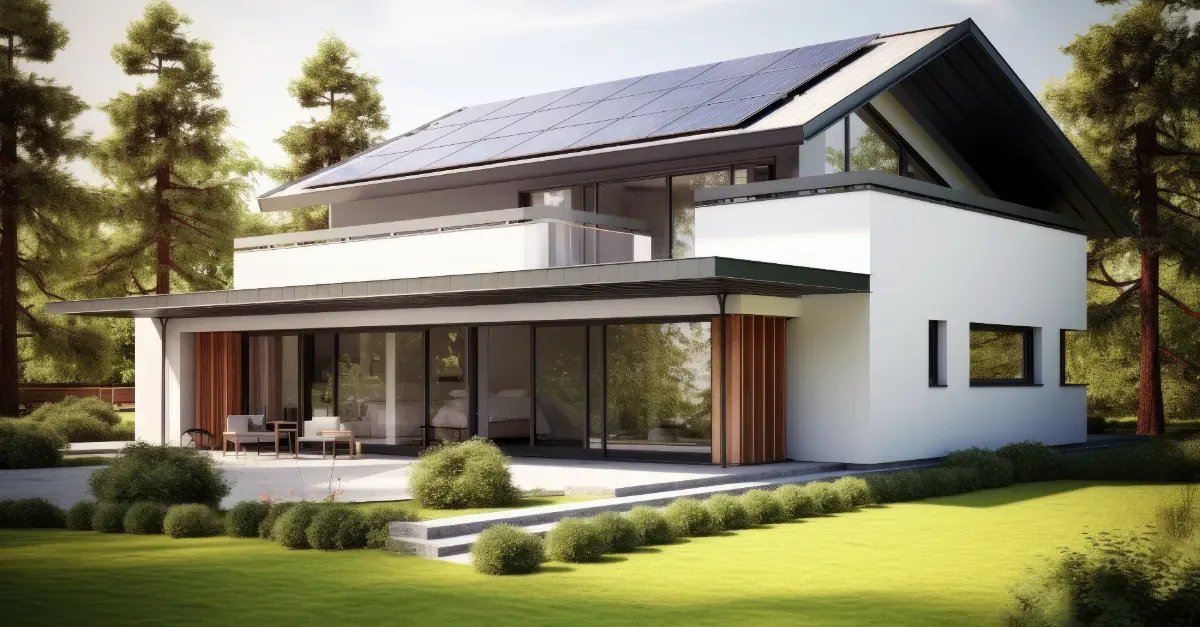
To generate renewable electricity at household level to run the pump, we can use photovoltaic panels installed on the roof of the home or on the ground near the pump.
Works and costs
The amount of land required to install a geothermal heating and cooling system for a house of about 200 square metres, for example, depends on various factors, including the type of soil, the local climate, the insulation of the house and the specific configuration of the geothermal system. However, we can provide a general estimate based on common principles.
There are two main types of geothermal loop that contribute to the costs:
Horizontal loops: These are laid at a depth of between 1.2 and 1.8 metres below the surface, where the ground temperature is relatively constant. For a house of 200 square metres, between 400 and 800 square metres of land may be needed for the horizontal loop, depending on the efficiency of the system and the ground conditions.
Vertical loops: If space is limited, vertical loops can be used, which require boreholes 30 to 120 metres deep. These take up less space on the surface, but require deep drilling. For a house of 200 square metres, the surface area required can be reduced to about 100 square metres, but this entails higher drilling costs.
These estimates are approximate and may vary considerably. Key factors in determining the actual space and quantifying the costs of excavation and materials:
Thermal efficiency of the house: A well-insulated house requires less energy for heating and cooling, reducing the demands on the geothermal system.
Thermal conductivity of the ground: Some types of soil transfer heat better than others, affecting the efficiency of the geothermal system and, consequently, the size of loop required.
Local climate: In areas with climatic extremes, the geothermal system will have to work harder, potentially requiring a larger loop.
The heart of the system is the heat pump, which includes a compressor, an evaporator, a condenser and an expansion device. These components can be made of various materials, including metals such as copper and steel, and other materials specific to the electrical and mechanical parts.
But let us come to the costs, and here is the second disappointment (unfortunately), as promised. Installing a residential geothermal system can cost from around 15,000 to 25,000 euros or more. Systems with vertical loops tend to be more expensive than those with horizontal loops because of the need for deep drilling.
Before making any decision, it is advisable to consult a professional specialising in geothermal systems who can assess your specific site and provide a more accurate estimate based on local conditions and the requirements of your home.