What is the circular economy?
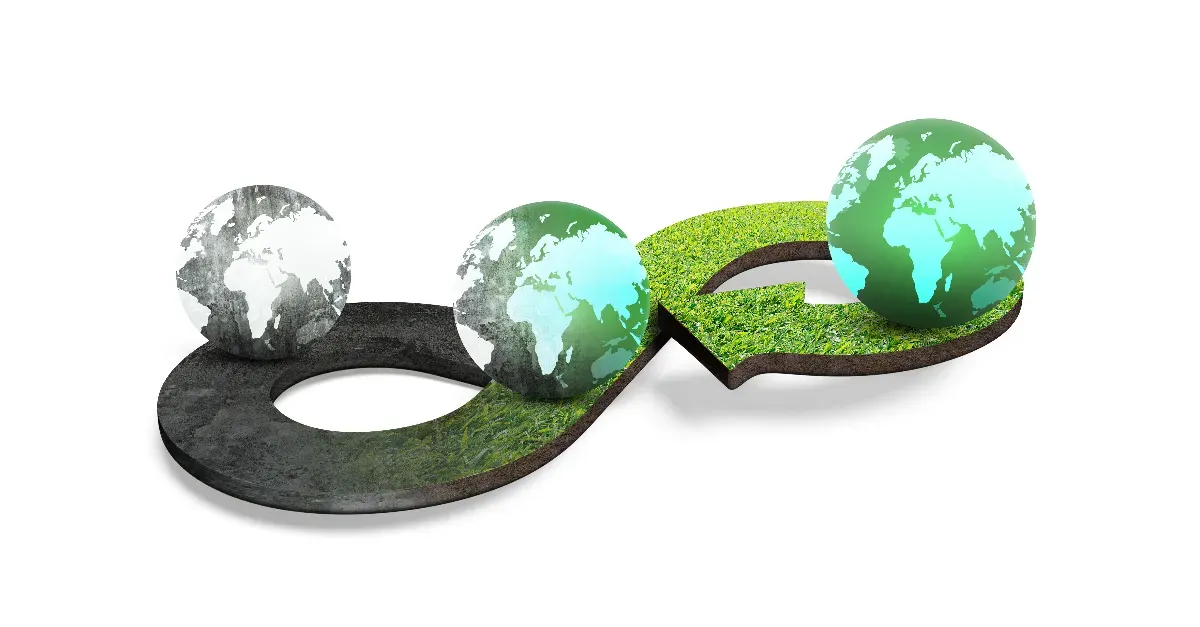
The circular economy is an economic model that promotes the reuse of resources and the production of waste that can be recycled. The circular economy is based on the proposal that materials should be designed to be reused or recycled at the end of their life cycle, rather than simply disposed of. Within this model, resources are kept circulating through the economy with the aim of minimising waste; it also seeks to slow the rate at which resources are consumed and wasted, increasing resource efficiency and reducing environmental damage.
With the growing scarcity of natural resources, such as water and fossil fuels, it is important to explore new models and ideologies that promote sustainability. The circular economy is one such example, and it has become increasingly popular in recent years. It does not necessarily entail a reduction in development, but rather an optimisation of the resources that help to create it.
The benefits of the circular economy
The model is based on the fact that materials are limited and, once used or consumed, cannot be created again. The model focuses on designing products that can be reused, repaired or recycled at the end of their life cycle. Companies that adopt the circular economy use materials more efficiently, which reduces costs. The circular economy also encourages the reuse and sharing of goods that would otherwise be thrown away.
For example, a car can be repaired instead of being replaced when it breaks down, and any object can be reused and given a new life if it is not abandoned but used by others. This stands in contrast to planned obsolescence in the industrial economy, which instead aims to define a product’s life cycle so as to limit its duration to a set period. In France, this practice is considered an offence, defined as the set of techniques by which a manufacturer carries out actions or activities designed to shorten the very life of products.
The goals of sustainable development
The Sustainable Development Goals are a set of goals that focus on the environment, social issues and economic growth. It is clear that when we talk about sustainability we are talking about concepts far broader than the circular economy, involving philosophy of life, beliefs, culture and the economy. Adopted by the United Nations in 2015, they replace the heads of state’s “Millennium Declaration”, which in 2000 set out the so-called “Millennium Development Goals” (MDGs) to be achieved by 2015.
The goals focus on 17 key areas, with a programmed agenda running to 2030. These areas were chosen to cover social, economic and environmental issues around the world, including problems such as poverty, hunger and inequality. The aim of these goals is to tackle these problems and create a better world for everyone, which is why sustainability is not tied exclusively to environmental issues. After all, on a planet with scarce resources, issues of inequality would only get worse.
The challenges of implementing both philosophies
The two philosophies require different approaches, making it difficult to implement them simultaneously. The circular economy focuses on changing production, while the Sustainable Development Goals focus on more ethical behaviour aimed at exploiting resources less. The two philosophies are certainly not incompatible and can coexist to achieve the result.
Conclusions
The circular economy and the sustainable economy are in fact two sides of the same coin. A virtuous use of the circular economy helps to achieve the sustainability goals that nations have set themselves for the future.