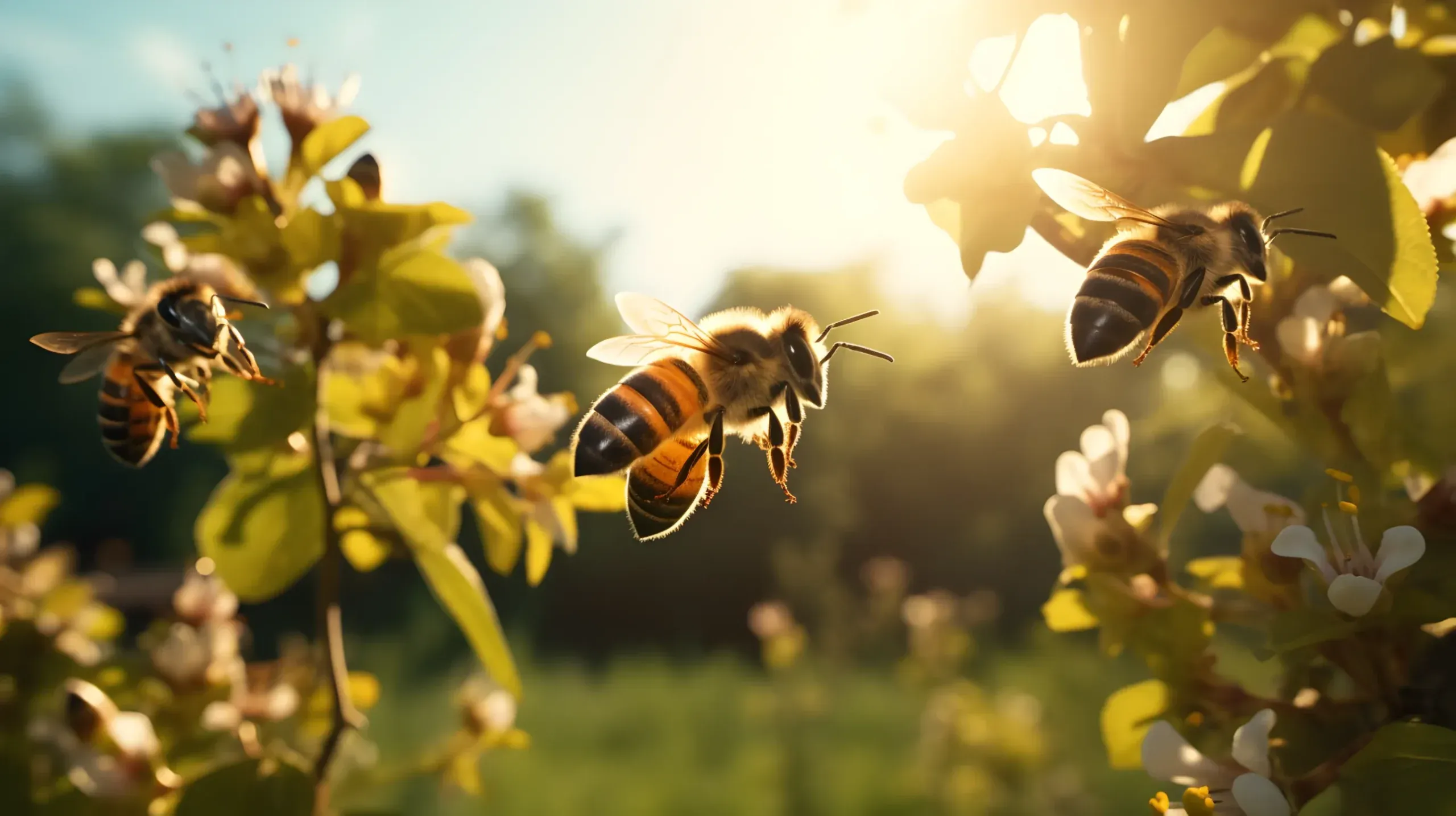
- Chemical contaminants: pesticides and other chemicals can poison bees and impair their navigation, immune system and reproductive capacity.
- Climate change: variations in the seasonality and intensity of weather events can affect the life cycles of plants and therefore the availability of food for bees.
A recent study has shown that the presence of healthy bees in an area is an indicator of a flourishing environment. In particular, the abundance of bees in an ecosystem is positively correlated with the variety of plants present, which is a sign of a healthy and resilient environment.
More than 75% of the world’s food crops depend to some extent on pollination, a service that bees provide free of charge. Without them, plants such as apples, almonds and even coffee would suffer drastically, with repercussions for global food production and market prices.
Honey production is a sector that directly reflects the health of bees. When bees are healthy and the environment is rich in biodiversity, honey production tends to increase. Conversely, a drop in production can be a sign of environmental problems.
Globally, some of the main honey producers include countries such as China, which leads world production, followed by countries such as Turkey, where the most expensive honey in the world is produced: ‘Elvish’ or ‘elf honey’, which is in fact Anzer honey (or Anzer Balı in Turkish), coming from the Anzer plateau in the Black Sea region of Turkey.
This honey is famous for its alleged therapeutic properties and the great diversity of mountain flowers from which the bees gather nectar. The Anzer area is rich in floral biodiversity, and it is said that over 500 different species of wildflowers grow here, far more than are found in ordinary bee foraging areas.
Then there is Iran, whose honey has a long history and tradition, with beekeeping practised in many regions of the country. Thanks to the wide range of climates and ecosystems, from the central plateau to the mountain areas, from the Caspian forests to the coastal regions, Iran has a rich floral biodiversity that allows the production of several varieties of honey. We mention some: Sidr honey (jujube), produced mainly in desert areas, is known for its rich flavour and medicinal properties; Thyme honey, obtained from the regions where thyme grows, is appreciated for its antibacterial qualities; Acacia honey, from the northern forests, is light and delicate, often preferred for its unobtrusive sweetness; Mountain flower honey, obtained from the wide variety of flowers growing in the mountain regions, is aromatic and rich in nutrients.
The United States should also be mentioned among the producing countries, where a wide range of climates and environments allow the cultivation of many plant species from which bees gather nectar. We mention some types: Clover honey, one of the most common and popular types of honey in the United States, produced in many areas but abundant in the great fields of the Midwest and the Great Plains; Alfalfa honey, from the alfalfa plants of the Midwest and the Rocky Mountain region, often light and delicate; Tupelo honey, produced mainly in Florida and Georgia, in particular in the Apalachicola River area in Florida, known for its unique flavour and because it does not crystallise easily; Wildflower honey, a multifloral honey obtained from a variety of wild flowers; Buckwheat honey, dark and strong, most commonly produced in Minnesota, New York, Ohio and Pennsylvania.
In Europe, honey production is equally diverse and varies considerably according to climate, flora and regional beekeeping practices. We mention:
Lavender honey: produced in abundance in France, especially in the Provence region, where lavender fields are a familiar sight.
Acacia honey: this light, sweet honey is popular in Romania, Hungary and Italy, where Robinia pseudoacacia trees are widespread.
Chestnut honey: with its strong, slightly bitter flavour, it is widely produced in Italy and Spain.
Heather honey: typical of Scotland and northern England, it has a unique jelly-like consistency and a rich, slightly bitter flavour.
Coriander honey: especially in Bulgaria and other Eastern European countries, where coriander cultivation is common.
Linden honey: produced throughout Europe, especially in areas such as Germany and Poland, this honey has a distinctive flavour and is said to have calming properties.
Wildflower honey: common throughout Europe, it is a blend of nectars from different seasonal blooms and reflects the biodiversity of the area in which it is produced.
Eucalyptus honey: mainly in Portugal and Spain, where the eucalyptus tree is abundant.
Thyme honey: popular in Greece, particularly on the islands, where thyme grows in abundance.
Orange blossom honey: produced especially in Spain and Italy, this variety has a delicate, aromatic flavour.
Rapeseed honey: common in northern European countries such as the United Kingdom, Germany and Sweden, this honey tends to crystallise very quickly.
Pine honey: especially in Greece and Italy, it is obtained from pine forests and has a distinct resinous flavour.
These varieties of honey reflect only a part of the vast range of honeys produced in Europe, which is known for its traditional and sustainable beekeeping practices. In many countries, honey is protected by designations of origin and quality standards that guarantee its authenticity and purity. Moreover, with growing interest in organic honey and eco-friendly beekeeping practices, Europe is at the forefront of sustainable, high-quality honey production.
Can the health of bees be improved? Certainly, there are examples of how targeted interventions can improve the health of these small pollinators. In Norway, the ‘pollinator corridor’ in Oslo, a project that created an urban path rich in native flowers, has improved the survival and diversity of local bees. The European initiative ‘Bee Careful’, aimed at protecting bees from exposure to harmful pesticides, has seen a reduction in the use of harmful substances and a consequent improvement in bee populations.
Let us not forget, then, that the health of bees is a reflection of the wellbeing of the environment. Protecting these creatures is not only a matter of nature conservation, but is essential to guarantee human food security. Through sustainable farming practices, a reduction in the use of pesticides and the promotion of habitats rich in biodiversity, we can ensure that bees continue to play their vital role in the ecosystem.