One of the most important Italian exponents of this movement is Mauro Staccioli, whose unique vision and deep bond with the land have left an indelible mark on contemporary art.
Mauro Staccioli: an artist in tune with the environment
Mauro Staccioli (1937-2018) is one of the most important exponents of environmental art in Italy. Born in Volterra, in Tuscany, he studied at the local Istituto d’Arte and at the Accademia di Belle Arti in Florence; before devoting himself entirely to sculpture in the 1970s, he began his career as a teacher.
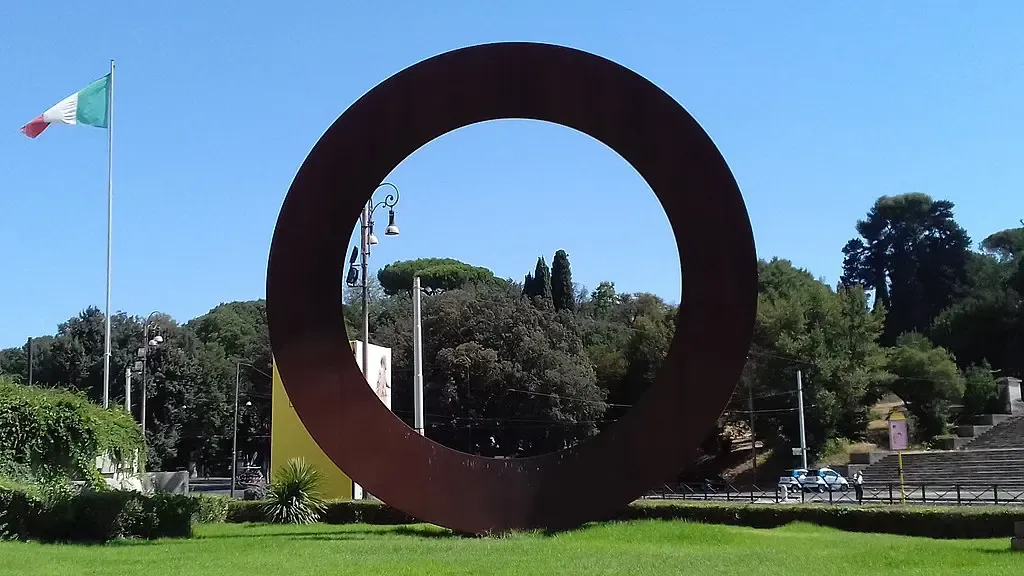
His art is rooted in the conviction that a work must engage in dialogue with the place in which it is set, becoming an integral part of the landscape and transforming how it is perceived. His sculptures, often large in scale and made of materials such as Corten steel and concrete, are site-specific installations that interact with the surrounding environment in a surprising and poetic way.
Moreover, the town of Volterra recently paid tribute to its famous citizen by opening a museum dedicated to him. The Museo Mauro Staccioli, inaugurated in 2023, is located in the heart of the beautiful Tuscan town and houses a vast collection of the artist’s sculptures, sketches, drawings and archive materials. This exhibition space not only celebrates Staccioli’s career, but is also a place for reflection and dialogue on environmental art and the landscape.
Some works by Mauro Staccioli in Italy
One of Staccioli’s most iconic works is Il Cerchio di Volterra, a large Corten steel ring installed in the Tuscan hills, the fruit of a perfect dialogue between the pure geometric form of the circle, which evokes continuity and perfection, and the natural landscape. The ring, with its empty centre, frames the surrounding panorama, inviting viewers to contemplate the beauty of nature from a new perspective. The work therefore not only blends harmoniously with the land, but enhances it, creating a unique vantage point.
Again in the countryside around Volterra, the artist’s place of choice, there is Ellisse, a work that seems to change shape depending on the viewer’s point of view, offering a dynamic and engaging experience.
The Ruota di Prato, on the other hand, is an installation in the Parco delle Sculture in Prato. It is a monumental section of a wheel, several metres high, again in Corten steel, which seems to emerge from the ground like a rediscovered archaeological ruin, evoking a sense of history and temporality, and inviting reflection on the relationship between man, nature and time.
Drawing on these very themes, Staccioli created Catanzaro 11 in the Parco della Biodiversità in Catanzaro, a ring in permanent dialogue both with the surrounding landscape and with the other sculptures in the vast park, a sort of open-air museum, among the most important in the Mediterranean area.
The legacy of Mauro Staccioli
Mauro Staccioli left an indelible mark on the world of environmental art. His works, characterised by rigorous formal research and a deep sensitivity to the natural context, continue to inspire and fascinate. His vision of art as a means of transforming and enhancing the landscape remains a powerful example of how creativity can contribute to sustainability and environmental awareness.
Staccioli’s legacy lies not only in his sculptures, but also in his ethical and aesthetic approach to art. His work reminds us of the importance of considering the environment as an integral part of the creative process and of seeing art as a bridge between man and nature, capable of generating new forms of dialogue and understanding.
At a time when environmental issues are at the centre of the global debate, the art of Mauro Staccioli makes a valuable contribution, showing how beauty and innovation can go hand in hand with sustainability and respect for our planet.
For more information on the life and works of Mauro Staccioli, see: https://maurostaccioli.org