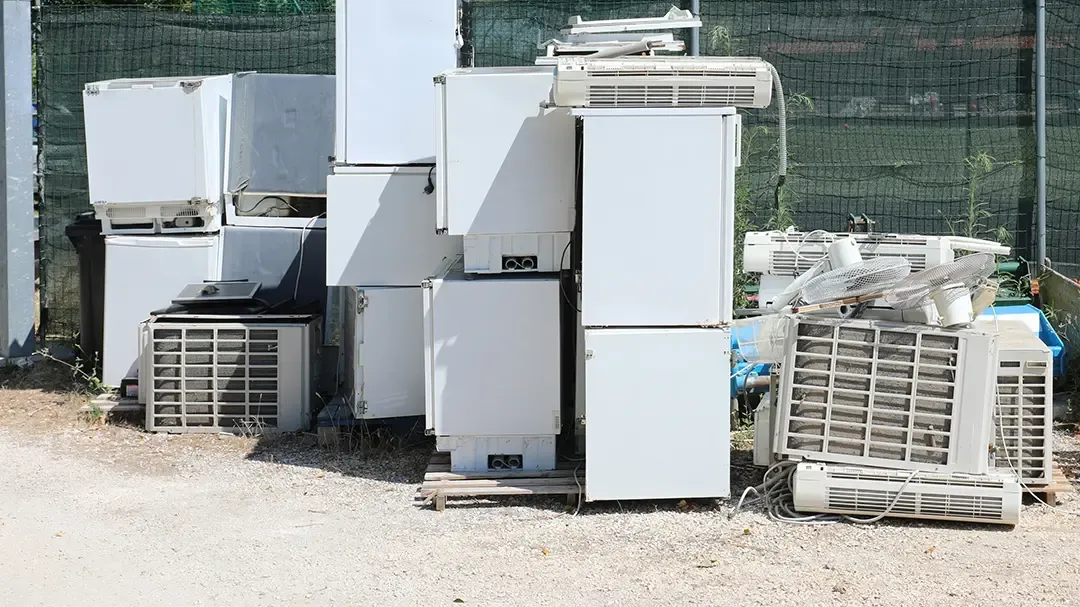
A country of empty homes (yet one that keeps consuming land)
The country of empty homes. This is how someone, ironically but not too much so, has described Italy when it is viewed from a building perspective, and above all in terms of the relationship between existing buildings and the land....
The country of empty homes. This is how someone, ironically but not too much so, has described Italy when it is viewed from a building perspective, and above all in terms of the relationship between existing buildings and the land.
In Italy there are over 31 million dwellings. Of these, just over 24 million are occupied in one way or another, while the other 7 million are unoccupied or occupied by people who are not resident – that is, they are second homes.
These are Istat figures, and they are also somewhat dated. They go back to the last census, carried out in 2011. Over 3.9 million more dwellings were recorded during the decade 2001–2011. The 2001 census had counted almost 27.3 million dwellings in Italy, of which 5.6 million were unoccupied.
According to Istat, the total number of dwellings recorded in 2011 amounts to 31,208,161 units. Of these, 77.3% (24,135,177) are occupied by at least one resident, while the remaining 22.7% (7,072,984) are dwellings that are unoccupied (empty) or occupied only by non-residents.
Show moreShow less
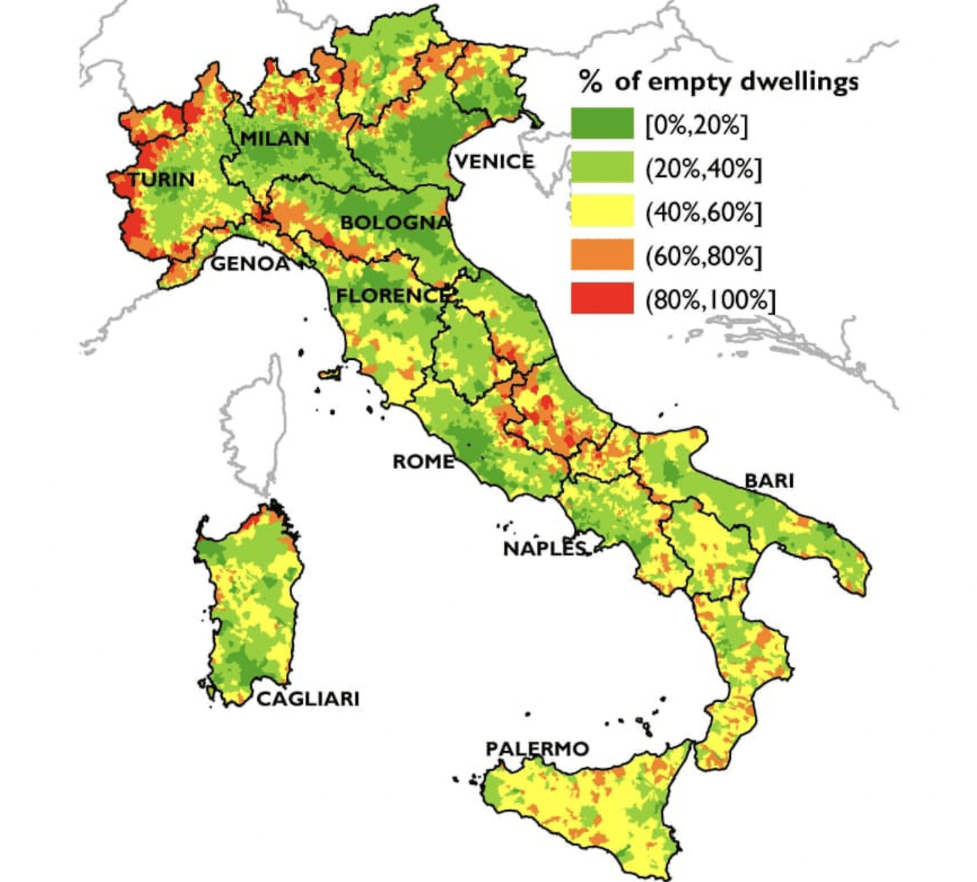
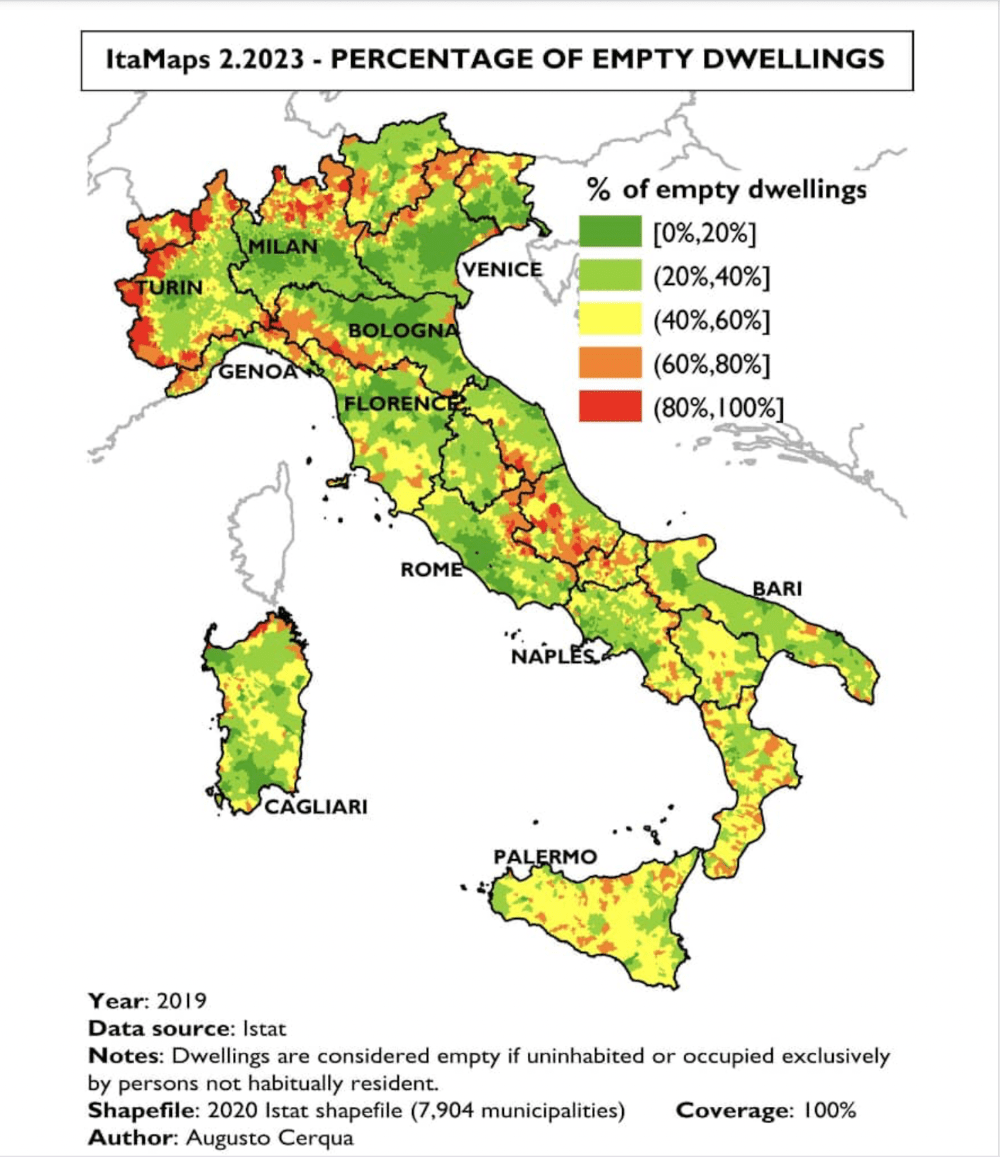
Looking at individual areas, the share of occupied dwellings ‘is well above the national average in Lombardy (84.5%), Campania (almost 83%) and Lazio (82.2%)’. The highest percentage of unoccupied dwellings is in Valle d’Aosta (50.1%) (‘in line with what was already found in 2001’), followed by Calabria (38.8%) and Molise and the Province of Trento (37.1%).
‘Between the 2001 census and the 2011 one’, the Istat note reads, ‘dwellings with at least one kitchen increased slightly (+8.1%), while those with only a kitchenette almost doubled (+82.3%)’. The highest share of dwellings with at least one kitchen is found in the Islands and the South (78.3% and 77.1% respectively), the lowest in North-West Italy (70.6%).
The map below shows the figures above visually:
Ispra data
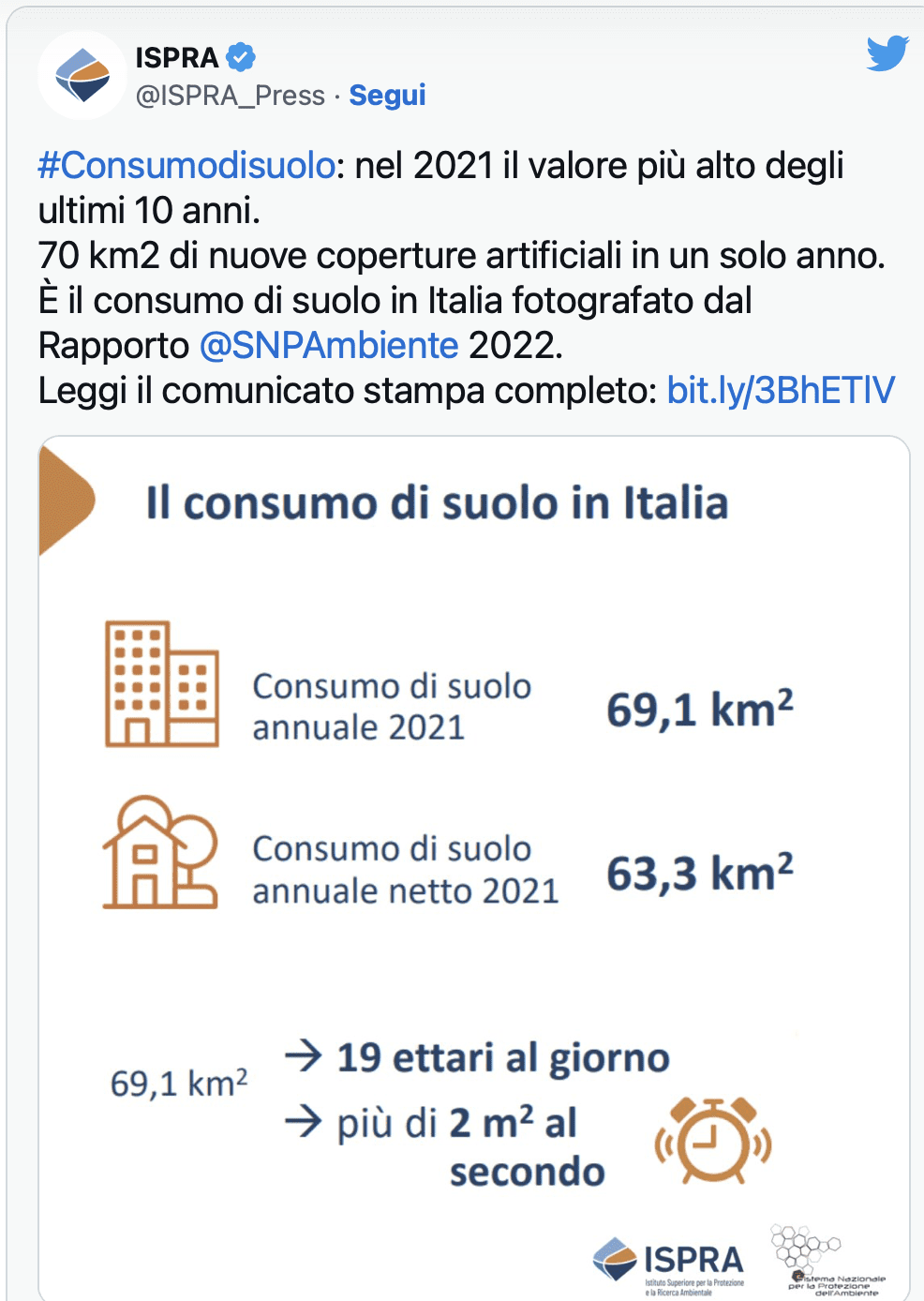
If Italy is therefore a country with many empty homes, it is also a country where land consumption continues at an unrelenting and unsustainable pace. And this is precisely what makes the figure on unoccupied homes problematic, to say the least. On the most recent World Soil Day, celebrated on 5 December, it was WWF Italy that renewed the alarm. Citing the 2022 ISPRA Report on land consumption, ‘in Italy we continue to lose 2 m² of soil every second’.
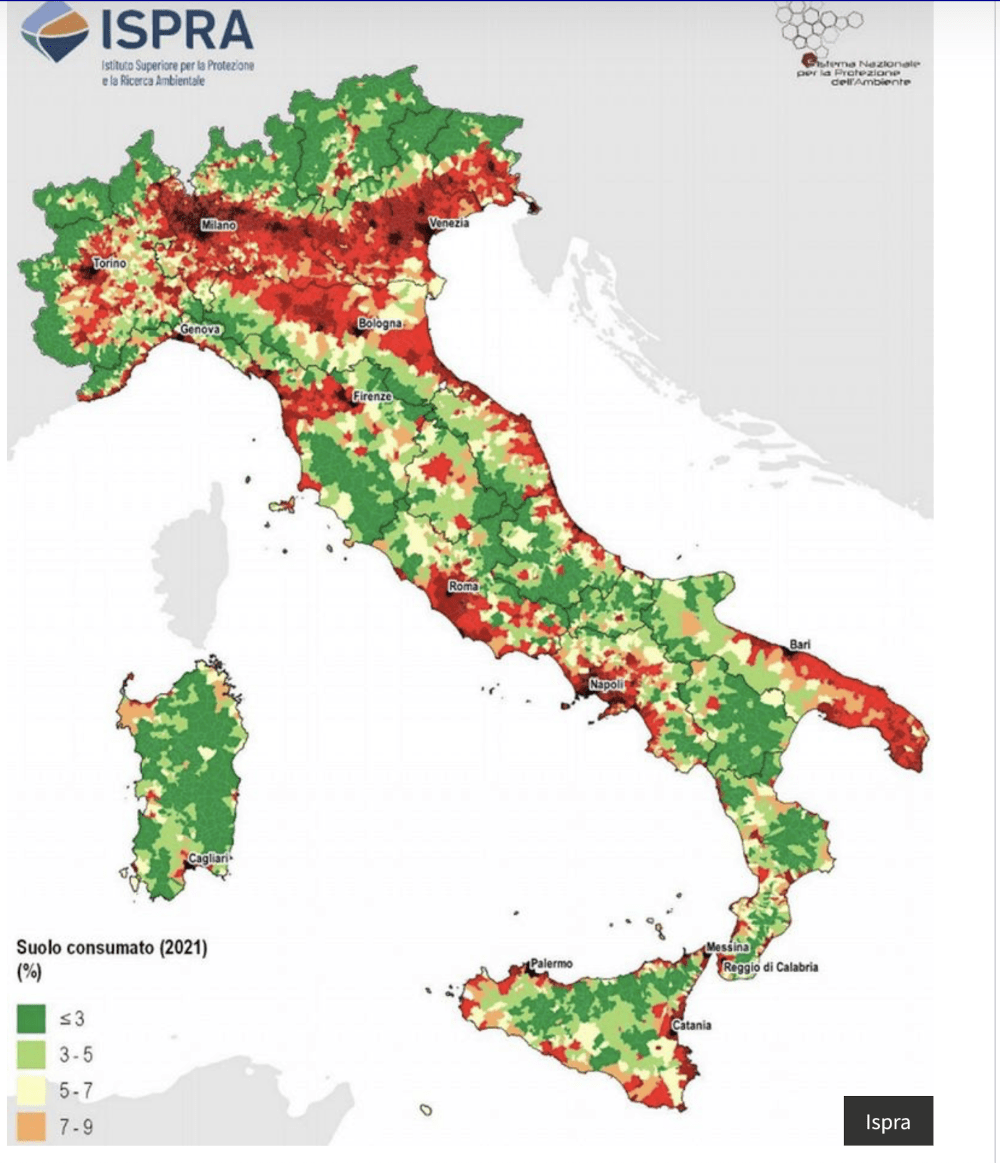
The ISPRA figures speak for themselves. In 2021 the average was 19 hectares of soil lost per day, the highest value in the last 10 years. A total of 21,500 km² of soil has been covered in concrete across the country, and buildings alone occupy an area equal to Liguria (5,400 km²).
These numbers appear in all their drama right after the tragedy of Ischia, the latest in a series of catastrophic events striking our country’s devastated and overexploited land.
As the Report points out, in fact, the soil lost since 2012 would have allowed the infiltration of over 360 million m³ of rainwater, worsening the hydraulic hazard of our territories (which from 2000 to 2019 caused 438 deaths in Italy – Source: CNR-Irpi). Concrete then plays its part, sealing surfaces and interrupting the recharge of aquifers. Here is a map showing the advance of concrete cover in Italy and its distribution by area:
Ispra data
Was it useful? Pass it on to someoneSharing an investigation is worth more than a like.