Ensuring that these needs are met is essential for animal welfare, in both farming and captive settings.
One of the clearest signs of the ‘mistreatment’ of animals and of the cruelty with which they are treated is called white striping. This is what emerges from the report by (Essere Animali)
‘White striping’ is a pathological phenomenon affecting chicken meat. As we said, it appears as white streaks of intramuscular fat inside chicken breasts.
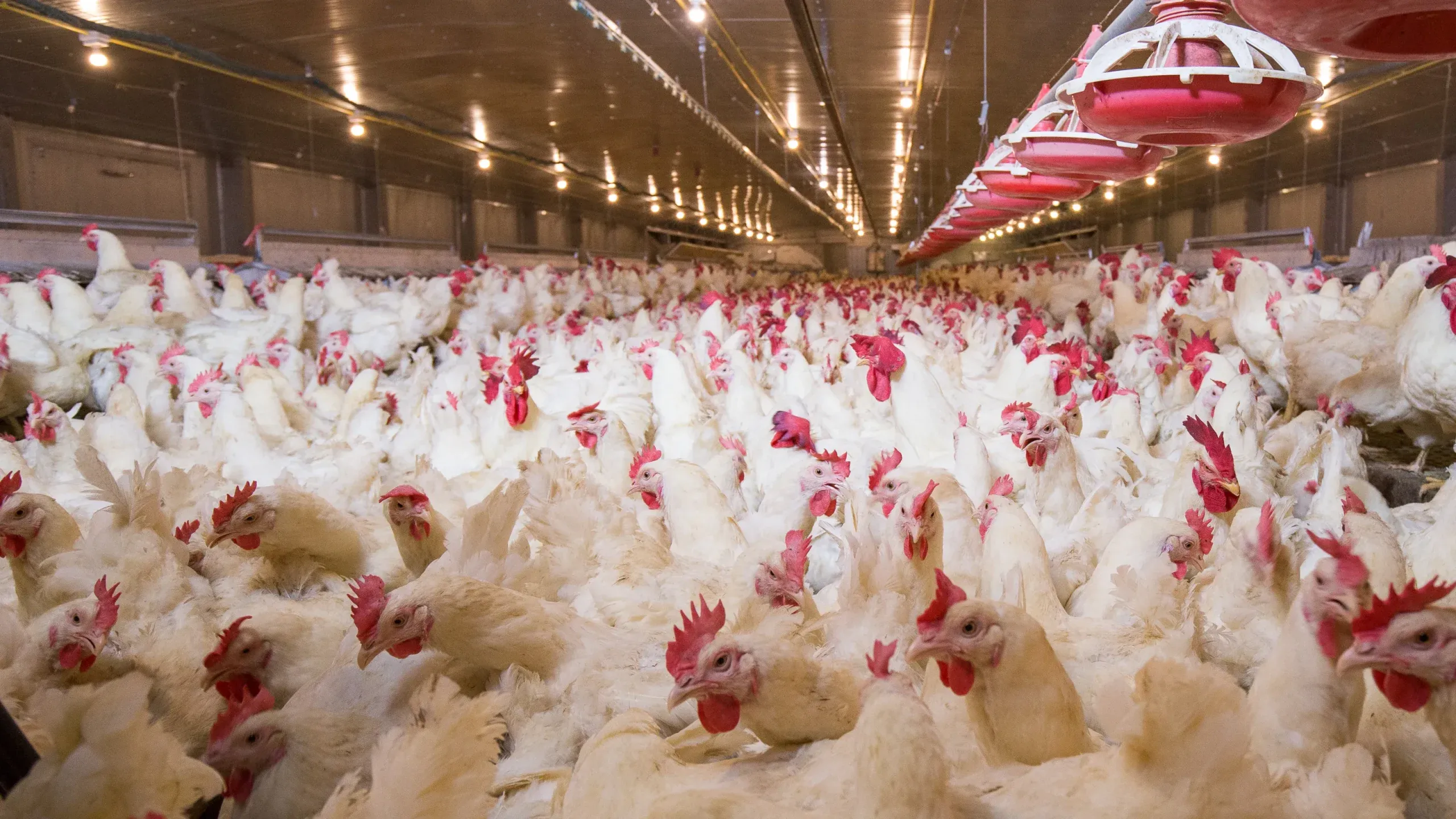
This condition has become increasingly common in intensive farms, where animals are selected for rapid growth and a high meat yield, particularly in the breast.
The white streaks not only alter the appearance of the meat, but can also affect its quality, reducing its texture and flavour and changing its nutritional content, in particular by lowering the amount of protein and increasing the amount of fat.
Chickens affected by white striping can have a fat content up to 224% higher than that of birds from extensive and semi-extensive poultry farms. Other research indicates a less dramatic increase, suggesting a variation that can range from 84% to 224% depending on the severity of the white striping.
Remember that in extensive farming the animals roam freely in the countryside, while semi-intensive birds are raised on very small plots of land.
Supporters of intensive farming argue that, despite the increase in fat, since the lipid content of chicken breast starts from a very low base, even with the hypothesised 224% increase the total fat content would remain relatively low; moreover, there is no scientific evidence that white striping poses a risk to human health, although it may indicate lower meat quality than that from extensive or semi-intensive poultry farms.
It remains evident, however, that the animal is treated cruelly, which can and should be avoided. In this regard, Europe and Italy establish by legislative decree that the owner, keeper or holder must take appropriate measures to ensure the welfare of their animals so that they are not caused unnecessary pain, suffering or injury, and a maximum stocking density of 33 kg/m2 is also set, roughly 10-12 chickens per square metre.
This density per square metre, however, is far from the bucolic image of “floor-reared” hens scratching freely in the farmyard; it can rise to 16-17 chickens per square metre inside sheds in hyper-intensive systems. Remember that floor-reared means without a cage, not necessarily in the open air.
The numbers are considerable: in 2022, 516 million chickens were slaughtered (Essere Animali data), equal to 1.21 million tonnes, a fall of almost 12% (-11.8%, ISMEA data), which nonetheless reflects a sector worth 5 billion 350 million (Unitalia 2022 data) for broiler chickens alone. It is in the commercial as well as the production sector that operators justify themselves by saying that price is the driving reason for the existence of this type of farming, which allows savings that also benefit consumers financially. Consumers, however, should reasonably be able to choose otherwise.
We wonder whether it is possible, today, in the logic of Environmental, social, and corporate governance (ESG), whose parameters affect the economic activity of multinational companies and not only them, that these companies have still not “equipped” themselves to change this production and market logic. A logic that is probably not liked by a significant part of the companies’ own stakeholders either, starting with customers.
other sources and further reading:
- decree LEGISLATIVE DECREE 27 September 2010, no. 181
- letter: https://welfarecommitments.com/letters/europe/it/