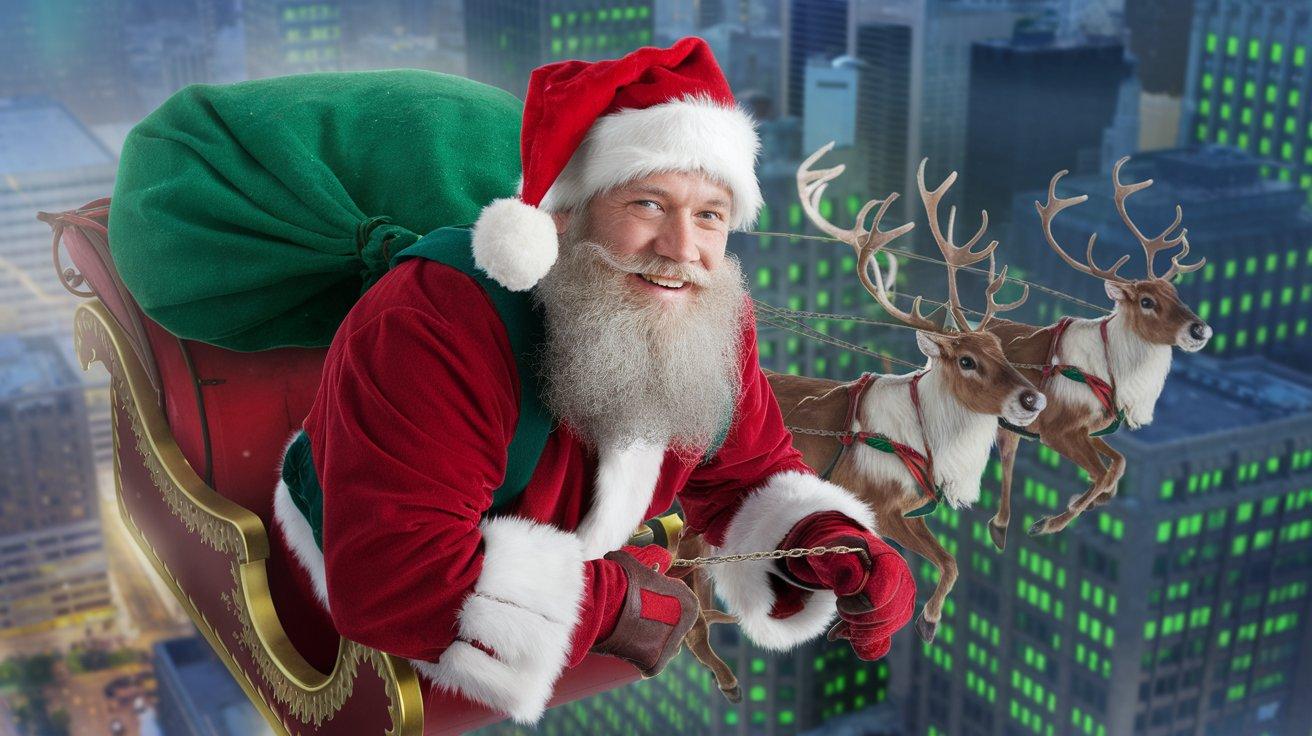
In the nineteenth century, in the United States, it was the writer Washington Irving who told the story of Father Christmas that we know best today, describing him as a little man who travelled on a wagon, flying among the trees. It was then Clement C. Moore, another nineteenth-century poet, who revealed to us in his poem Twas the Night Before Christmas that Father Christmas travelled with eight reindeer, each with a name, and that he brought presents to all the children who had behaved well.
Over time, in short, Father Christmas became more and more like the one we know today, above all thanks to the drawings of a German artist named Thomas Nast, who showed him to us plump, laden with gifts, with a long beard and mistletoe on his head, dressed in red with white fur.
Nast’s idea was taken up in the 1930s by Coca-Cola: yes, by that very multinational that created the famous drink! In Coca-Cola’s advertisements Father Christmas acquired his most famous image: dressed in red, with a prominent belly, smiling and cheerful, ready to hand out presents to everyone. But why did Coca-Cola need Father Christmas? Simple: it needed a spokesperson to boost sales in the winter months, and Father Christmas was considered perfect for the role.
Coca-Cola, then, needed Father Christmas, but did Father Christmas really need Coca-Cola? I think that if we could ask him he would answer: “What damage to my image! There were already those who saw me as someone who only brought presents, feeding consumerism… then Coca-Cola delivered the final blow! Today, partly because of it, many see me as the symbol of a consumerist world, where all that matters is receiving material gifts and owning things.”
Actually, our dear Father Christmas would be right… over the years, he has become the emblem of consumption, of economic well-being and of the accumulation of objects: all things that have certainly not done our planet any good. Think about it: did we always really need what we asked Father Christmas for? Do we still have the toys he gave us, or did they, alas, end up in the bin when there was something we liked more?
Father Christmas would not be at all happy about all this! His nature can have very different facets from those we are used to seeing: he can, and I believe would like to, also be a great teacher of sustainability, able to show us how we can become better people and more respectful of the environment.
First of all, how does Father Christmas travel? He certainly doesn’t use a noisy engine that pollutes the air, but a sleigh that flies silently, pulled by reindeer. And the presents? The army of elves who work for him, making the toys we ask him for, is tired of all this plastic! Better wood, fabric, paper or recycled material.
And anyway, who said that presents have to be only toys? An afternoon at the park, a trip with the family, a book to read together, a seed to plant in the garden: are these not just as important in life? A toy, after all, breaks or bores us, whereas a lovely memory stays with us for ever! Sometimes, to make others happy, you don’t need material objects: a kind thought or a gesture of love is enough.
If, then, Father Christmas could speak about our lifestyles, I think he would have a lot to say to us: for example, he would be angry because the ice of the North Pole, where he lives all year round in preparation for Christmas, is shrinking and increasingly threatened by pollution.
Travelling through the sky and seeing the world from above, after all, he must be well aware of how, because of us, our planet is in a sorry state. Too much waste and too little greenery… that is why he keeps an eye on us and makes sure, every time we open our presents, that we dispose of the materials properly and waste nothing!
The true spirit of Christmas, after all, is not only receiving things, but also caring for one another and for the Earth. Even small gestures, such as choosing a sustainable present or not giving in to waste and consumerism, can make a big difference. So, every year, Father Christmas continues his journey, hoping to see a better world from above: if we listen to his message, we too can become, together with him, guardians of a greener Christmas.