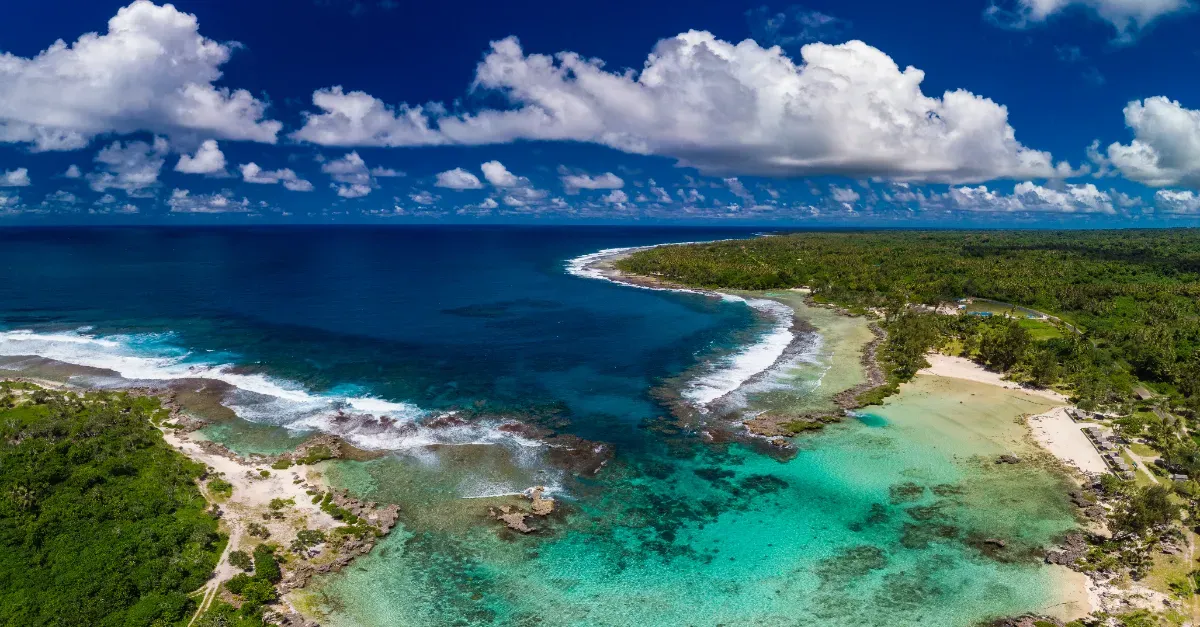
The older residents remembered well the dives and swims they had enjoyed as children in its turquoise waters, chasing all sorts of fish and admiring the varieties of marine flora.
A memory, precisely: because in recent years the Erakor lagoon has turned into a huge dump of plastic waste.
“The plastic formed a small island inside the lagoon, it was so thick,” one of the residents recounted. “We used fishing nets to pull out some of the rubbish, but we didn’t know how to get rid of it all. We were overwhelmed.”
In Vanuatu, too, it soon became clear that the fight to free the coasts from plastic, if carried out only through the goodwill of the inhabitants, is – and here the expression is quite apt – like trying to empty the sea with a teaspoon.
Tonnes and tonnes of plastic packaging, essentially for the food industry, reach Australia every day, as well as the other continents of the world.
In the case of the Pacific islands, onto which a large share of this waste washes up, very few governments (Vanuatu is an independent republic) have adequate facilities for recycling or waste management on their narrow strips of land: which is why rubbish, if it is not burnt, stays afloat in rivers or lagoons like that of Erakor.
So why tell the sad story of what was becoming a former paradise submerged by plastic?
Because the government of Vanuatu put a drastic policy in place a few years ago to solve the problem. Something that could, indeed should, work as an example for many other countries around the world.
As early as 2018, the government was one of the first in the world to ban the sale and distribution of certain single-use plastics: among them, plastic straws.
Over the following six years, thin plastic shopping bags have practically disappeared: most residents bring reusable bags with them to the local market or grocery shop.
At the many festivals and outdoor events held across the archipelago, food is now served wrapped in banana leaves instead of in polystyrene containers.
The result is a very substantial reduction in plastic, and a visible one. “Since the ban was introduced, you can see that the lagoon has become cleaner,” the residents say.
But the small great revolution of Vanuatu – and this is the even more interesting part – came not from the government first, but from the activism of individuals. In this case, thanks to a Facebook post by a Frenchwoman who had moved to the Oceania islands, named Christelle Thieffry.
Thieffry, who arrived in Vanuatu more than 20 years ago, was immediately struck by the plastic waste that swirled through the skies of Vanuatu when the wind picked up. So she and her husband decided to do something.
They opened a Facebook page called “no plastic bag, please”. At the same time they launched a petition asking people to sign it to ban single-use plastic bags. In a few weeks (this was in 2017) they had collected more than 2,000 signatures, forcing the Prime Minister of Vanuatu to address the situation.
It was the then Foreign Minister who developed and implemented the no-plastic policy: first of all, by imposing fines of at least 20,000 vatu (£130, a significant sum in Vanuatu) on anyone caught breaking the ban.
In 2020, seven more items widely used in everyday life were added to the list of banned plastics: from cutlery to disposable plates and artificial flowers. Plastic bottles, however, are still allowed, since banning them and replacing them with other types of container would still pose significant difficulties.
It is also interesting that, over the years, an industry has developed to provide sustainable alternatives to the banned items. On the island of Pentecost, communities have begun replacing plastic pots with biodegradable ones made from the leaves of the native pandanus. The pandanus is a perennial palm-like plant that bears a fruit, similar to a pineapple, much prized in Oceania.
A social enterprise called Mama’s Leaf began producing fabric sanitary pads even before the ban, and has now widened its range to include nappies and reusable bags.
Will all this be enough to stop the invasion of plastic, on ocean coasts as in the rest of the world?
The battle in Vanuatu is not yet won. Plastic waste continues to devastate the natural environment, and swimming is no longer allowed in the Erakor lagoon because of the pollution.
“The fact is that most of the plastic waste comes from packaging for pasta, rice or biscuits,” explains a local activist. The aim must be that one day the plastic ban will include all the packaging of imported products.
It will certainly not be easy. But in the meantime the government of Vanuatu plans to extend the plastic ban to new categories of goods, and has said that this year it will also introduce a deposit scheme for plastic bottles to help dispose of them and, if possible, soon eliminate them altogether.
In short, this is the way forward.