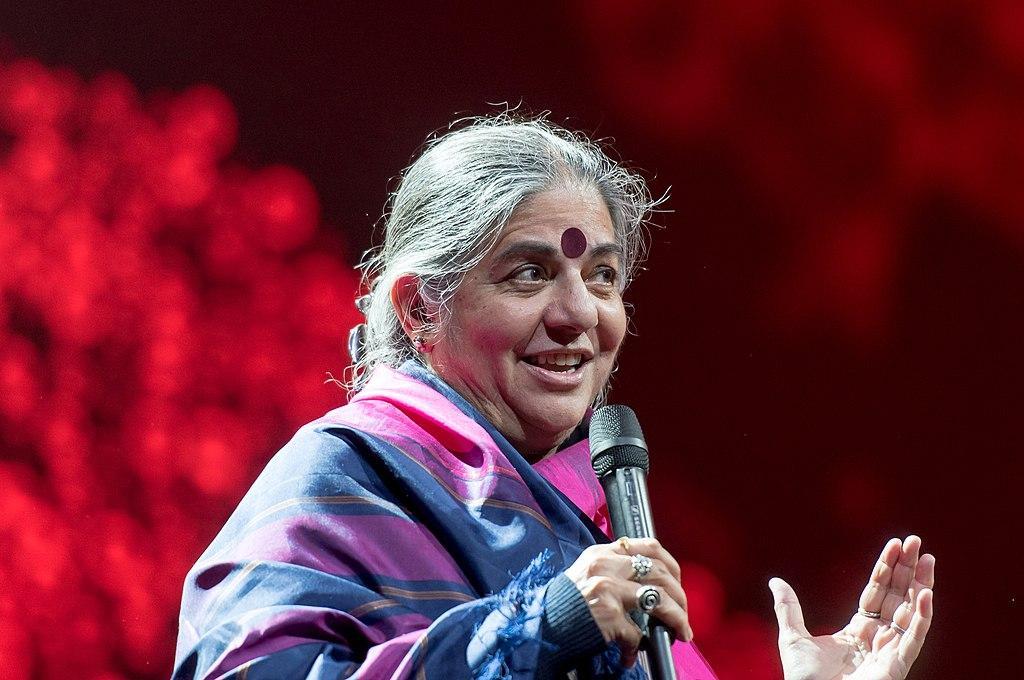
In 1993 she received the Right Livelihood award, also known as the ‘alternative Nobel prize’. In the early 2000s the American magazine ‘Time’ called her an ‘environmental hero’.
In 2004 Vandana Shiva founded Bija Vidyapeeth: the University of Seeds, an international college devoted to the study of organic farming techniques and natural insecticides.
The speech reproduced here was delivered by Vandana Shiva in 2014 at the Food Otherwise Conference, organised by the Rural Sociology department of Wageningen University in the Netherlands.
Wageningen University & Research is an agricultural institute that is a world reference point in the field of food and environmental studies; it collaborates with the Dutch government and other political institutions, with businesses and with the main NGOs.
VANDANA SHIVA – Another agriculture is possible
Address to the Food Otherwise Conference. Rural Sociology Wageningen University, 21 February 2014
So, why do I say that we need another food system and another system of agriculture?
Because the one we have was never intended, and was never designed, to be what it is.
Every tool of the current system was designed for war. And it should never have
entered our food system.
Pesticides were designed for the concentration camps – I am talking about the first generation – and then they were designed for biological and chemical warfare. It was only when the industry, which should have closed down after the war, decided: oh, let’s run a nice advertisement: ‘DDT is good for me’.
If you look at the advertising slogans from the time when the war was ending, they tell you how an industry that had grown used to war profits was at that moment turning into an agro-chemical industry.
Synthetic fertilisers were made in explosives factories. And that is why, the next time you read about a terrorist attack, in Afghanistan, India or Oklahoma, there will be a small note saying: ‘fertiliser bomb’.
Remember the young man in Oslo who bought fertiliser and then blew up all those offices and then shot the young people on the island?
These are weapons of war, and they are also toxic and poisonous. So the first reason why we need another food system is: we need a food system without poisons.
(…)
Another reason why we need another food system is that an agricultural system designed around inputs from war can only work as a monoculture. If all I focus on is nitrogen, phosphorus and potassium – what is called the NPK mentality – then I can only grow crops that can handle those set doses. Whereas if I grow maize and beans, the bean fixes nitrogen for me and the two can grow together.
As soon as you apply synthetic fertilisers, on the other hand, the plants begin to compete. We have this wonderful mixture of pigeon pea, Toor Dal, which grows quite tall, and Ragi, which is millet. These two plants have grown as companions for millennia. Ragi gives you calcium, iron and fibre, and Toor Dal gives the soil nitrogen, but gives you protein.
(…)
I grew up in India, where the water in the desert was 10 feet deep. The Green Revolution does not only require external inputs; monoculture also requires a great deal of water. In Punjab 90% of the water is used for irrigation, globally it is 75%. And what comes out is polluted water full of nitrates, which create dead zones in rivers, in bodies of water and in the oceans.
Those monocultures based on toxic substances are destroying biodiversity, displacing crops as well as varieties and species. We human beings used to eat about 8,500 different species of plants. In India, before the Green Revolution, there were 200,000 varieties
of rice, 1,500 varieties of mango and of beans. I remember when I put together a collection of wheat and gathered 1,500 varieties, and took them to what became the Cambridge seed bank, which was later privatised to Unilever and then to Monsanto. That is where they took the gluten-free wheat and then patented it: we had to fight that case over the patent, because it came from the Indian collection.
(…)
In 1995 the FAO organised a conference on plant genetic resources in Leipzig. At the time it was estimated that 75% of biodiversity in agriculture had disappeared, because of chemical monocultures and the introduction of varieties designed exclusively for chemical response. My guess is that it is now about 90%, because back then Argentina had not yet been destroyed, the Brazilian Amazon had not been torn to pieces on a large scale for soya cultivation, and the US Midwest was not a monoculture of GM soya and GMO maize.
So my guess is that about 90% of crop biodiversity has disappeared.
Chemical sprays destroy even more. They have caused the disappearance of 75% of bees and colony collapse. But not only of bees.
We carried out a study in the areas where BT cotton is grown, and in four years of planting 22% of the beneficial soil organisms were killed by the release of toxins. There is a new study showing that spraying Round Up on crops was killing the milkweed that sustained the monarch butterfly. And there have been studies from Cornell University showing that BT maize pollen kills the larvae of that butterfly. It is not surprising, then, that 75% of monarch butterflies have disappeared.
(…)
Even though it destroys 75% of living systems and ecosystems, the myth is now widespread that without
industrial agriculture the world cannot be fed. The figures are now repeated every day: 70% of the world’s food is produced today, in 2014 – not a century ago, not fifty years ago, but
today, 2014 – on small farms. The reason why the UN had to declare this year ‘the year of family farming’ is because of this figure.
The main reference point for food security is small farms and urban gardens. Only 30% comes from industrial agriculture: yet this 30% is destroying 75% of the planet.
The deduction that follows is easy: if that system were allowed to spread until it destroyed the remaining 25%, would we get more food or zero food? A destroyed planet will give no food at all. Dead soils, vanishing water, a totally chaotic climate, no more seeds: it is a recipe for absolute disaster. Not only a disaster, but human extinction itself.
(…)
The Green Revolution was introduced in India in 1965. We are talking about 50 years ago. In 50 years 75% of the planet has been destroyed. It will take only 10 years to wipe out the rest; many more species will go, and the human species will certainly be caught up in it.
So the reason why we need another system is that we should try to survive into the future as a species. No species has deliberately designed its own extinction, but through industrial agriculture we are doing so. It is in the design of the agricultural system, because it is destroying the basis of agriculture: ecological systems. It is in the design, because in reality it is not an efficient and productive use of natural resources.
(…)
I read in an Indian newspaper that Wageningen University is working on the food problem. They are actually planning to grow food on Mars. They have a research project under way at this university.
Our research institutes are behaving really cleverly, in doing what does not need to be done and not doing what must be done! The Navdanya movement was created to conserve biodiversity and seed variety; we strengthen biodiversity. We ask farmers to grow as many varieties as possible on the farm, and then to eat the farm’s produce according to their needs.
So, when people tell me that organic is too expensive, I answer: ‘Not for the farmer who grew it’. And so they have first claim on organic food. Having put in place the conservation of biodiversity and the intensification of non-biodiversity, we decided not to measure the output of monoculture, which is the yield per acre that is always talked about.
Yield is that for a single product, and the amount of it that leaves the farm. So the grain of wheat is counted as yield but not the straw that stays on the farm. Maize is counted for what it yields, but not the maize stalks. In this way what should be recycled on the farm is treated as waste and is not returned to the soil.
In Punjab this system has meant that the monoculture is harvested by combine harvesters and, as you know, combine harvesters leave an enormous amount of residue, which then has to be burned. If any of you try to come to Delhi in winter, you cannot land because of the smog!
(…)
So, when we carried out the analyses on biodiversity and productivity, we saw that without doubt a farm rich in biodiversity produces more. Pablo also showed a figure with the combination of maize and pigeon peas. What we found was that the greater the biodiversity, the greater the productivity and, for the farmer, the greater the
profit. First of all because the farmer does not fall into difficulty and, secondly, because the farmer has resilience. In 2009 we had droughts and floods beyond anything one could have imagined the year before. We lost 20,000 human lives in our region because of last year’s climate disaster, something that never reached the international news.
If you have a diversified harvest, one crop will thrive instead of another and it will not be wiped out.
(…)
Another reason why we need another food system is that we cannot afford this blindness towards the gift of abundance that nature gives us, the gift of biodiversity. It has already cost us too much. Now we need to work with biodiversity, to produce more food and nourishment while consuming less of the earth’s resources. A smaller impact and a greater yield. The current system has an enormous impact with a negative yield.
And there is another great reason why we must move to another food system: a reason that has to do with science and knowledge. For me, as a scientist, when assessing a farming system the first thing to study is the way in which the soil, plants, animals and the human community relate to one another.
What are the connections? This knowledge of connection is ecology, which is a science of relationships, and that is why agroecology – without anyone being paid to say agroecology, everyone talks about agroecology – is a movement that has grown without lobbyists.
(…)
The biotech industry gets angry when I say that the reason genetic engineering is not a good idea is that it is just a stupid way of doing things.
It is a stupid way to get iron into food, to do it through GM bananas; it is a stupid way to get vitamin A, to do it through golden rice; it is stupid to control food pests by inserting toxic genes into plants through BT toxins – and it is even more stupid to try to control weeds through herbicide resistance. In just 15 years, half of the farms in the United States have been overrun by superweeds: half, that is, 17 million.
So what are they doing now? They are putting genes into maize with resistance to an ingredient of Agent Orange, 2,4-D. And Dow is once again the big player in the game! Lobbyists have worked with the European Commission to get the Pioneer 1507 proposal approved, just recently. Pioneer 1507 was developed jointly by DuPont and Dow. Dow,
as you will remember, is the same company responsible for the endless injustice perpetrated in Bhopal.
(…)
On the one hand there is control, on the other harm. As far as biotechnology is concerned, there has been a great deal of discussion
about safety. We are told over and over again: all the research says it is safe. Some neutral, independent research has instead found harm.
Arpad Pusztai was the first person commissioned by the British government to study GM potatoes, in 1998. He did not expect to find what he found. Brains reduced in size, enlarged pancreases, a compromised immune system, total damage to the endocrine system. At that point the director of the study held a press conference. He declared:
“If this happens in three months of feeding, what will happen if human beings eat this for their whole lives?” For a couple of hours the BBC covered the problem, and then silence fell. Blair made sure that Arpad’s laboratory was closed. Arpad had moved to England after the invasion of his country, Hungary, in search of freedom. He went back to Hungary, to find freedom.
More recently, Seralini – one of the best French scientists – decided to carry out a two-year study, having been head of a monitoring body. He discovered that the studies carried out by the agri-food industry were very, very approximate.
At that point he said to himself: “I must find out what is going on.” He carried out a study that became very famous in the “Journal of Food and Chemical Toxicology”. The people in the agri-food industry tried to hide it, and there was an attempt to retract it. The journal, however, replied that it had been peer reviewed and that they could not retract it. It had passed through every kind of scientific validation. So what does Monsanto do? It simply gets a new editor, Goodman, into the Journal. He said: “Now I am retracting the study.”
I call this way of doing science terrorism. It is a serious threat to independent science and independent research.
(…)
The last reason why we must replace the old system is that this old system truly cannot last more than another five to ten years: but in those five to ten years it can survive only by establishing total domination. Totalitarianism over our farmers: a situation in which farmers cannot grow what they want in the way they want. They are locked into “seed slavery”. When Pablo showed those slides about slavery, someone asked: “Are you suggesting a parallel?”
I am suggesting a parallel, of course. When you begin to fight for “seed freedom”, I see a parallel. At the time of slavery it was black people who were captured in Africa and taken to work in the cotton and sugar cane fields of America. Today all life is being enslaved. All life. Every species. We have never had such imperialism over the whole planet.
Never. And, of course, farmers who commit suicide do so because they feel enslaved and trapped, and they find suicide the only way out. It is a totalitarian system, caused by the way knowledge is managed. Science has been replaced by propaganda. The amount of space you can buy in the newspapers will decide what we are to call science. Not how much knowledge you have generated.
(…)
What we are witnessing is a very profound phenomenon of vertical integration of the food system. Five companies that control seeds, five companies that control the grain trade, five processors, five retailers. That is what we are talking about: twenty companies. All integrated, one into another. And if you look at what happened in California, where people were asking for labelling laws, it was not only Monsanto that resisted.
Coca-Cola and Pepsi Cola put money into it: because they use high-fructose corn syrup made from GM maize. They won: and they won in terms of force-feeding bad food to people.
We know well the harm created by junk food and the problem of obesity that I have already spoken about. From the analyses I have made over the years, this system of vertical integration with the combination of
Pepsi, Walmart, Cargill and Monsanto brings the farmer 1%. 1% of the euro spent by the consumer, or of the dollar or the rupee. Because it brings only 1%, it drives people away from the land. It makes farming unviable, because of the injustice. And so it happens that only 1% of the population remains to work the land; the return is only 1%, and the rest goes into corporate profits in the agri-food sector. No wonder big investors want to get into the food business.
What we need is a 50% model. 50% should go back to farmers and the population and the local economy, 50%. We do it at Navdanya, so it is not so impossible. And if 50% of the return reaches the farmer, 50% of people will remain to work the land. In any case, 50% will remain in the food system, unless they become part of the necro-economy. The necro-economy is the economy of death. The one that produces pesticides, sprays them, drives the lorries, emits carbon dioxide: all the jobs that are killing the planet.
(…)
Instead we could have 50% creative work. Creative work with the land, creative work with food. I know how enthusiastic young people can become when they relate directly to food. Yesterday I was served a fantastic dinner before coming here. It was prepared by a young woman who gave up a marketing management job and now does raw food cooking. Delicious! If only we could free the energies of young people. Take care of the soil and the seeds, take care of our food and create work from it.
And that is why at Navdanya I created the Earth University: to have, fundamentally, a place where the principles of the food system can be learned with intelligence, but also through nature as a teacher, and farmers as teachers: and your own learning becomes a teacher. And now every September, because of the great demand from young people all over the world, we have begun to offer an A to Z course on agroecology and organic food systems. I hope some of you will come. But whether you come or not, know that
food is the place, the seed is the place where we must reclaim our democracy and save the world from the totalitarianism they are putting in place. It will happen, little by little. If not, before we realise it, we will no longer be able to make changes. We have a short span of time to reclaim both our bread and our freedom. Otherwise we will have neither bread nor freedom.