Historic trains: an Italian excellence
Italy is, indeed, the custodian of a rich railway past and stands out for its extraordinary heritage of historic trains: we are the country with the highest concentration of active tourist railways, a treasure to be preserved and enhanced, not only for its historical and cultural value, but also for its potential in terms of sustainable tourism and the enhancement of inland areas.
Steam locomotives that seem to tell stories of a bygone age, vintage carriages that evoke the charm of travel in times past: a true museum in motion!
For its uniqueness and beauty, the experience offered by the Treno Natura in Tuscany stands out.
A unique journey through the Terre di Siena
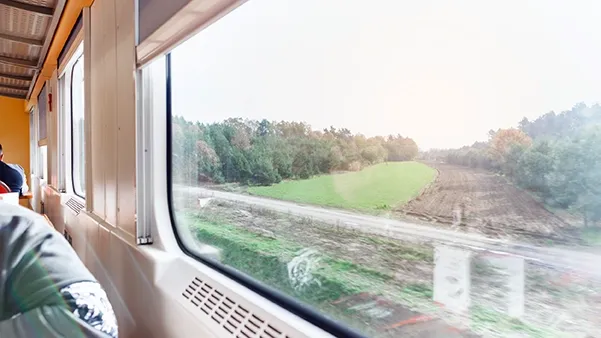
Travelling on the Treno Natura is not simply a matter of getting from one place to another, but a real plunge into another time dimension. Pulled by a steam locomotive, the train winds through an iconic landscape, the Tuscan one, made up of gentle hills shaped by time, medieval villages that seem suspended in another era and a food and wine culture rooted in a thousand-year-old tradition.
The Treno Natura routes are a kaleidoscope of opportunities to explore the different facets of the province of Siena. Each season brings new itineraries combining travel, cultural discovery and food and wine. The route is, in fact, often paired with events such as food festivals or village fairs, which can be reached by getting off the train independently or on guided excursions.
But let’s look in more detail at the places the Treno Natura visits in spring and autumn 2025.
Siena: heart of the Tuscan Middle Ages
Often the starting or finishing point of the itineraries offered by the Treno Natura, Siena welcomes visitors with its medieval majesty. A UNESCO World Heritage Site and the first Italian city of art to be certified a sustainable tourist destination by the Global Sustainable Tourism Council (GSTC), the city of the Palio enchants us with its Piazza del Campo, an architectural masterpiece that pulses with history and traditions. The Duomo, with its marble façade and richly decorated interior, is a masterpiece of Italian Gothic architecture, while the Pinacoteca Nazionale houses the most important collection of works of art of the Sienese School, with masterpieces by Duccio di Buoninsegna, Simone Martini, Ambrogio and Pietro Lorenzetti.
Getting lost in the maze of alleys in the historic centre lets you discover noble palaces, churches and craft workshops that hand down ancient skills. Ceramic making is, for example, a Sienese speciality. A stop at a pastry shop is then a must, to taste panforte and ricciarelli, typical sweets made with almonds and dried fruit.
Immersed in greenery, the city offers a restful and authentic visit, but the surrounding area, the Terre di Siena, offers equally breathtaking stops.
Asciano and the Crete Senesi: a lunar charm
Leaving Siena behind, the Treno Natura heads into the unique and evocative landscape of the Crete Senesi. Reproduced on countless postcards and famous all over the world, these clay hills, shaped by the elements into soft, rolling forms, offer an almost lunar vision.
The train stops at Asciano, a small medieval village, during the village festival, where you can taste the excellence of the area: the zone is famous for its prized white truffle and for its extra virgin olive oil, with an intense, fruity flavour.
A short distance from Asciano stands the imposing Abbey of Monte Oliveto Maggiore, a Benedictine monastic complex rich in history and art. The cloister is adorned with a splendid cycle of Renaissance frescoes painted by Sodoma and Luca Signorelli.
San Giovanni d’Asso: the excellence of the white truffle
The journey continues towards San Giovanni d’Asso, “white truffle capital of the Crete Senesi”, during the white truffle market and exhibition. Here, the culture of the most prized of fungi is deeply rooted, and a visit to the Museo del Tartufo offers an interesting overview of its history, its hunting and its properties. Naturally, local cuisine celebrates the truffle in countless preparations, bringing out its unmistakable aroma.
The Val d’Orcia: land of art and wine
Continuing its itinerary, the Treno Natura goes deep into the heart of the Val d’Orcia, the first Italian landscape to be recognised as a UNESCO World Heritage Site. Here, in spring, the train stops at San Quirico d’Orcia for the Orcia Wine Festival, while in autumn Castiglione d’Orcia hosts the porcini mushroom festival. Along the way there is no shortage of chances to savour other typical local products, such as Pienza pecorino or extra virgin olive oil. But food and wine excellence is matched by another kind of excellence: cultural.
San Quirico is, indeed, known for its link with the ancient Via Francigena, an important pilgrimage route still walked today by many hikers drawn by the picture-postcard landscapes of the Val d’Orcia. In the village you can visit the Horti Leonini, a splendid Renaissance Italian garden, a space where culture, nature and silence blend together.
Castiglione, on the other hand, is dominated by the Rocca Aldobrandesca, which offers a panoramic view of the surrounding landscape, a source of inspiration for countless artists. A visit to the church of Santa Maria Maddalena, a classic Romanesque stone parish church, is a must, as is the Sala d’Arte San Giovanni, a small museum where you can admire paintings made for the village by some of the greatest exponents of the Sienese School.
Ultimately, every kilometre travelled by the Treno Natura invites you to connect deeply with the authentic soul of Tuscany, discovering its food and wine and cultural excellence at a slow and restful pace. What better idea for a day out?
For more information on the Treno Natura: https://www.fondazionefs.it/it/link/treno-natura-toscana.html
For the calendar of departures from Siena and for bookings: www.visionedelmondo.com