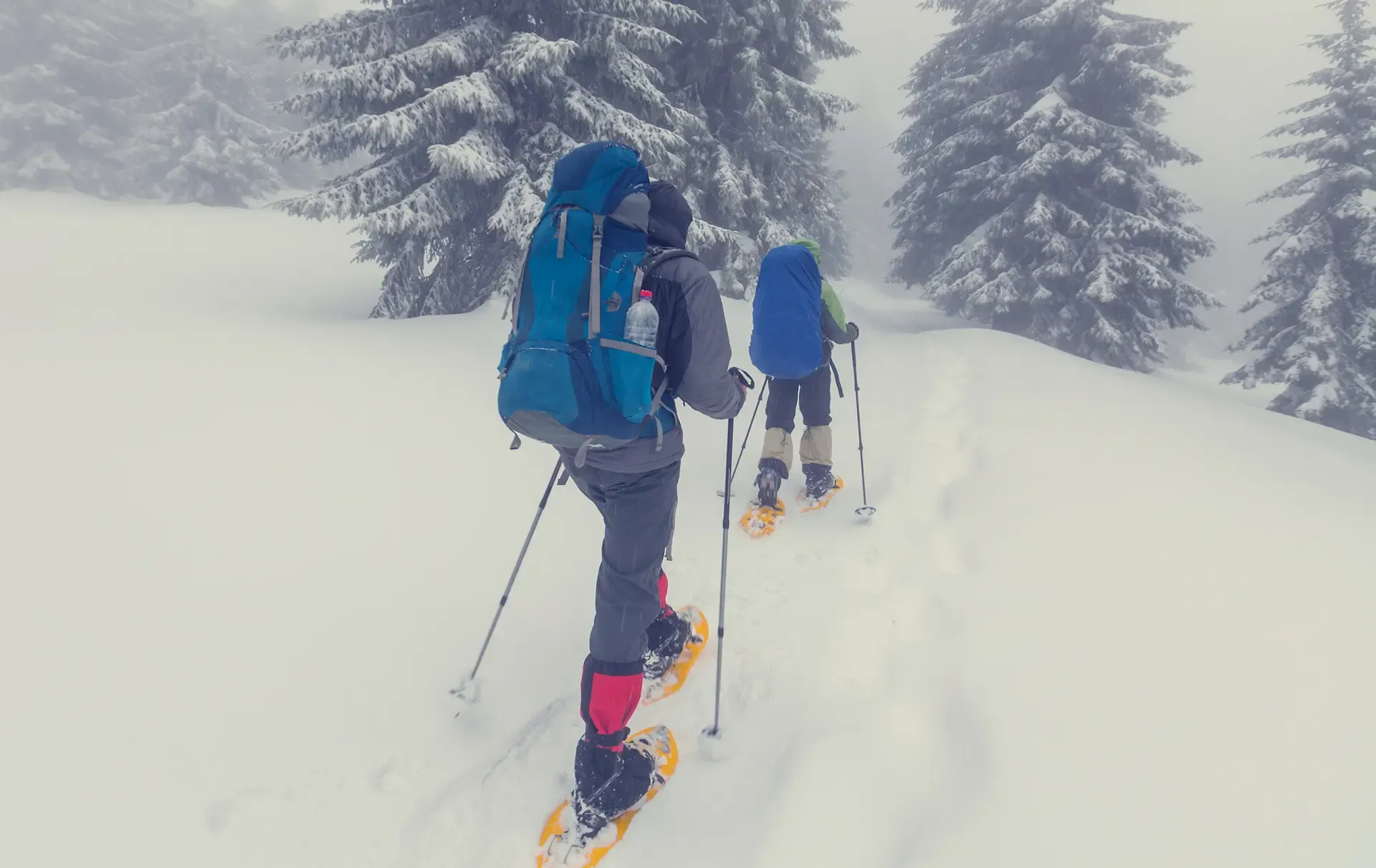
Less tiring than cross-country skiing (which nonetheless remains the queen of alternatives to downhill, of course), snowshoes are a typical means of ‘slow’, eco-friendly tourism that is good for nature and for us.
- They can be used without any need for ski lifts. This means no more need to disfigure the mountains with new lifts (such as the planned link between the Val d’Ayas and Valtournenche in the Aosta Valley, the so-called ‘Cervinia-Monterosa’: which its promoters assure us will be ‘eco-compatible’, and one really cannot understand what they mean by this word, unless they plan to build it in the sky…)
It means saving large amounts of energy and water that would go into producing artificial snow. Let us remember that the artificial preparation of groomed pistes also has a negative impact on the systemic balance of the soil.
- Snowshoes are accessible to a wide public: they require neither particular technical skills nor great financial means. The latter is not an aspect to be underestimated, as skiers well know when they draw up a budget for their ‘ski week’.
- It is a complete physical activity that engages several muscle groups and offers benefits for both body and mind. Walking on snow stimulates the cardiovascular system and can contribute to psychological well-being, thanks to the connection with nature and the reduction of stress.
- Last but not least, in recent years snowshoe makers have begun to use more eco-friendly materials in their construction, further contributing to the sustainability of the product.
Let us look at 6 ‘paradises’ (the word is entirely apt) in our mountain areas, not among the best known, but where the snowshoeing experience will certainly prove, for anyone who wants to try it, something unforgettable and utterly fulfilling.
- Trentino. Brenta Dolomites. A classic climb is the one to Cima Campantich, in the Brenta Dolomites. From the top you can admire an incredible panorama over the whole Brenta group and the Val di Breguzzo.
By car, drive along the Val di Breguzzo as far as the locality of Limes, then on to the locality of ‘Le Sole’ (1,400 m).
From here the climb begins up to Malga Lodranega (1,658 m). Then along a forest road to Malga Campantich (1,849 m). Continue north-west to the summit.
Difficulty: medium.
- Aosta Valley. From La Salle to Arpilles. An excursion to be done with the Trek Alps guides. Available all winter on request. For information: info@guide-trek-alps.com
Leave the car in the hamlet of Challancin, beneath the mighty bulk of Mont Blanc. Follow the yellow waymark number 2 towards Col du Bard. After about half an hour of snowshoeing in open areas, a steeper path takes us into the woods.
You reach the farm track again: then, turning right, you soon arrive at the village of Arpilles. A handful of houses suspended in time and space, beneath Mont Blanc, which dominates in all its grandeur. From there, those who wish can continue towards the Col du Bard.
- Cima Paganella and the Eagle’s Throne
This excursion too must be done with a guide. Days: FRIDAY from 9.00 am to 1.00 pm. To book: https://www.activitytrentino.it/activities/ciaspolate/
A circular route on the summit of the Paganella. You snowshoe along unbeaten trails: the view sweeps over the natural amphitheatre of the Brenta Dolomites and the Adige valley.
The end point is the Eagle’s Throne, where the so-called Via Ferrata delle Aquile also ends, well known and popular in the summer season.
- Guided snowshoe walk: Journey to the ‘Far East’, Monte and Forte Lisser
To book:
https://www.naturalmentemichele.it/escursione/ciaspolata-viaggio-allestremo-oriente-monte-e-forte-lisser/
A snowshoe walk on the Asiago Plateau to Monte Lisser and towards Forte Lisser. Monte Lisser, in the eastern part of the Plateau of the Seven Municipalities, overlooks the Valsugana and the Brenta Canal.
You reach Forte Lisser in Enego along little-known routes, in a continuous alternation of natural beauty and historical memories, above all linked to the Great War.
- Friuli. Lake Sauris. Between the waters of the Friulian lake and the woods of the eastern Dolomites, a snowshoe walk in one of the most extraordinary environments of our Alpine arc.
You set off from Sauris di Sopra, at the car parks of the ski lifts.
The route begins along the ridge of Monte Ruke, up to where the mountain slopes down towards Lake Sauris. The track follows the forest road, with climbs and descents of no great size.
The overall duration is about three hours, ending at the Agriturismo Monte Ruke, in the heart of the Carnic Alps.
For information:
INFOPOINT SAURIS
Frazione Sauris di Sotto, no. 3
Tel.: +39 0433 86076
Fax: +39 0433 866900
giulia.colle@com-sauris.regione.fvg.it
- Apennine route on Corno alle Scale. In the Bolognese Apennines: starting
from the car park of the Laghetto del Cavone. You cross a splendid beech wood, until you emerge near the Valle del Silenzio and the Passo della Porticciola. From there you can gaze on the Balze dell’Ora and Monte Nuda, among the most beautiful formations in the whole Apennines. The snowshoe walk ends at the Croce della Punta Sofia, with a breathtaking panorama that embraces Tuscany and Emilia, ranging from the Alps to the coasts of Corsica.
Info and bookings:
https://www.andareazonzo.com/trekking/escursione-guidata-ciaspolata-verso-la-vetta-del-corno-alle-scale/?srsltid=AfmBOoo-3npiem57hwiqI1MKulbVs9nY648mY1LpbG4odvNuWWZ5RuMv