UNESCO recognition is, furthermore, an invitation to preserve and enhance this heritage for future generations, and a demonstration of how tourism can be managed sustainably, promoting a slow, environmentally respectful way of travelling. Along the Appian Way, in fact, travellers are encouraged to walk or cycle, exploring places calmly and attentively, thus helping to reduce environmental impact and support local communities.
But what are the most evocative stops along the Appian Way?
Rome and the Parco degli Acquedotti
The journey along the Appian Way begins in Rome, the heart of the Roman Empire and the city from which the road set out to reach Brindisi. The Parco degli Acquedotti, on the outskirts of the capital, is one of the most evocative destinations on the route: here, the remains of ancient aqueducts stand majestically in the Roman countryside, offering a perfect fusion of nature and archaeology, and providing an ideal place for quiet walks and picnics, immersed in ancient history.
The Alban Hills
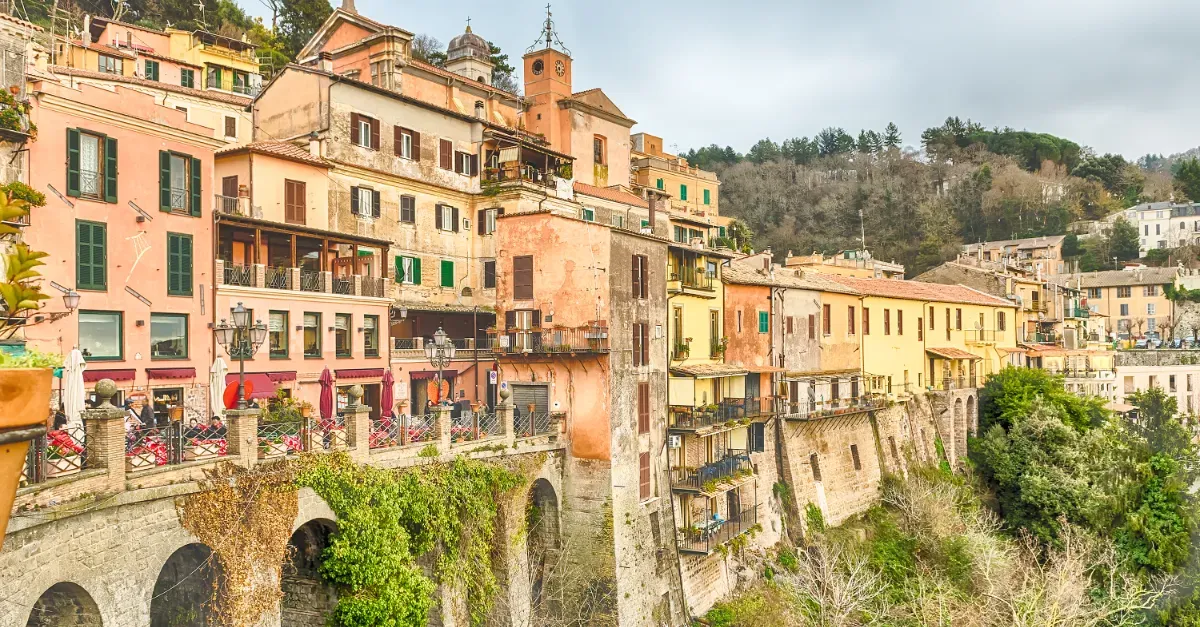
Continuing south, the Appian Way crosses the Alban Hills, a territory rich in ancient Roman temples, buildings and engineering works, as well as home to the Parco Regionale dei Castelli Romani, an ideal area for excursions, walks in nature and visits to ancient villages such as Frascati, with its Tusculan Villas; Nemi, famous for its lake; and Ariccia, also well known for its culinary speciality: porchetta.
Terracina and the Temple of Jupiter Anxur
Continuing the journey, you arrive at Terracina, where the landscape is dominated by the Temple of Jupiter Anxur. Located on Monte Sant’Angelo, also known as Monte Giove, this ancient sanctuary offers a breathtaking view of the Tyrrhenian Sea and the Ausoni Mountains. Terracina is also famous for its beaches and its historic centre, which make the town a perfect destination for those seeking a combination of relaxation, history and culture.
Campania with Capua and Benevento
Leaving Lazio and continuing into Campania, the towns of Capua and Benevento are essential stops along the Appian Way. In Capua you cannot miss the ancient Campanian Amphitheatre, one of the largest of the Roman era, second only to the Colosseum, where for centuries hundreds upon hundreds of gladiators fought.
Benevento is once again a place rich in history: its Roman past is borne out by the majestic Arch of Trajan, which has become the symbol of the city over the years. The Lombard rule, however, has also left its mark on the town, with monuments such as the Church of Santa Sofia, which is also inscribed on the World Heritage List.
Basilicata: Venosa
Continuing south-east, you reach Basilicata, where one of the loveliest stops on the route is certainly the ancient town of Venosa. Known as the birthplace of the Latin poet Horace, it is home to numerous archaeological sites, including the Abbey of the Santissima Trinità and the Archaeological Park, set in breathtaking landscapes. Once again, Venosa represents a perfect blend of nature, history and culture.
Puglia from Taranto to Brindisi
Puglia is the last Italian region crossed by the Regina Viarum, which ends at Brindisi. Among the most evocative stops is certainly Taranto, known as the city of two seas because it is bathed by both the Ionian (the Mar Grande) and the Mar Piccolo, but also sadly known for its forced industrialisation, which over the years has killed too many people and caused enormous environmental problems. For some years now, the city has been struggling to turn the page, and it is doing so also by rediscovering its ancient traditions and its past.
Its historic centre, characterised by narrow alleys and ancient palaces, is indeed a true journey through time. The Aragonese Castle is a must-see, and the National Archaeological Museum of Taranto (MArTA) houses one of the most important collections of artefacts from Magna Graecia.
It is hoped that UNESCO’s recognition of the Appian Way Regina Viarum can give the city further momentum to overcome a difficult past and focus on a greener, more sustainable future, also through culture.
Moving towards the Salento, we come across another destination that is nothing short of evocative: the Archaeological Park of Egnazia (Fasano), which preserves the remains of an ancient Messapian and Roman city. The imposing walls, the monumental tombs and the forum are testimonies to the region’s rich history, while the adjoining museum offers a collection of finds that tell of everyday life in antiquity. After the visit, a swim in the crystal-clear sea that bathed, and still bathes, the coasts of ancient Egnazia is a must.
Finally, the Appian Way reaches Brindisi, an ancient Roman port that was one of the Empire’s main gateways to the East. In the heart of the historic centre, the terminal columns of the Appian Way are still visible, marking the end of the road and serving as a landmark for travellers in antiquity.
Brindisi’s historic centre also offers a variety of medieval churches and noble palaces, such as the Cathedral of San Giovanni Battista and the Swabian Castle, which bear witness to the city’s rich past. A visit to the natural harbour is also a must, an ideal place to relax and enjoy good fish.
A slow and sustainable itinerary
After dwelling on the main and most evocative stops along the Appian Way, one cannot help but conclude that it is much more than a simple road. The Regina Viarum represents a route through the history and landscapes of Southern Italy, and a unique opportunity for those seeking slow, sustainable tourism. Walking or cycling along this ancient route allows you to discover hidden places, appreciate the beauty of nature and immerse yourself in local culture.
The Appian Way, now a UNESCO World Heritage Site, is ultimately an itinerary that invites discovery and reflection. It is a journey through centuries of history and culture, offering visitors the chance to explore Southern Italy in an authentic and environmentally respectful way.
Every step along the Appian Way is a step towards sustainability, a tribute to the past and an investment in the future.