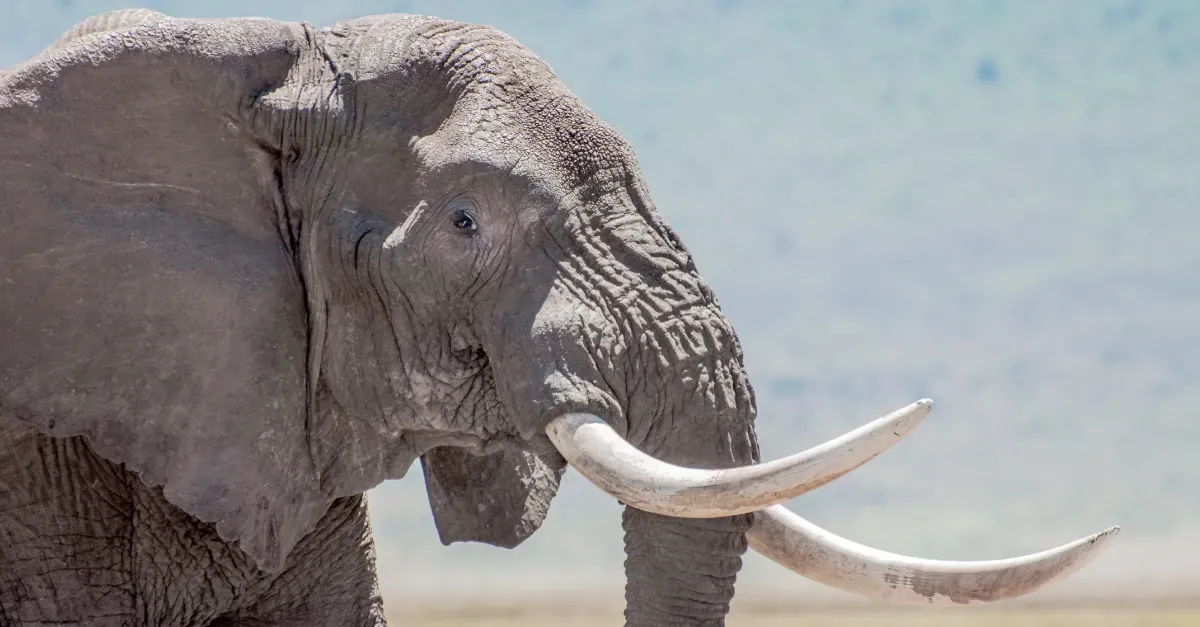
The news of recent weeks is the lifting of the ban by the authorities – a ban long maintained – on hunting them. Environmentalists have gone on the warpath. Meanwhile other voices argue that trophy hunting can support local economies and even help protect threatened species.
The battle over the super tuskers began last year, and was in fact sparked by a decision of the Tanzanian government, which after thirty years ended an (admittedly informal) agreement with Kenya, allowing hunters to legally shoot at least two of the 10 remaining super tuskers.
This is a cross-border herd, which migrates between Kenya (where trophy hunting is banned) and Tanzania, where the whole body of wildlife legislation is far more permissive: trophy hunting of wildlife is in fact allowed, once (wealthy) foreign hunters have purchased a ‘premium safari’ package.
The elephants targeted by trophy hunting were among the largest and oldest. This, far from being an acceptable criterion, is on the contrary a double disaster for environmentalists. They represented ‘one of the last gene pools for such a great mass of ivory and the source of the largest tusks ever collected’.
The Tanzanian government must now decide whether to issue further super tusker hunting permits for next year. This is why international pressure not to do so has been growing in recent weeks. An appeal published in the journal Science urges the authorities to back down and to focus instead on ecotourism. ‘Alive, these super tuskers have great biological, economic and social value’, they wrote. ‘Once they are shot, their contribution ends’.
‘These elephants have always been dear to the Maasai’ a member of the local community, Jackson Mwato, executive director of the Amboseli Ecosystem Trust, told the press, referring to some 158,000 hectares (390,000 acres) of wilderness. ‘They have always lived alongside us. They know no international borders and some of our clans bear their name. If they disappear, it will be a loss for the country and for the Maasai community’. Around 65,000 families depend, in fact, on the tourist economy generated by (non-hunting) safaris.
Even angrier are the scientists who work on species conservation, such as Joyce Poole, co-founder of Elephant Voices and lead author of the letter of protest against the killing of the super tuskers.
‘Those killed were keystone individuals’ Poole explains, ‘from whom younger males learn and who coordinate the movements of closely bonded animals. Those who claim that hunting has no impact look only at the numbers and ignore the role these individuals play in animal society’.
There are also those who think differently, in favour of controlled and selective hunting. One is Professor Adam Hurt of the University of Gloucestershire, co-author of the book Trophy Hunting.
‘However distasteful many may find hunting’ Hurt argues, ‘it can work and does work as a source of income for conservation and communities. It has been shown that abolishing trophy hunting – and the conservation incentives it creates – without funded alternatives can lead to greater loss of wildlife’. According to Hurt, ‘some studies have found that habitats managed for hunting can protect many other at-risk species nearby’.
Even among Tanzanian tour operators there are those who favour lifting the ban, on frankly economic grounds.
‘Some people pay 5,000 dollars for the licence and about 10,000 dollars for the trophy. Renting a whole block can come to 60,000 dollars. Isn’t that what creates jobs for the local population and returns money to conservation? A hunting camp employs almost 30 local people’.
Provided, however, that the hunters are accompanied by anti-poaching staff – extending the range of patrols – and that they shoot only old animals. ‘If my cow gets old, I usually sell her to a butcher or slaughter her myself. In the same way, wouldn’t you rather get the best price for an animal that would have died of old age anyway?’.
Old questions and long-standing issues are thus raised once again.
Opponents of hunting reply that the age of these elephants, their uniqueness and our growing understanding of the complexity of their communication make the losses particularly hard to bear.
Poole, who has studied the Amboseli population since 1975, discovered that elephants call one another. ‘My heart goes out to them, because they are incredible animals’, she concludes. It is hard to disagree.