Every urban centre chosen for this important role has the opportunity to show Italians, Europe and the world its cultural and artistic wealth, to attract visitors from many places, and to revive its tourism and local economy.
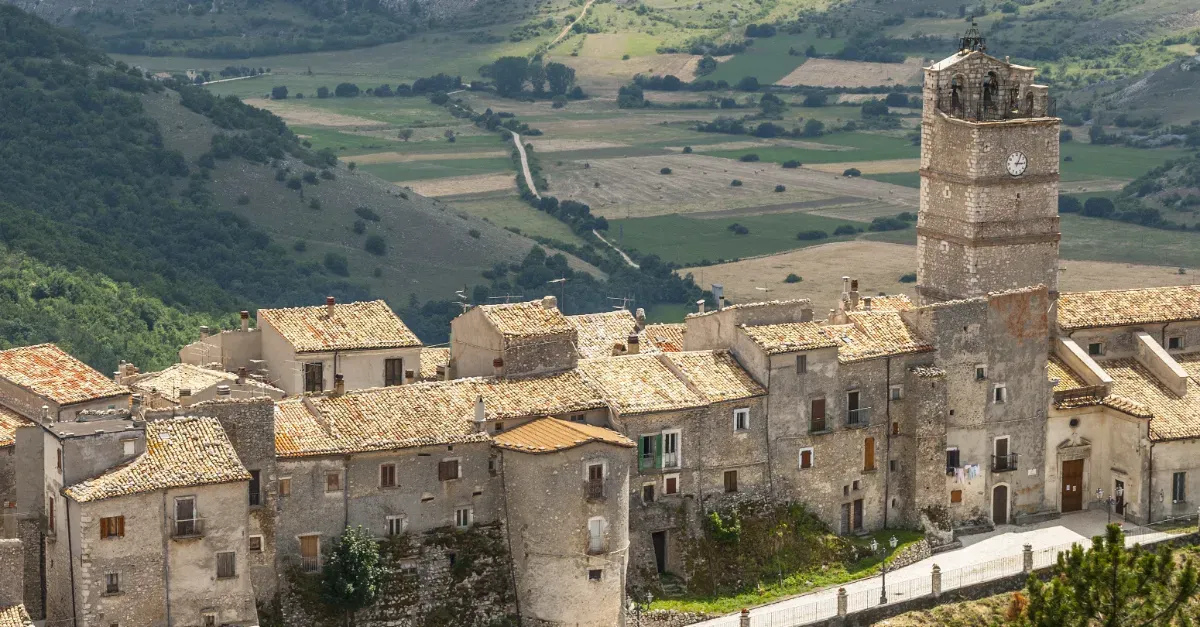
For a city like L’Aquila, which has had to come to terms with serious losses and destruction that have still not been repaired (above all with regard to public buildings), being named Italian Capital of Culture will be a unique opportunity to show its rebirth after the disastrous 2009 earthquake. And, it is hoped, to speed up the work.
L’Aquila Italian Capital of Culture 2026
The project that brought L’Aquila its victory is based on a fundamental concept: the integration of culture and sustainability. The city is committed, in fact, to promoting culture as a tool for sustainable development, focusing on initiatives that enhance its heritage while respecting the environment and the local community.
The ‘L’Aquila Città Multiverso’ project is based on the four pillars of the New European Agenda for Culture, in particular social cohesion, public health, wellbeing, creativity and innovation, and socio-environmental sustainability.
The idea is to make these four elements interact, giving rise to projects of artistic creativity and urban regeneration founded on multiculturalism, multidisciplinarity, multitemporality, multi-reproducibility and multi-naturalness.
What the city wants to build is a model of sustainable development for the region that could also be replicated elsewhere, in particular in the inland areas of Italy and Europe. The aim is to reconnect the urban centre, the suburbs and the neighbouring small towns, enhancing the individual cultural identities of the villages and offering widespread, slow tourism, through the many events on the programme.
In this way, besides fostering the creativity and cultural rebirth of the Abruzzo regional capital and the surrounding villages, benefits are also generated in terms of social inclusion and the socio-economic wellbeing of residents.
L’Aquila therefore wants to make a fresh start, involving young people and the local community in building a sustainable future, a green legacy for the new generations, in which culture is the engine of change and progress.
The jury’s words
It was precisely these elements that convinced the jury, chaired by the journalist and writer Davide Maria Desario, who expressed its positive opinion in the following words:
‘The dossier proposes a model for enhancing the region and its cultural, artistic and natural heritage. It aims to recover identity, focusing on culture seen as a driver of growth and as a founding element of a community. The project involves a significant number of organisations, creating a strong bond with the surrounding areas. […] The attention paid to young people, who will not only be users but protagonists, was appreciated’. [MiC - L'Aquila Capitale Italiana della Cultura 2026]
L’Aquila’s naming as Italian Capital of Culture 2026 is therefore meant to be an important recognition for a city that has shown it can face challenges and difficulties with courage and determination. And a call to commitment, for everyone, to complete the work as well as possible, under the essential banner of sustainability.