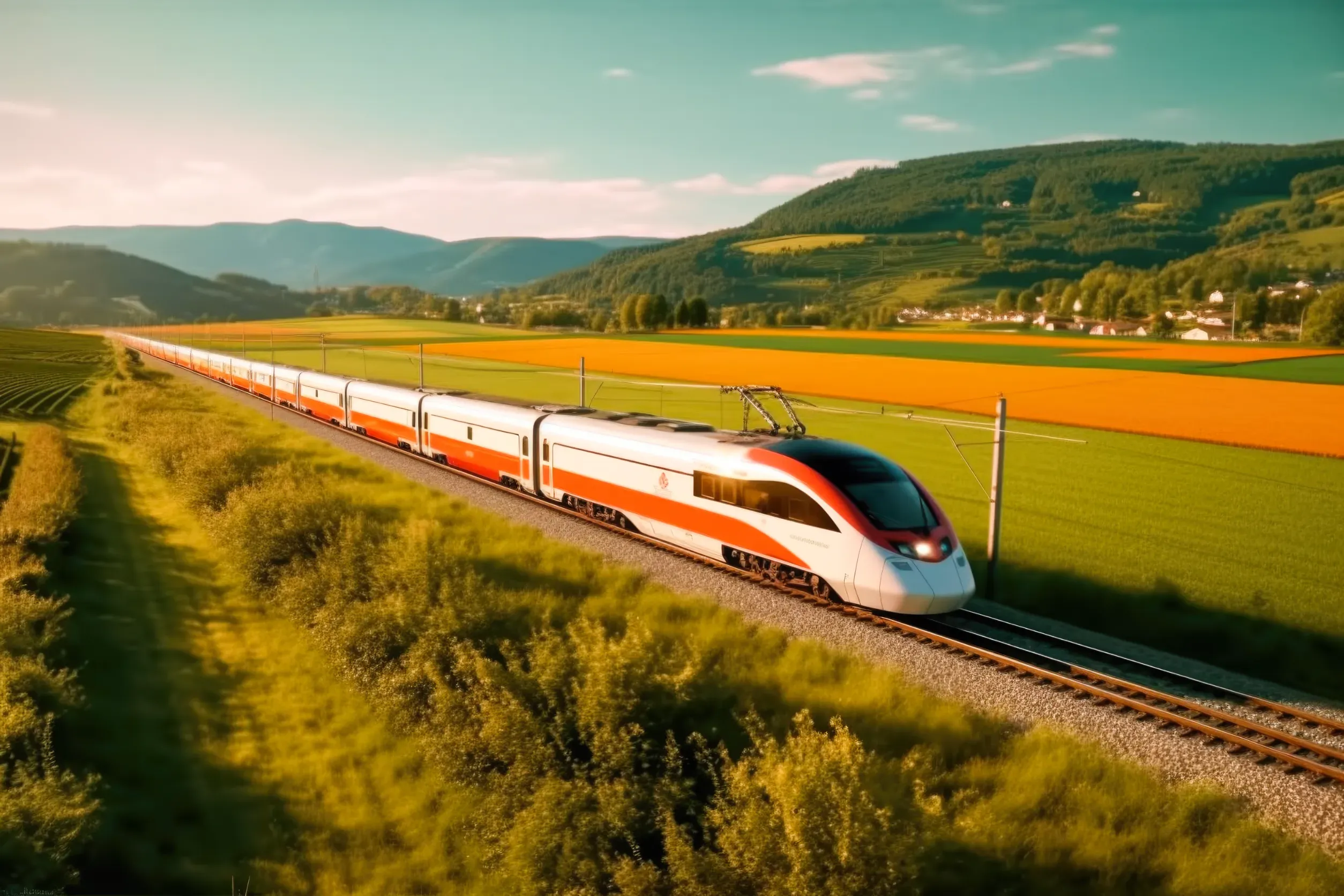
Green high-speed trains offer advantages in terms of shorter waiting times and fewer formalities, and a more direct arrival in the city centre, which can make the whole journey comparable to, if not faster than, flying, especially when you take logistics and waiting into account.
Those who are particularly sensitive to ecological issues can also put sustainability on the scales. The main reason why high-speed trains are considered more sustainable is that their greenhouse gas emissions are significantly lower than those of aircraft. High-speed trains, especially those powered by renewable energy sources, have a much lower carbon footprint per passenger than aircraft.
Trains are generally more energy-efficient than aircraft. This is due to the greater efficiency of electric motors and the lower resistance to movement compared with air travel.
Many railway systems in Europe are increasing their use of renewable energy to power their trains. This further reduces the environmental impact of train travel compared with flying, which depends mainly on fossil fuels.
High-speed trains use infrastructure that takes up less space than airports and has a lower environmental impact during construction and maintenance. They can also carry more passengers per journey, making the use of land and resources more efficient.
Trains often connect city centres directly, reducing the need for additional transport (such as buses or taxis) from the airport to the final destination. This is not only more convenient for travellers but also reduces the total emissions associated with the journey.
In Europe, various rail operators are adopting renewable energy. For example, Deutsche Bahn in Germany uses a significant percentage of renewable energy to power its trains. Similarly, the Netherlands has made great strides in powering all of its electric trains with wind energy.
SNCF, the French national operator, is working to reduce the environmental impact of its trains, including the use of renewable energy. The TGV, the French high-speed train, is an example of energy efficiency in rail transport.
Trenitalia has introduced highly energy-efficient trains and is exploring the use of renewable energy sources. Its Frecciarossa and Frecciargento trains are examples of energy-efficient high-speed trains.
Renfe, the Spanish operator, runs high-speed rail services such as the AVE and is committed to reducing the environmental impact of its services.
Nederlandse Spoorwegen, the Dutch national rail operator, made headlines for powering all its electric trains with wind energy.
The Swiss Federal Railways are known for their efficiency and sustainability, using a mix of renewable energy and sustainable practices in their operations.
Among the main operators, Trenitalia connects Milano Centrale station with the Gare de Lyon in Paris, or with GV/Inoui.’