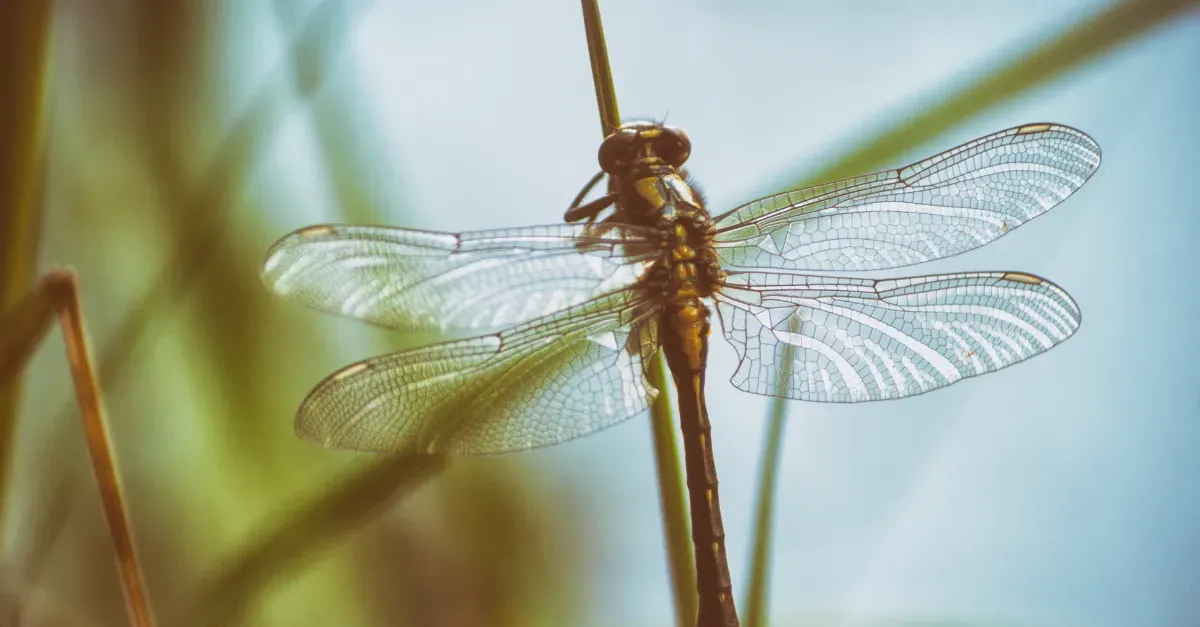
Another Latin word from which the name libellula might derive is libra, meaning scales: indeed, when you watch this elegant insect fly, it always seems to be in perfect balance, just like the pans of a set of scales.
Dragonflies also have a very long life cycle, beginning their existence as aquatic larvae before turning into winged insects. This metamorphosis has led many cultures to associate the dragonfly with change, growth, strength and resilience.
In Vietnam, for example, dragonflies are believed to be the spirits of warriors fallen in battle. In Japanese culture, on the other hand, the dragonfly is a sign of good luck, victory and courage. In other traditions, including that of Native Americans, the insect is considered a spirit guide that helps people connect with the natural world and find inner harmony, and it is therefore associated with wisdom and spiritual quest, becoming a symbol of awareness and of the ability to see beyond appearances.
Moreover, the fact that it is a very beautiful animal, with iridescent wings that shimmer in flight, has also linked it to the concept of creativity and to artistic inspiration.
Finally, a legend is associated with the dragonfly: it is said that, in ancient times, a mighty dragon ruled over a vast region, lighting up the night with its fiery breath. It was feared by all for its strength and ferocity, but it also had an extraordinary quality: the ability to transform into any creature. One day, the dragon decided to change its appearance into a dragonfly, in order to explore the world in a different way. However, once it had taken on the insect’s form, the dragon felt so light and free that it forgot how to return to its original shape, remaining trapped for ever in the dragonfly’s fragile body.
The specific origin of this fascinating legend is unknown, but it seems to derive from an intertwining of myths and symbolism found in various cultures, especially Eastern and Native American ones. In short, it is meant to offer a universal message of transformation and adaptability, also symbolising the pursuit of gentleness, simplicity and lightness of spirit. Curiously, in English the word for the insect is dragonfly, a term that recalls the story of the dragon.
The ecological importance of dragonflies
But beyond the poetry hidden behind this insect, it is important to stress that dragonflies play crucial roles in many ecosystems, both in the larval stage and in adulthood. Their ecological importance shows in several ways: first of all, the insect is a voracious predator and, as a result, contributes to the natural control of mosquito populations and various pests. This task is extremely important above all in tropical settings, where mosquitoes often carry malaria or other diseases such as dengue.
Secondly, dragonflies are extremely sensitive to environmental conditions, which means that if an ecosystem is home to dragonflies, its water and air are of good quality. In this sense, the dragonfly can be described as a bioindicator, that is, an insect that signals the good health of the natural environment. Conversely, a decline in dragonfly populations in a given area may point to problems linked to excessive pollution, water acidification or the overuse of pesticides.
Thanks to their long life cycle, dragonflies also inhabit a variety of settings: the larvae are born in aquatic ecosystems, while the adults move into the terrestrial environment. This movement helps transfer nutrients between water and land, feeding various levels of the food chain. Dragonflies themselves are also a source of food for other animals, such as birds, fish and amphibians. Protecting them therefore also means preserving the biodiversity of other species that depend on them.
Unfortunately, however, many factors threaten the survival of these splendid insects and, as so often happens when it comes to ecology, if you want to find the culprit you only need to look in the mirror. It is, in fact, because of humans that dragonflies are losing their habitat, owing to the excessive use of pesticides and other chemicals harmful to the planet.
In addition, rising global temperatures, scarce rainfall and increasingly extreme weather events are having a negative effect on dragonfly populations, which have fewer and fewer wetlands available. Moreover, the warming of the water often brings an invasion of alien species, which upset the natural balance of ecosystems and put local biodiversity at risk.
In short, protecting these marvellous animals means protecting our planet at the same time. Who knows, perhaps the very fact that the dragonfly symbolises strength, adaptability and change can give us hope!