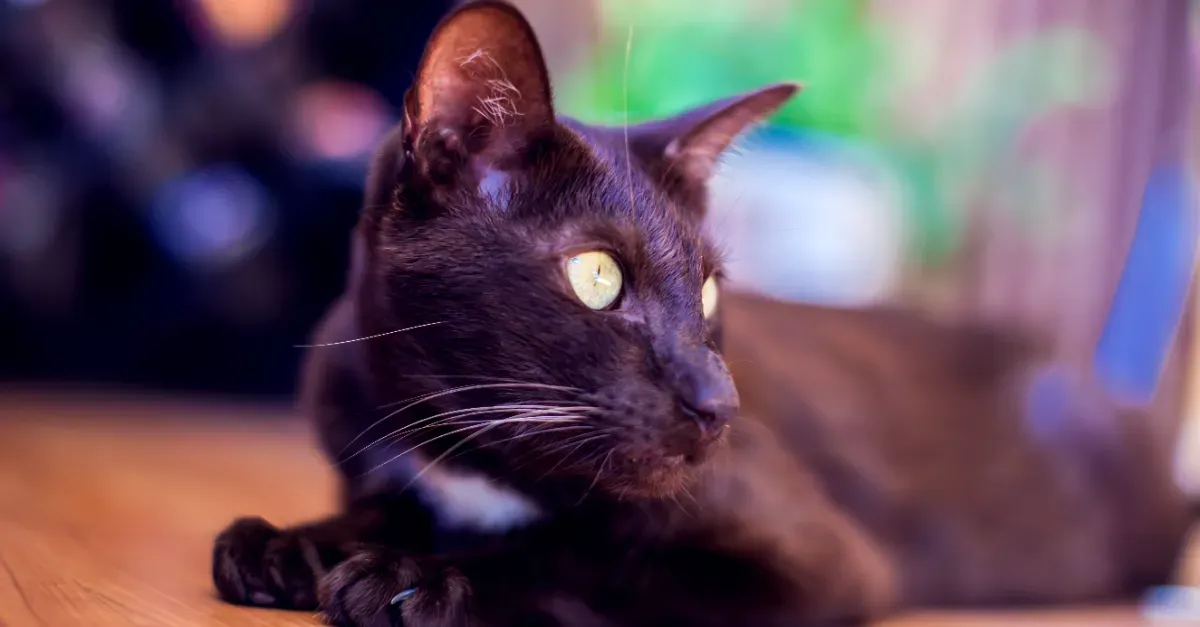
The black cat, with its coat blending into the night and its elusive, independent nature, typical of all cats in any case, came to be believed to be an incarnation of the devil. It was thought that witches could turn into black cats to move about undisturbed at night, or the black cat was believed to be a faithful companion of these evil creatures.
This idea may stem from the fact that women who lived alone, and who were therefore viewed with suspicion in a society in which a woman always had to be subject to either her father or her husband, sometimes took care of stray cats, for company and also for usefulness, since cats drove away mice and other pests. These women, precisely because of their independent way of life, were unfortunately often branded as witches, and the cats were linked to them.
Of course, these were only beliefs with no basis in fact. Over time, however, the idea that the black cat was evil became part of popular culture and remained entrenched even after the persecutions ended. How many of us, after all, still avoid crossing the road if a black cat has passed first?
But has it always been this way?
And yet, cats have not always been associated with evil. The ancient Egyptians even considered them divine, to the point that killing a cat was a crime punishable by death. Archaeologists have, in fact, found numerous statuettes and depictions of this animal: many of them, incidentally, are made of bronze and seem to represent a black cat!
Of course, many years separate us from the ancient Egyptians, yet even in modern times there are examples of black cats that, far from bringing bad luck, became true popular icons. Let us immerse ourselves, for example, in the atmosphere of bohemian Paris at the end of the nineteenth century: the name of one of the city’s most iconic venues at the time was precisely Le Chat Noir, the black cat.
Founded in 1881 by Rodolphe Salis in the Montmartre district, it was a literary and artistic cabaret, eclectically and evocatively decorated, which soon became a meeting place for artists, writers and musicians. The mysterious and fascinating atmosphere of the venue was, moreover, evoked by its name which, with hindsight, certainly did not bring bad luck, since Le Chat Noir was, and still is today, an icon of bohemian Parisian culture, a symbol of creativity and artistic freedom that inspired later generations.
A matter of perspective
Even today, not all cultures see the black cat as a bringer of misfortune; on the contrary, they associate it with a positive meaning.
In Japan, for example, a black cat is considered a talisman that wards off evil spirits and guarantees prosperity, so much so that statues of the ‘Maneki Neko’ (the beckoning cat) are widely used in shops and homes to attract luck and customers.
Even in countries closer to ours, both geographically and culturally, such as England and Scotland, having a black cat in the house is seen as a sign of prosperity, and receiving one as a gift is considered a wish for good luck.
Is it not, then, just a matter of perspective?
In this regard, many social media users, whether individuals, cat adoption organisations or animal welfare associations, have begun to use their accounts to debunk the false myth that black cats bring bad luck, showing how affectionate, intelligent and wonderful they are, just like any other cat, and encouraging their adoption.
Moreover, not everyone may know that on 17 August the United States celebrates ‘Black Cat Appreciation Day’, an occasion created precisely to raise awareness and combat the discrimination that black cats still suffer today, especially in shelters, where, as mentioned, they are often less likely to be adopted.
In Italy and other European countries, Black Cat Day is instead celebrated soon: on 17 November. So let us all get ready to debunk this false myth, freeing our minds from these unfair superstitions and declaring loudly that black cats do NOT bring bad luck!